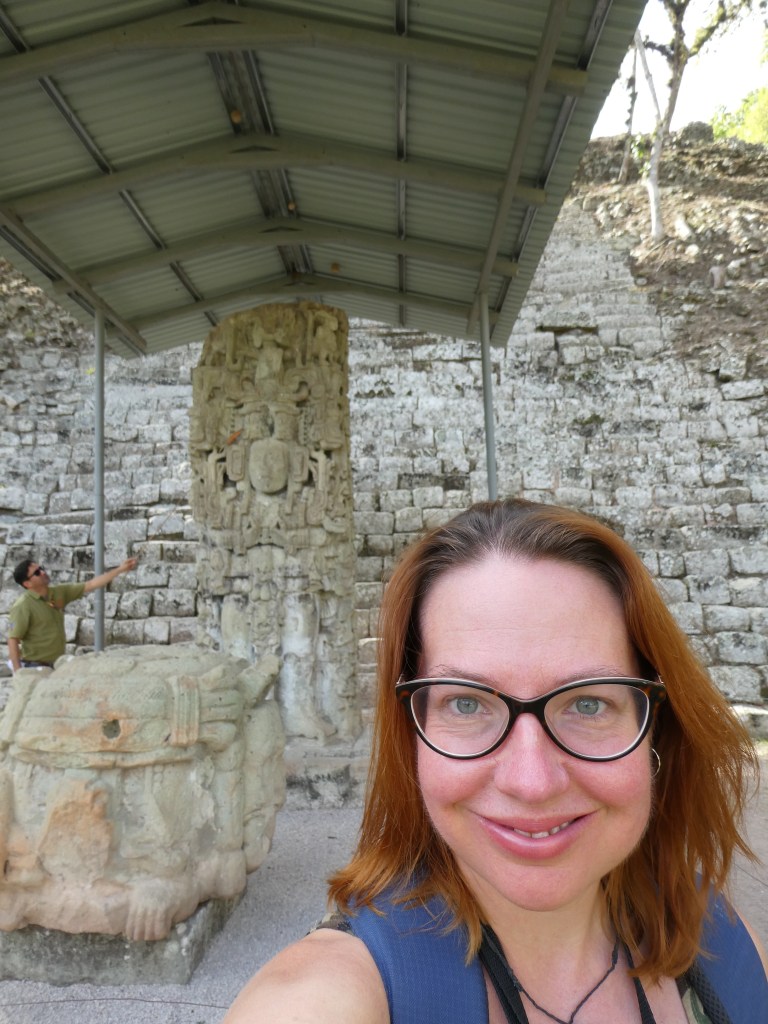
I’d dreamed of visiting the Copan ruins in Honduras since I was tiny. (Ok – I’m still tiny but I mean really tiny. Well, it’s not like I’d had a growth spurt since the original Sonic the Hedgehog came out.) But my youthful dreams didn’t bank on my encounter with the most powerful, demonic jungle spirit of them all – Honduran rum.
I awoke from the sleep of the dead in my damp bikini, mercifully intact from bites. (I had not been so lucky two days previously in Antigua with about 10 mosquito bites on one arm that still itched.) Loyal readers will remember a number of HockTales in which our intrepid heroine embarked on a few experiments with local beverages and ended the evening in unflattering poses, only to rise again like the proverbial Hulk Hogan from a bodyslam. This was next level. I don’t know what was in that Honduran rum (Motor oil? Bong water? Black magic?) but I was completely shattered. I was grateful that I did not travel to Vomit City on the porcelain bus. At least rum seems to agree with me in that sense.
Today was going to be a challenge.
Despite my handicaps at independent living that morning, I showered and was the first one out on the scrounge for food. Our guide, Pamela, expressed great surprise at my resurrection and general level of vitality. (Red life bar of 80s video game goodness surprisingly high.) The hotel served breakfast as cooked by the housekeeper and diligently served by her six-year old daughter. I went for the desayunos tipicos which was pretty much what I was about to eat for the next two weeks although I didn’t know it at the time – scrambled eggs, plantains, beans and cheese curd. Plus coffee. Please for the love of God. All dirt cheap in limpies too. (Recap – the Honduran currency is called limpia. I call them limpies because I’m juvenile and that just seems funny.) Mark and Debbie, two other breakfast club members, turned up by then for their own cheap eats.
We caught three person tuk-tuks out to the Copan site which was fairly close to the town. Awesome riding in them with the wind on my face. I felt like a dog sticking its head out the window of a car. Usually vehicles are a motion sickness risk and I was worried that the fragile stomach – now full of ammo – might switch to projectile mode on the back of the driver’s neck but all was fine. We disembarked and entered the central building for purchasing tickets, although we didn’t have to do that as it was already included in our tour but we seemed to hang around in the waiting area for an inordinate amount of time.
Copan is about as far right as the Mayans go. That doesn’t mean that they’re neo-Liberal conservatives looking to privatise more assets or shave their heads and go all nationalist. Nobody’s wearing a Make Copan Great Again hat. I just meant that the ancient Mayan culture clustered mainly in the Yucatán Peninsula and stretched over to Honduras and a bit into Nicaragua, but Copan is the biggest Mayan site out of the Yucatán. If you’re a Mayan enthusiast like I am, you know Copan is pretty much the end of the line if you’re travelling south from the Yucatán. The Mayan influence starts to peter out from there.
In 1839, the American lawyer/writer/politician John LLoyd Stephens (an original slashie) and the English Stephen Catherwood swapped their top hats and etiquette for machetes and malaria on an exploration for Mayan sites. There were rumours of cities in the jungles but nobody seemed that interested in them. They couldn’t be as grand as the Egyptian pyramids, the Greek Parthenon or the Roman coliseum built by the greatest, wisest civilisations because they were built by the … er … locals. Some of the big cities with huge temples that stuck out were known but there was a legit belief throughout the privileged world of white dudes with $$$ or long lineages – particularly those who had travelled on the Continental grand tour – that these architectural wonders were built by the Egyptians. (Apparently they’d just surfed over on the back of a flotilla of crocodiles from the Nile.) So the Mayans couldn’t really win either way. A good dose of racism kept the Mayan cities safe in the jungle canopy for a while. As they uncovered these amazing jungle ruins and found a few more that nobody else seemed to know about, Stephens was the first to call bullshit on all this Egyptian crap and attribute them to the Mayan people in his account of his muleback road trip with Catherwood. His book, Incidents of Travel in Central America, featuring Catherwood’s outstanding illustrations, was a huge success. They came back for more a couple of years later. (The second one is an even better read. Bizarrely, they start conducting eye operations on the local populace up in Merida, I think. Who knew snipping retinal nerves was an essential moneymaking explorer skill.)
Copan was the first Mayan city they found and he was gobsmacked. “Architecture, sculpture, and painting, all the arts which embellish life, had flourished in this overgrown forest; orators, warriors, and statesmen, beauty, ambition, and glory, had lived and passed away, and none knew that such things had been, or could tell of their past existence … It lay before us like a shattered bark in the midst of the ocean, her masts gone, her name effaced, her crew perished, and none to tell whence she came, to whom she belonged, how long on her voyage, or what caused her destruction … All was mystery; dark, impenetrable mystery.”
Cool!
Famously, Stephens bought the entire site for $50 from the local owner who considered him a fool for purchasing such useless land. (I guess not a big subscriber to the History Channel then.) Stephens considered removing the entire city by boat and floating the lot up to New York to dump in a museum, but mercifully thought against it. Today, we know it’s bad to steal other people’s cultural heritage. Back then, Stephens probably figured that the owner clearly didn’t care about any of the contents of the land and it was now his to do with as he pleased. Plus remember, he was North American. Land and ownership was everything. It was purely the logistics that stopped him.
We met our tour guide, Marvin, who introduced himself as Marvin the Martian, a sarcastic nod to the 1968 Erich von Daniken book ‘Chariots of the Gods’ which attributes the great archaeological and marvels of the world to aliens. (Stephens did what he could but numbnuttery prevails.) His point was that von Daniken’s book stripped him and his people of their cultural heritage entirely. He went around getting everybody to point out where they were from – eg America, Germany, UK etc – and saying that they had a cultural heritage from there, whereas he had no idea if we believed Uncle Eric. Then he turned his back and moved on. This was Marvin’s style – dry humour, abrupt and not that chatty.
He led us down a long, dusty, tree-lined path which was originally one of the Mayan sacbes or paved, white roads. He stopped at a a ditch which was part of the original Mayan drainage system. I was starting to suffer with my pounding head, rapid pulse and shortness of breath. A mob hit and a topple forward into a Mayan aqueduct wouldn’t be a bad outcome. In 2000 years, archaeologists could question the presence of the bones that would probably still smell like rum and conclude I was a lady pirate. A long guessing game concerning what Mayans used for toilet paper ensued. This must have gone on for 10 minutes or at least it seemed like it. The answer – corn! In my white girl wasted pain, I may have missed a critical element of the conversation here as I doubt it was actually the old corn on the cob. I can’t imagine that being too comfortable. Plus you wouldn’t want to wait for somebody to finish their cob when there were needs. “Hurry up and eat that maize cob, Jaguar Bird! I really have to go! I ate soooo many tortillas last night!” I have considered this in the light of the great TP Crisis of Aussie COVID-19 2020 and believe it to be the corn husks.
Marvin’s next stop was a magical mystery botanical tour of fruit and trees along the sacbe. He’d show us an avocado (local) and then quiz us on where other fruits or vegetables were from. I was starting to get a bit edgy. Bring on the ruins! I didn’t care for fruit quizzes. I looked at my watch. We had barely an hour before we’d been told that Marvin would bundle us back in the tuk-tuks. We’d wasted loads of time waiting, then a ten minute toilet guessing game, now fruit quizzes, and we’d only seen an an aqueduct when I knew this place was loaded with Mayan historical treasures. I was tired, frustrated and suffering. I saw a cocoa bean tree – insert sarcastic hooray.
Finally, we reached a wire fence that marked the entry to the historical site. Two macaws flew overhead and perched in a tree right above our heads. The group lost its shit and went on a photographic bonanza. The previous day many of them had paid to go to a macaw sanctuary. (I went to the archaeological museum of the ruins for a small taster.)
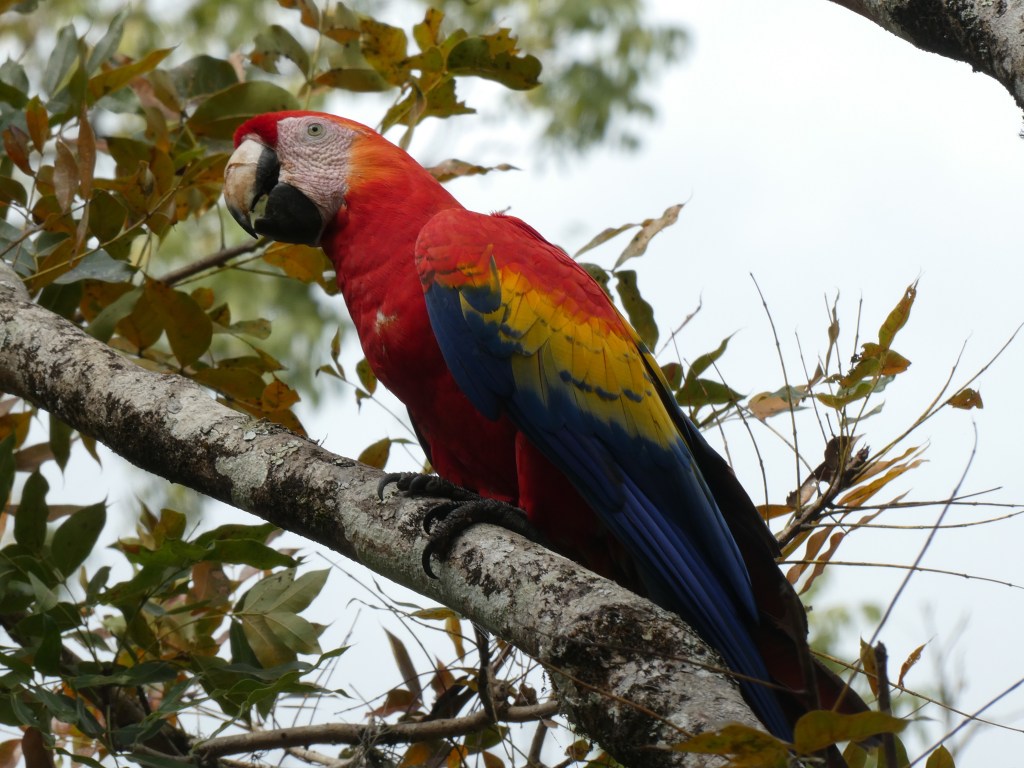
Marvin gathered us by a map of the site next to the fence, talking us briefly through the site’s history.
That’s when I saw it.
The horror.
The turkey.
I fled.
I have a morbid phobia of turkeys. They terrify me. Some people have spiders, some people have snakes. I have turkeys. I was attacked in a petting zoo when I was 2. That’s the source. I know it’s not rational – that’s why it’s a phobia!
It was guarding the fence from the inside. Warning me. Letting me know I was about to enter its territory. With its flared feathery tail and disgusting wrinkled wattle, it was a big fat gobbler about to gobble my soul if I got too close (e.g. 10 metres).
Welcome to Indiana Jo and the Curse of Copan.
I have no idea what Marvin said about the site as I trembled behind a tree and tried not to wet myself out of terror. So please take this moment to appreciate a brief history lesson from ‘Scribes, Warriors and Kings: the City of Copan and the Ancient Maya’ by William F. Lash’. An aside – I bought a few books online during my travels and shipped them home to my parents only to find them trapped there during the recent lock-in debacles. I have since been reunited with these beauties that Mum diligently sprayed with Glen-20 just in case …
Copan was the capital city of a Mayan kingdom from the 5th to the 9th centuries. It was occupied for over two thousand years. At its peak, Copan covered an area of over 250 square kilometres and at least 20,000 people lived there. The central area covered 0.6 square kilometres with 6,000 to 9,000 people there. It seems that King Specsavers (see earlier post) left the Tikal region in Guatemala and founded Copan in the Preclassic period. It took a while to build momentum but Copan became one of the more powerful Maya cities with a heyday around the 7th-8th centuries. But bad stuff happened in 738 when Copan’s famous and long-reigning king, 18 Rabbit, was captured and beheaded by the rival city, Quirigua. This was a devastating blow (sorry) that took 17 years to recover from but they started rebuilding again. Copan hung on as a power until the 9th century but the population in the greater city from the original 20,000 to about 5,000. The jungle reclaimed the monuments and the temples but the site was so remarkably stable that that it didn’t begin to collapse until hundreds of years after it was abandoned.
After Marvin’s speech, he presented our tickets at the gate and we went through the turnstile. The vicious bird of death had waddled back down the path on its side of the fence, so I entered cautiously. In the distance, I saw another one. Great. My eyes darted from one to the other. I would be vigilant. Keep the enemy in line of sight at all times.
The ruins were at the end of a long path. The way down was like a mini wildlife park. A family of agoutis running in the undergrowth, popping up like little large rodents – only cuter!

Macaws wrapped their claws around wooden perches under huts, eating fruit or whatever else they were into. I went over to check them out and the turkey was there. The pressing need to see the macaws suddenly receded. The group was really into the macaws and the agouti and the blackbirds (were the turkeys nursing years of resentment at not being as cute as the other animals and ready to lash out???) but I was becoming more and more conscious of the time. Birds, schmirds. Would we run out of time for the ruins? Would my stomach hold? I wanted to see it all! I think we’d spent about forty minutes at that point and we hadn’t even got there yet. My frustration and headache was increasing.
Finally, we were there! On the lawn of the Great Plaza of Copan! Unlike other Mayan plazas like Palenque or Chichen Itza, the Copan plaza doesn’t surround and overwhelm with massive temples. It’s pretty open. You could probably have a few picnics and kick the footy around if you didn’t want the Honduran government to deliver a few stern words or the the birds to scab your food. It’s flat as a tack. We can think of it as a bit of a square. The far three ends are enclosed by steps that would have led up to bleacher type seating to watch public events. The closer end features a small and unexcitingly named Structure 10L-4 which I think was more of an altar from memory?
However, the drawcard down here are the famous stelae of 18 Rabbit that stand in the Great Plaza. They are recognised worldwide as outstanding examples of sculpture. The detail is amazing. Look.
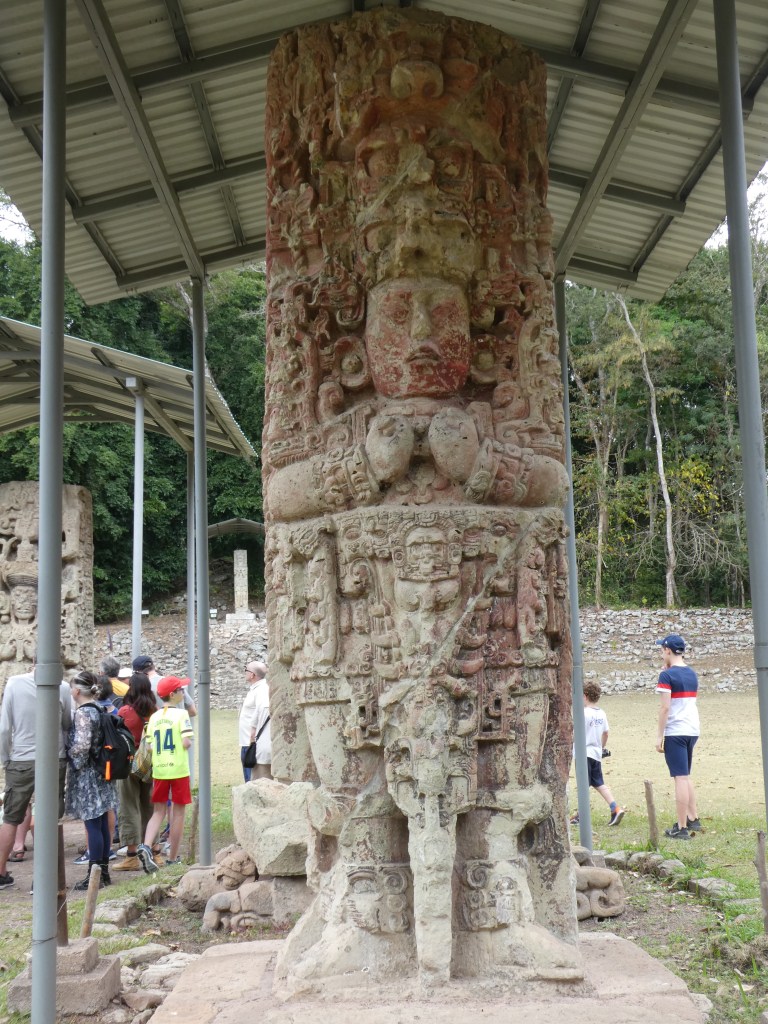
The Great Plaza, or Stelae Plaza as some like to call it now, consists of 7 of these massive stelae. Marvin told us that they are all of 18 Rabbit because he was a massive egomaniac. That seemed a bit of a harsh call. I like to think of him more like a Ninja Turtle figurine in all their different costumes in the 90s. For example, another stela was thought to be a woman. No – it was a Rabbit in drag. The king was wearing a ceremonial skirt.
But look at the marvellously intricate detail. You can imagine the jade earrings, you can see the distinctively semi-Asian features on the face and the work on the headdress is unbelievable.

The stelae are unimaginatively named Stelae A through to F. Those are not tiki huts. Rabbit is not waiting for a mai tai from Don the Beachcomber. Each of the stelae are under a bit of Stratco sheeting to protect from some weather damage. I know, the rain’s going to get straight in the side but Rabbit’s been here without anything since the 8th century so I’d imagine he’s pretty happy to see a bit of shade. (Actually, he was captured and beheaded in Quirigua so to have 7 heads covered under shades must be marvellous.)

These stelae represent the majesty of 18 Rabbit’s rule. He was nice enough to erect a couple of his ancestors close by too. It would have been impressive to sit high on the bleachers, looking down at the massive stelae casting their shadows in carefully positioned spots like a giant sundial as public ceremonies such as executions took place here.
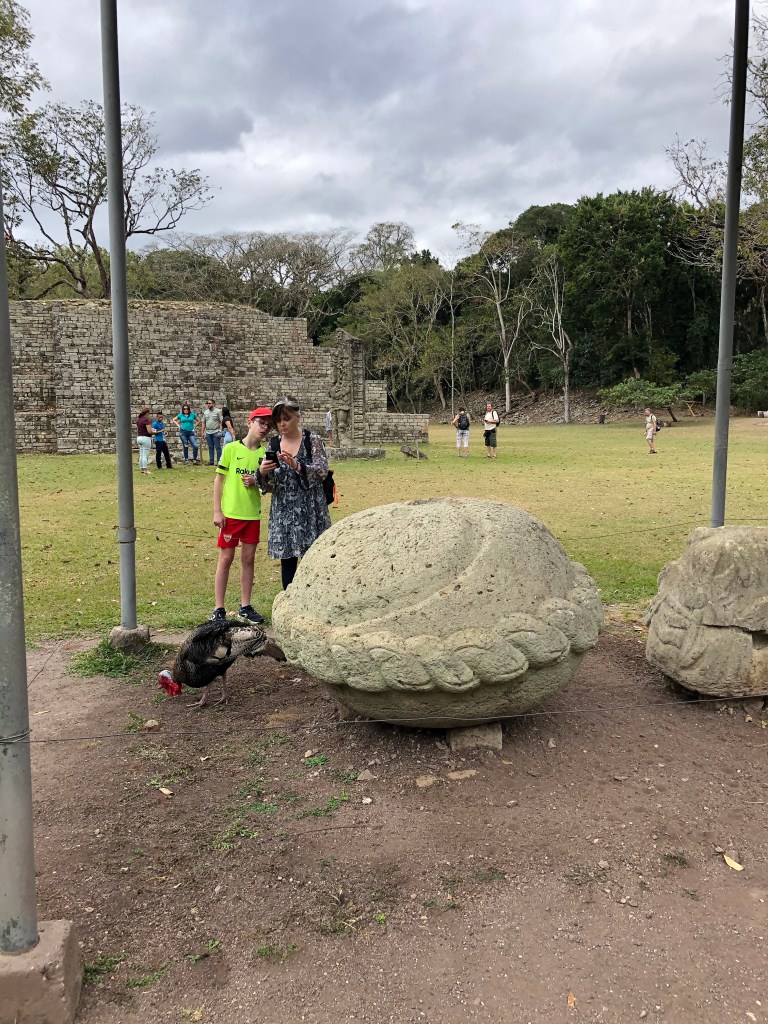
At the foot of each stelae was a massive rock that was actually a sacrificial altar. That’s as far as I got. BECAUSE THE DEMON BIRD FROM HELL WAS HERE!!!!!
It had stalked me down the long pathway from the wildlife area! I abandoned the tour group, dashing for cover behind a 1,320 year old giant Rabbit. I poked my head around the side. Where was it now??? I was frozen to the grass. The newest monument of the Great Plaza – Stelae H(ockTales). Me so terrified behind a MesoAmerican monument. Photographic evidence of cowering is not available. I don’t quite know why I pulled out my camera, but I caught the exact moment when the HELL BIRD started to come for me again.

A scream audibly caught in my throat, partially choking me for a split second as I shot out of my secure spot and bolted for the protection of another stelae. It could smell my fear. It was after my soul. I was the Brody family and this was a feathery Jaws with a face like a malignant tumour, hunting for its prey.
The Mayan gods were angry that day, my friend. I had incurred their wrath and they had sicced their nightmare war bird to tear me limb from limb as punishment. Had I disrespected them by entering their sacred plaza with a hangover? Was it because I wore the symbol of Palenque’s King Pakal on my chest? Were they mad because I was leaving the Mayan kingdoms on the way to Costa Rica?
Something spooky was definitely going on. The thing I loved the most was derailed completely by the thing I feared the most. Coincidence?? The Mayans sacrificed turkeys – now this one was here to sacrifice me. Speaking of sacrifice, before I lost 10 minutes of historical guided commentary darting between the stelae like a phobic pinball, Marvin was talking about the sacrificial altar. He pointed out this one (resemblance to Cornish pasty noted). And look who returned there, preventing me from getting any closer than this zoomed in shot. I really wanted to get in there and examine it in detail – an excellent opportunity to get up close without fences or railings – but the beast was guarding it as effectively as a Rottweiler with an AK47 in his mouth.
By this point, I was shaking and almost crying. Add in the headache and total body annihilation and it was a physical and mental assault on my entire being. For the record, I apologise for nothing! My turkey phobia is stupid but it’s just strong as any normal person’s phobia for snakes or spiders or heights or deep water. I felt like I was being stalked as this horrible wrinkled pecking monster was there at every turn. I was sad to leave the Great Plaza but so relieved to escape with my underwear clean.
We left the stelae for a brief interlude at the small building at the edge of the Great Plaza where Marvin showed us the original paving of the sacbe on the ground. He also talked some about sacrifice here and most of the group thought it was barbaric from memory. The thing is – most of it was voluntary. It was considered a great honour to give your life so that your blood could keep society going and you got a free ticket to the next phase in the afterlife. It was a sacrifice with honour. That’s why it’s a sacrifice – not a murder. You put your hand up for it or got picked as the best of the best. At Copan – and all the Mayan sites – the elites practiced bloodletting with thorns or stingray spines to pierce their skin. Blood was life. The blood would nourish, but also help them communicate with their ancestors because they were high as kites while they did it. So when people were sacrificed or self-harmed, they didn’t experience pain because they were drugged up or it happened quick. A barbaric society inflicts pain and torture and horror on its people – that’s not what happened. Prisoners of war probably weren’t so lucky. Ask Rabbit.
We cut through the ball court – we would return there later – for the most magnificent stelae of them all in front of the Acropolis. On the way, I sensed I needed to build the bonds of camaraderie a bit with Marvin. I’d been to many Mayan sites and normally form a pretty tight bond with the guides over the hour because I’m normally the only one who has a real passion for Mayan archaeology and history. After the tours, they’ve sent me reference materials or their own photos or told me their own special stories because they know I’m really interested. But Marvin was a stone wall. I tried to explain my bizarre behaviour, because he undoubtedly thought I was a weirdo. He just told me the turkeys were friendly. He asked what my favourite bird in Australia was. Not really the right question for somebody who doesn’t like birds in general due to influence of the Great Turkey Attack of 1981 and whose brain wasn’t functioning at its peak. I think I might have named a Rainbow Lorikeet out of desperation because it was the only one I could think of that wasn’t a duck. This wasn’t going well.
The Great Plaza was the province of 18 Rabbit. Now, we entered the Court of the Hieroglyphic Stairway. (Just wait – we’re not at the stairs yet.) This is a section of larger monuments built by a ruler that I was sure Marvin called Smoke Snail but all the books I’ve bought called Smoke Shell. Hmmm. Personally, I prefer Smoke Snail as an evocative term but it makes me wonder whether I heard him wrong the whole time. The rulers’ names are very exact because there is a huge list of them (more foreshadowing). Let us call him Smoke Shell then.
As promised, we reached the most magnificent stelae of them all!!!!! Whereas 18 Rabbit was the most prolific in terms of stelae, this stela of Smoke Shell to me was the most beautiful, detailed and intricate of the lot. It too comes with the mandatory altar and hut accessories in the Stela Action Figure Set.

The Acropolis – a popular Greek word for old Mayan temples – may contain Smoke Shell’s remains. Like 18 Rabbit, he holds the magic serpent bar of kingship. He was the 15th ruler in the dynasty and this stela was constructed in 761 AD.
This stela stands in front of a massive set of crumbling stairs. They once led to a huge, double storied temple with a treasure trove of facade sculptures and hieroglyphic panels (thanks William L. Fash). The A listers sat up the top, watching the ritual games and happy/unhappy endings on the ball court. A bit like Eddie McGuire lording it up in the best spot at the MCG to watch a Collingwood game with the best and fairest decapitated at the end.
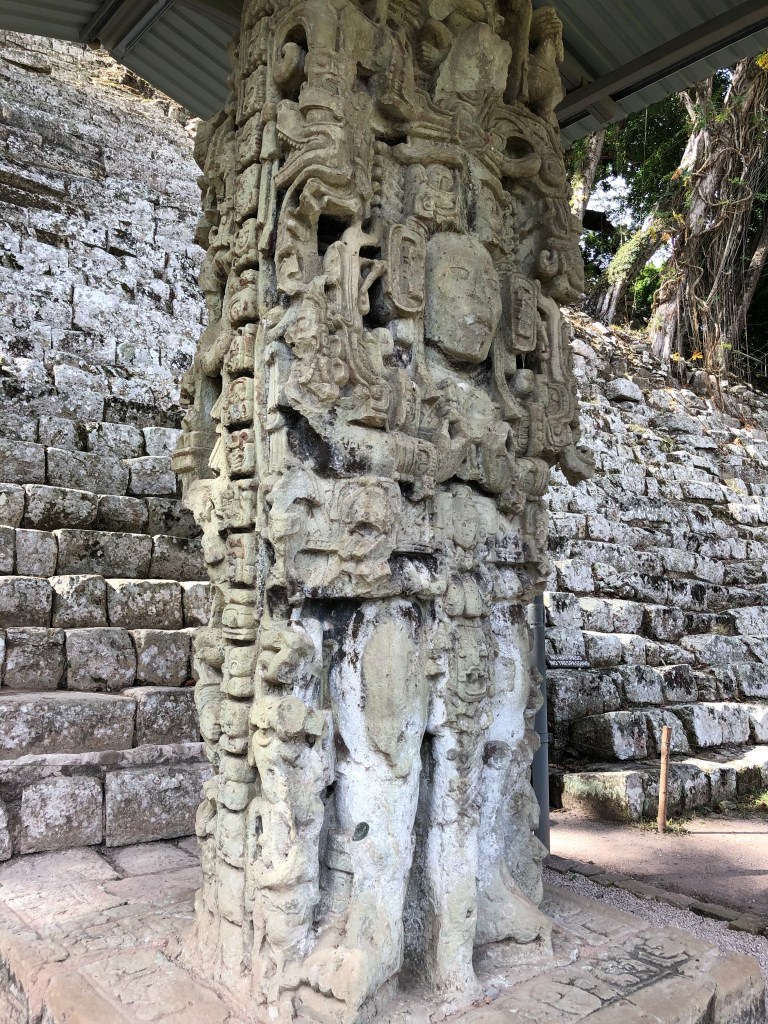
Copan’s stelae are legendary. Mayan sites are usually famous for something unique and special. Palenque has the tomb of King Pakal, Tikal has the magnificent high temples and the jungle setting, Coba has the tallest temple, Ek Balam a tea house built to look like jaguar jaws and Bonampak has the most colourful, haunting murals. Copan is renowned for the detail of its sculpture and carvings.
Whereas other Mayans carved their glyphs or stelae from limestone or rock, the Mayans at Copan used the unique raw materials of the Copan valley. William H. Fash refers to it as “green volcanic tuff” which is a type of stone. It is apparently super stable, but to me also looks super malleable like clay. I remember Marvin saying that the people had access to raw materials unlike any other Mayans and that it was easier to carve more detailed monuments that preserved for longer. My book also says that a source of obsidian was only 80km away which means that they had great knife blades and cool bracelets.
Back to the stela – it was simply awesome. The detail was phenomenal. Both sides depict anthropomorphic beings and animals in a wild tree of life.
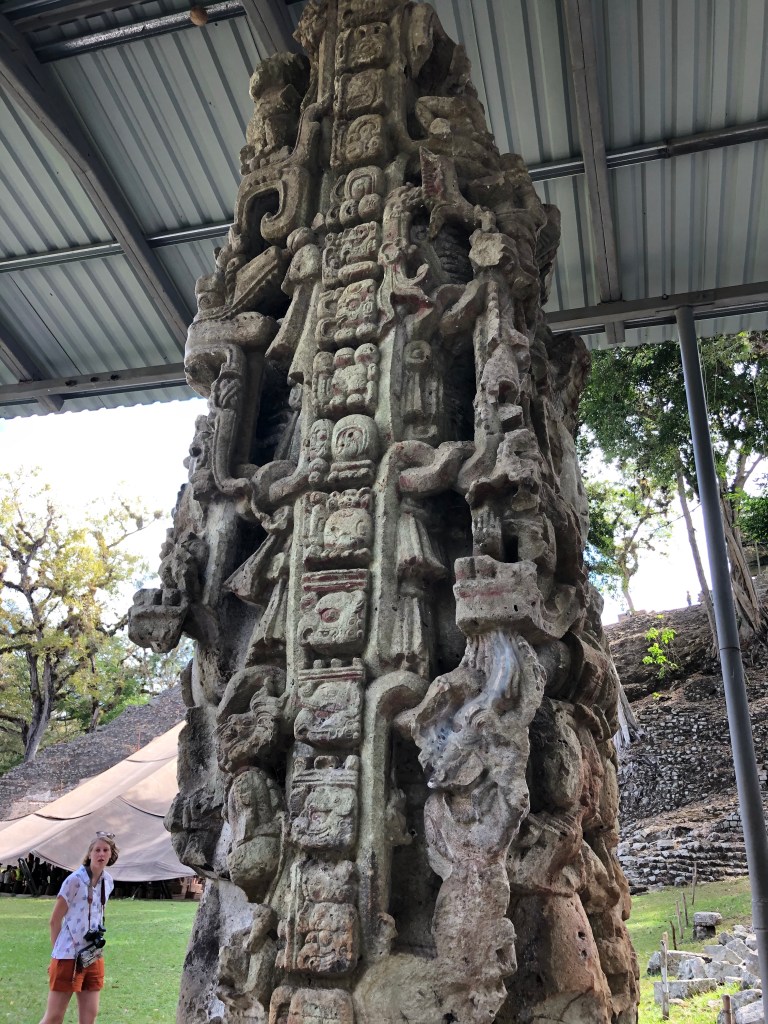
Apparently two small figures sprouting from behind the knees represent his ancestors being born like ears of corn at the beginning of life.

Look at the glyphs on the ground. It’s like the best bathmat ever. Ikea – please make this and name it something Swedish now. Smoke SlingaShell.
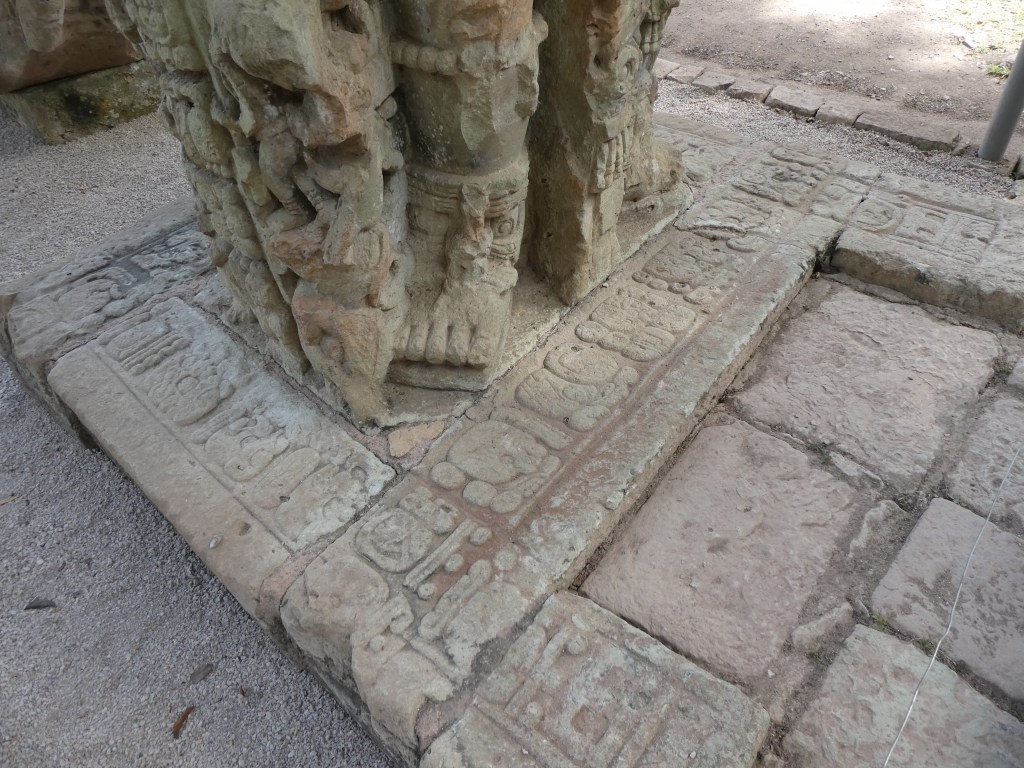
And, as for that altar, Marvin had no idea. Just animals. Take your pick because there were literally a few of them it could possibly be. A choose your own adventure altar. Ok then. Let’s move onto the ball court.
Remember all the scarlet macaws at the start of the wildlife strip? (Incidentally, I don’t have a problem with them. They’re not wrinkly and terrifying.) They loved them in Copan. Look at the beak. Makes it look friendly like a budgie!

This is a pretty killer view of the macaw head and the dilapidated stairs of the Acropolis with the top of Ol Smokey’s head just visible. This shot is a bit of a primer for the view from the top – just imagine two temples whacked on the top.
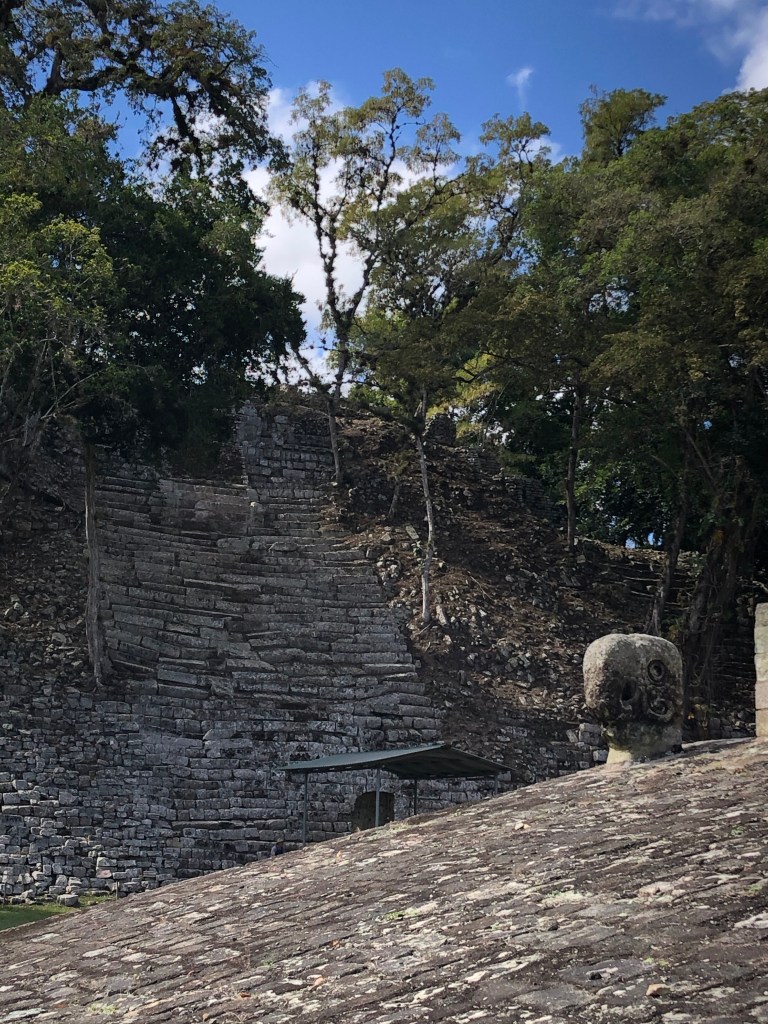
Behold Copan’s ballcourt. No Jordan like dunking or three pointers from the line here. But it’s the second largest ballcourt in the Mayan world, after the giant Wembley Stadium equivalent of Chichen Itza, and is considered their entrance to the Underworld. Note – matching bookend macaw on the far side. The ballcourt features two of these long panels. The two teams of 3-5 players would square off against each other, hipping and shouldering a hard rubber ball around without using their hands. That ball was HARD. Players wore a heavy yoke around their waist to protect their essentials (needed for precious stingray spine bloodletting later). Rules unclear to us now but part-game, part-ritual, part-harvesting of blood to keep the gods happy, the rain falling, the sun shining, the crops growing and the ancestors smiling on the reign of good king Smokey, Rabbit or SpecSavers etc.
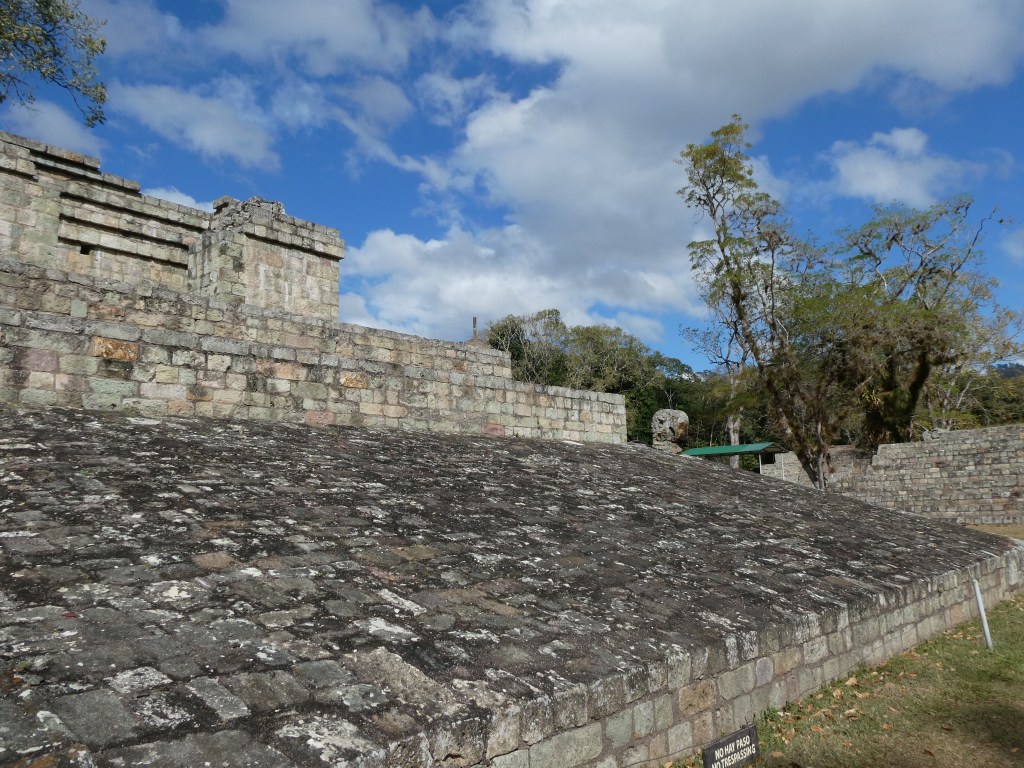
This was the best bit of the ballcourt. It’s another macaw but how creepy does it look with that tongue?? It’s hard to get a decent shot of it from the angle but you can make out the talons and the wings. It’s truly spectacular. It’s a bit like a Skeksi from the Dark Crystal – a film with horrifying killer bird creatures in Jim Henson puppet form in the 80’s.
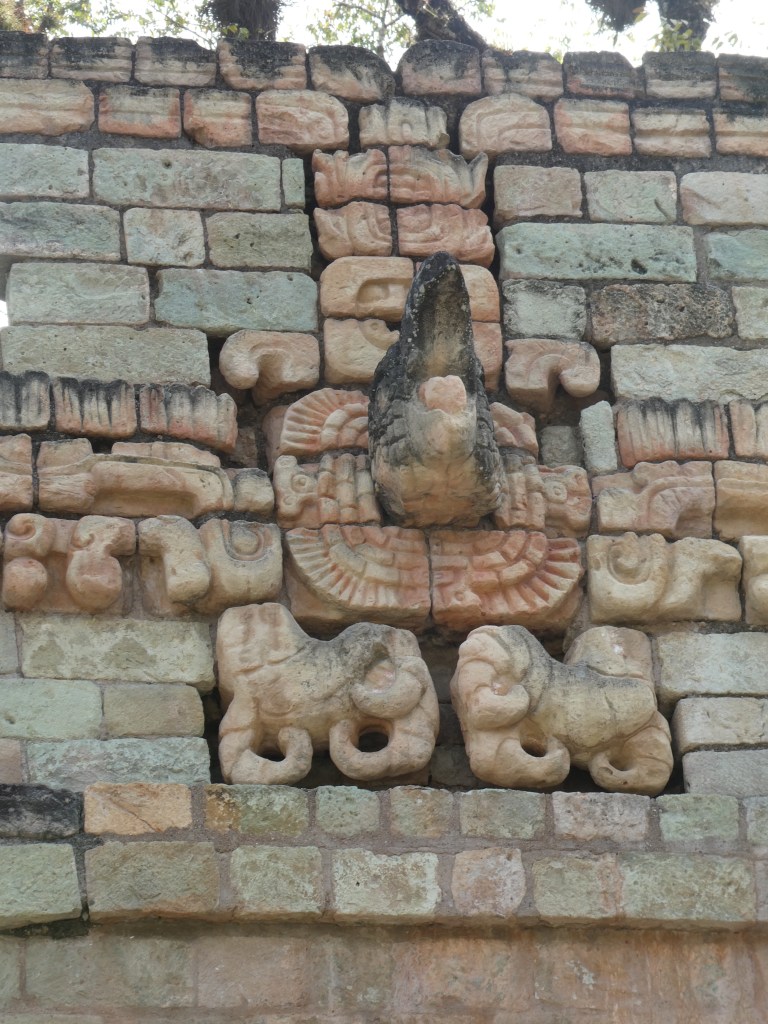
After my headache reached eye watering new heights, we stepped about three metres to the right to discover Smoke Shell’s masterpiece -the Hieroglyphic Stairway! It’s Copan’s highlight and the big ticket item that I knew about beforehand from my visit to the archaeological museum the previous day. The stela is another Smoke Shelfie. All the glyphs up both sides tell the story of the rulers and the history of Copan from Smoke Shell’s time. William L. Fash reckons the point of the stairway was a bit of a political boost for Smoke Shell and his dynasty, legitimizing it in the face of 18 Rabbit’s humiliating capture and decapitation. A rallying cry to the people of the glory days. Hey – we got our arses kicked but we’re back, baby! Imagine it all painted a deep, punch-you-in-the-face red too with a hint of blue/green on the stelae to look like bird feathers.
In the middle of the steps are figures of Smoke Shell’s illustrious ancestors. Actually, it’s Copan’s version of a Snapfish photobook of the important events that happened in the city’s lifetime. The inscriptions are still being deciphered but we know that it references Yax K’uk Mo, the founder (King SpecSavers), the births and deaths of kings, important rituals and dynastic heritage. There’s a figure that may represent 18 Rabbit despite his gory ending. As the Mayans ascended the stairway, they went back in time past their illustrious ancestors. (The Mayans were big on ancestor veneration. Smoke Shell would have been first on board with a premium Ancestry.com subscription.) Some figures are entirely broken off but you can see where they originally were from the gaping holes.

This is a close up with my 20x zoom on my camera of one of the rulers on the Hieroglyphic Stairway. Even just the trim on the brocade at the bottom of the throne is marvellous. The raised mouth sticking up a bit like an angry puppet is the headdress. Underneath, you can just make out the face with the earrings. Then the entirely trashed body (I felt a lot like this at the time.) He’s ‘armless. But you can can get a sense of what he might have looked like whole back in the day if you have a good imagination. Also, look at all the steps. They aren’t entirely flat and boring. Stuff has been carved onto them. In fact, the entire stairway has more to glyphs than 20 stelae put together and I believe they’re still working on decoding them.

Interestingly, Fash’s book reveals that the mortar in the Hieroglyphic Stairway is the weakest of all the structures at Copan. It is ironic that the stairway designed to illustrate the power and longevity of the dynasty was the first one to disintegrate.
We headed back past Smoke Shell’s first stela, over to a set of stairs to climb up on top of the Acropolis. Back in the day, the Mayans would have climbed up the Hieroglyphic Stairway or the Acropolis steps. But the tree roots were popping out the stones in the Acropolis, making clambering not an option.
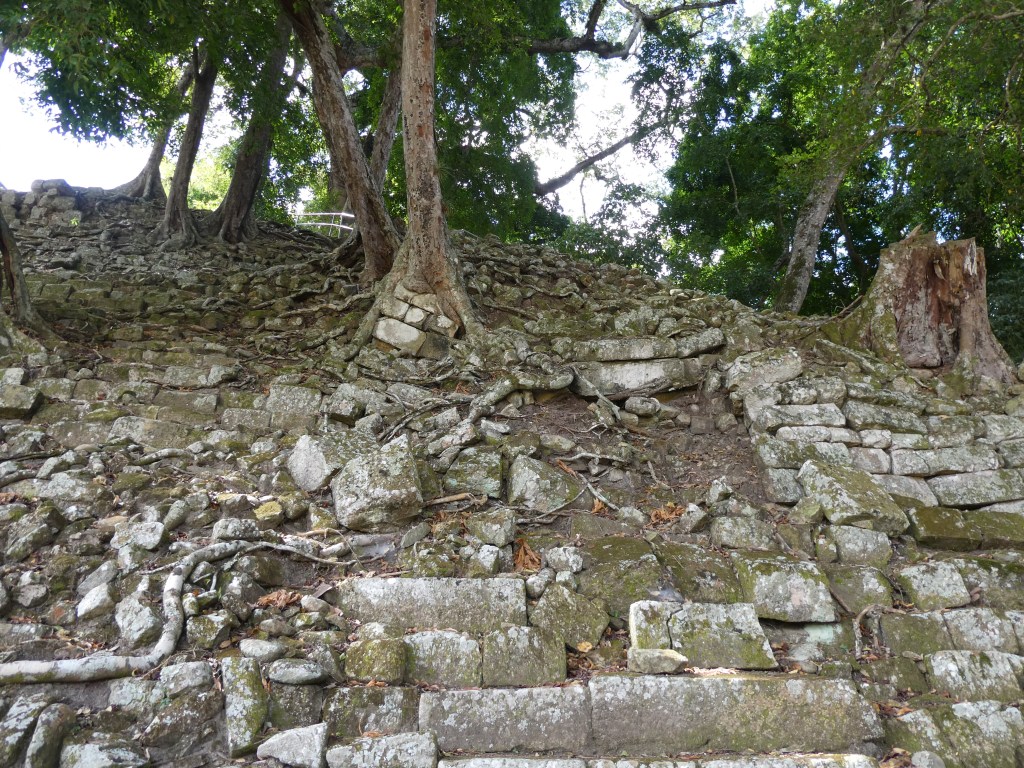
A more modern set of steps up the back of the Acropolis hill led to the top. This view of the Hieroglyphic Stairway group from the steps gives a bit of perspective.
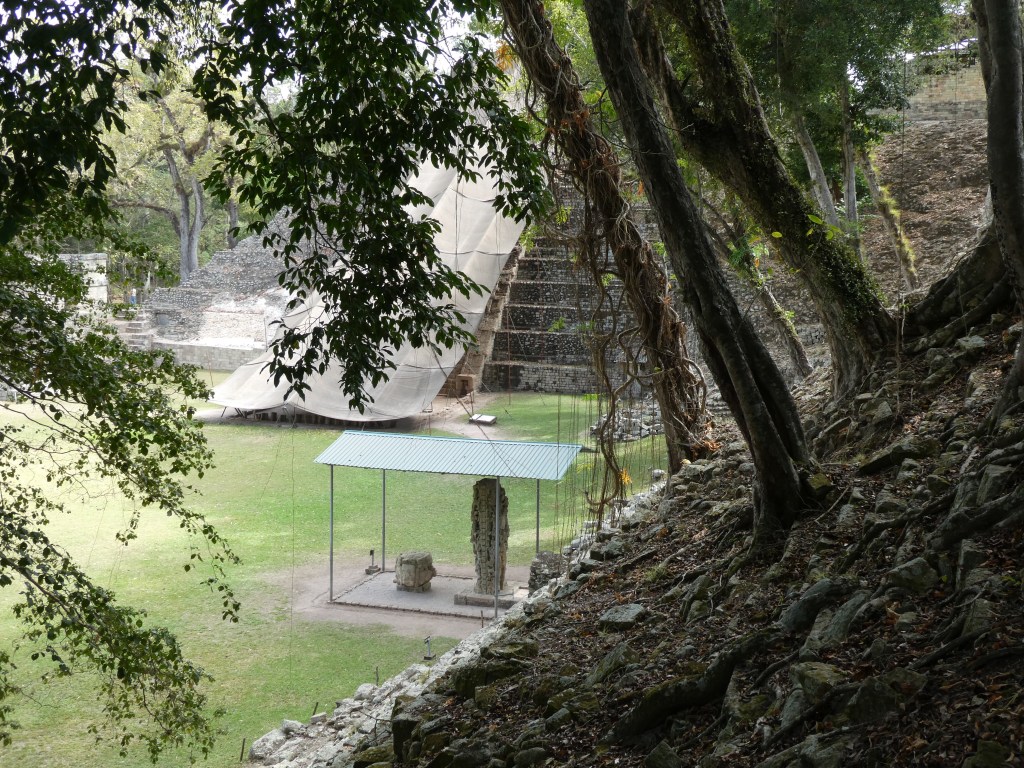
From here on out, it became pretty clear that Marvin was quietly freaking that he wasn’t going to get us into our taxis in time. We stood on top of a temple called the Acropolis and looked over the West Court (thanks Fash). At the time, I had no idea what was down there. It’s only now that I’m looking at the map in the book that I am piecing together that we took this route out.

We came around the top of the Acropolis to the East Court which is a much smaller, rectangular plaza. In fact, some Googling reveals that it was the original plaza. It’s older than the other areas and was built in 573 by the king , Moon Jaguar. You know when a city builds a bigger, better football stadium and leaves the old one behind? That’s what happened here. 18 Rabbit built the epic Great Plaza for public events but Moon Jaguar’s plaza kicks on. Apparently the tomb of King SpecSavers is underneath …
Anyway, the East Court is all about the Jaguar Sun God. Cats love the sun, right? Apparently they like dancing too. The plaza features two dancing jaguar gods.
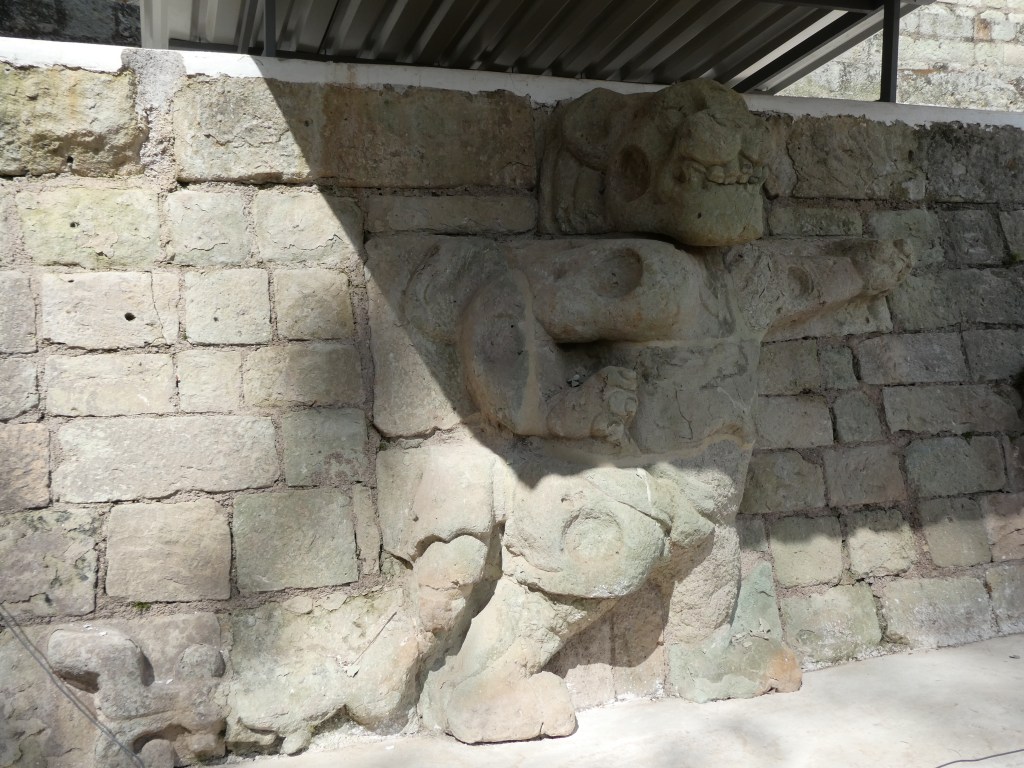
And this ripper of a sun god.

The East Court is also the entrance to the Rosalila Temple. Rosalila is the most complete temple discovered at Copan and the best preserved of ANY Mayan temple. It’s a red temple literally whole and untouched inside the Acropolis. But Marvin informed us that we weren’t going in there. He said the project to view it wasn’t entirely finished. So, in his opinion, the ticket price to see the temple was not good value for money. Hence, he had not purchased that ticket type for us.
My little HockTales heart broke. I commenced a silent, invisible, full-on Donald Duck epic quack attack tantrum inside my suffering head. I’d travelled halfway across the world to see Copan, which is not an easy place to get to. Hours of driving and a border crossing from Antigua in Guatemala, and now hours of driving and a border crossing to Suchitoto in El Salvador. Probably 10 hours in a van all up. Let’s not even get into how much money, time and effort had been expended travelling from Australia. The odds were stacked against me returning to Copan anytime soon if ever. So for Marvin to deny me the opportunity to see that temple because he didn’t think it was value for money (not because of lack of time because we could have gone through there with a few less games of ‘Which Country Was that Fruit From’) was a kick in my already churning guts. Even if the project was partially finished, just seeing something of that temple with my own eyes would have been better than seeing nothing which is what happened. Of course, I said nothing because there was no point. We didn’t have the tickets.
Onwards with heavy heart, pounding head and poker face.
We came down to the West Court which is the interior of that selfie with the pyramid I took a while back. The side of the Acropolis has these skulls halfway up it.

Cool. Skulls always make me feel a bit better. Fash says these are human but they look like monkey skulls to me.
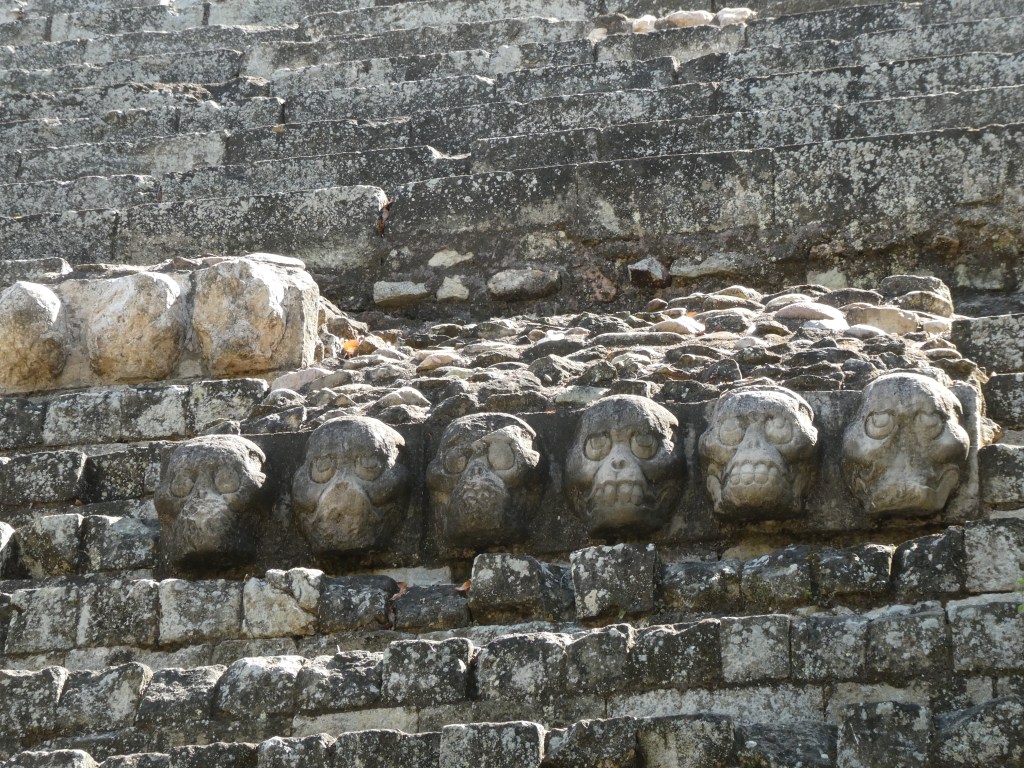
The Acropolis is a bit like an apartment block with every ruler building their own unit on top of the previous occupant’s. It all looks like a bizarre giant hill with steps on all sides now. This particular side was built by the king Yax Pac who built a huge reno over the top of everybody else’s at the time. But the most famous part is not the building, but the altar at the foot of the steps – Altar Q. Whereas the Hieroglyphic Stairway certainly features all the kings, it was a bit of a bitch to decipher by all accounts. This handy rock has them all in order in a square! Starting with King SpecSavers on the corner, it goes around to portray all 15 Mayan rulers in chronological order seated on their name glyphs to end with Yax Pac(man) and his date of accession in 776. The deal being that Yax had a chat with his ancestors on the day of his accession and received their blessing. One suspects an artisan had been carving this for a while though. Doesn’t look like an express 24 hour turnaround to me. A bit like – here’s one we prepared earlier – we were just waiting for that accession date and let’s bang that out with a chisel. Fash states that Yax Pac sacrificed 15 jaguars in a crypt under the temple – one for each of his ancestors. Apparently two were juveniles. Even for the king’s accession, the Mayans had to settle for only 13 prime specimens which might indicate the extent to which the jungle was receding at the time. Fun fact – Altar Q here is a replica. The original is in the site’s Sculpture Museum. Something else we weren’t allowed to see …

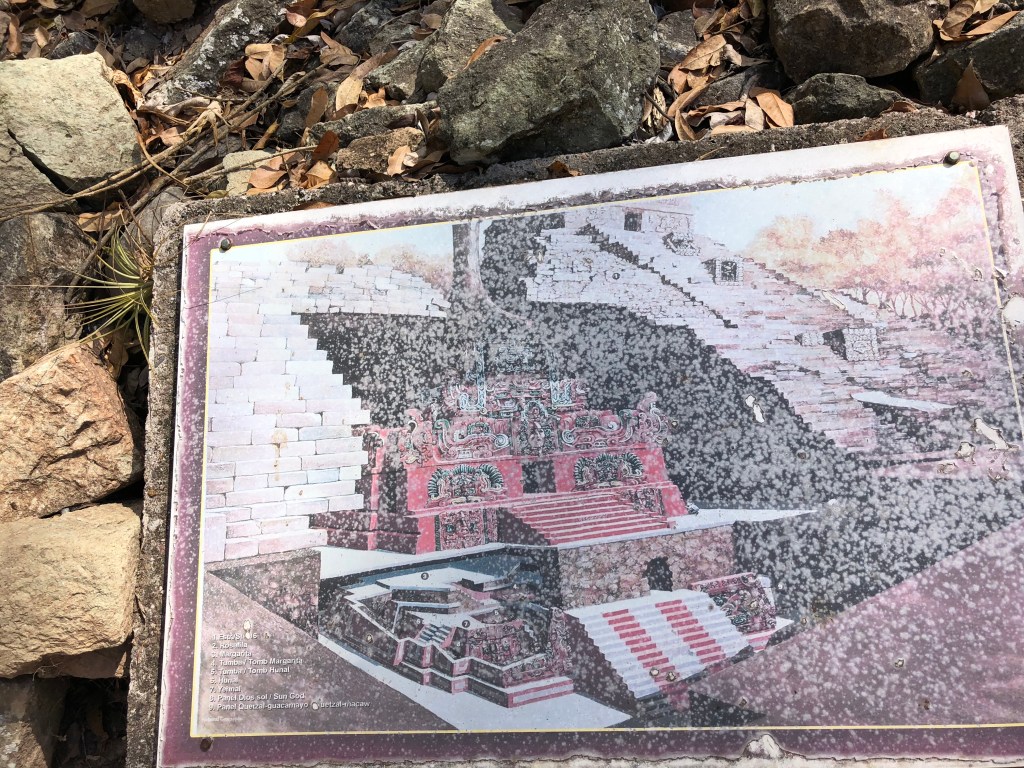
Below is a picture of the Rosalila Temple encased inside the Acropolis exactly where I was standing. (The stairway to the right is where Altar Q was.) See what I mean about the temple inside a temple? It’s like a babushka doll inside a babushka doll. The colour is meant to be amazing. The previous day I had bought a pair of earrings of the Rosalila Temple thinking I was going to see it. Now I wear them and think of this picture and the book of the Sculpture Museum I bought online with the Rosalila Museum on the cover.
This was cool. Features look simian like the skulls to me. Also loving the glyph down the bottom that looks a bit like the glyph for ‘lord’. Could mean monkey lord? Who knows? I can’t remember and I was on my last legs at this point. I told Marvin that I had read Stephens and Catherwood’s accounts. Finally, now that it was time to go, he had shown a spark of recognition that I might have a shred of interest in his culture.
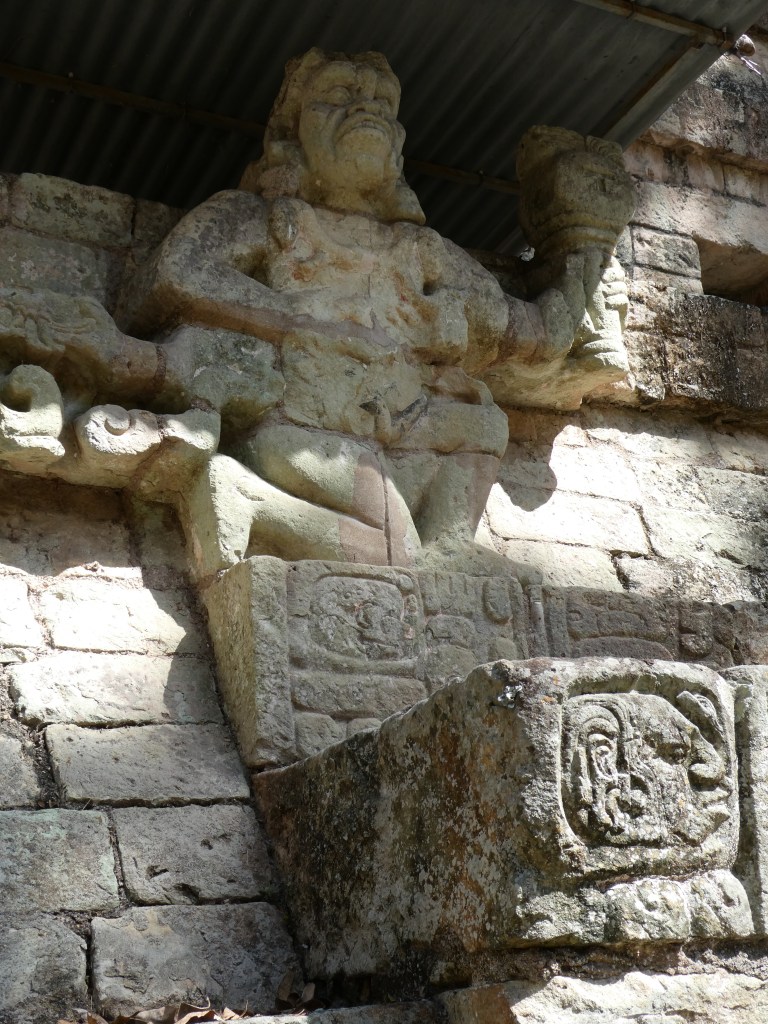
Note – a bit more reading reveals that this was another Reviewing Stand like the jaguar East Court. Essentially a grandstand or bleachers if you live north of the Mexican border. This creature was a decoration on the steps.
It was a morning I would never forget. Copan was terrifying in its beauty as I found most Mayan sites but the detail on the sculptures and engravings gave it a special edge. There was so much more that we never got to see – an entire cemetery complex for one – don’t get me started on the other stuff – and so much that I missed out on due to that wretched demon bird from hell blocking me. Fear, joy, beauty, pain, sorrow. I’d experienced it all and I was knackered. I am desperate to go back for further explorations like Stephens and Catherwood, but it’s logically very difficult. We’ll see.
We tuk-tuked back to Copan town for lunch. Most of the group had skipped breakfast and was starving. The quest was on to spend the remaining limpies before we crossed the border to El Salvador where we could spend as many ripped US dollars as we wanted. We patronised a cool cafe, dining on the local specialty which I think was called a balleada. It resembled a quesadilla. I recall mine was chicken and cheese. I recall it being super filling and delicious and eating the entire lot. (I always eat the entire lot.) I also went for horchata because it was nice and cool. The weather was heating up and I was not feeling like an Americano was the go. I remember happily keeping some limpies in my back pocket to buy some more Mayan earrings from the girl on the jewellery stand outside the cafe.
I limped back up the steep hill to the hotel. My stomach lurched dangerously. Oh god. Now it was full of chicken and corn-based tortilla products ahead of a 5 hour or so drive. I dashed straight for the hotel’s guest bathroom, thinking perhaps a strategic spew could prevent public shame in the mini-van. But my efforts yielded no fruit. Then we were on the road to Suchitoto.
The curse of Copan wasn’t over though …
We entered pothole hell. My position in the backseat middle was unfortunate. Since I wasn’t feeling well, I should have been up the front but those spots went fast and I was shuffling at a sub-optimal pace too slow to secure one. The back was all that was left. The group luggage was tightly packed in the space behind me. No divider or cage though. Under normal circumstances, this might have been ok. However, the Tetris like packing skills of the driver were no match for the terrible, bumpy roads and the crappy suspension of the bus.
This shot out and smashed me in the back of the head.

Ironically, this was my rucksack. Fortunately, I had been struck in the skull by the end containing the dirty laundry so damage was minimal. But I was super lucky. The other suitcases around it were the hard candy ones. If they had shot out with the comparative speed of a poorly tied log on the back of a lumberjack’s truck like old bluey had, I’d have gone down with a concussion.
A couple of other bags tumbled forward with a key part in the Jenga tower now gone. After a brief pit stop to change up the luggage arrangements, we moved spots because some of the bags had to sit on the seats. I scored an even worse seat over the right back wheel of the bus. For the rest of the trip, I felt every lurch and jolt and so did my stomach and head. It was a long drive. A very long drive. I suspect we stopped at a couple of service stations for toilet breaks as we usually did. There may have been a futile attempt to cat nap. I probably wrote one of these blogs on my phone. We crossed the border into El Salvador and I have no clear memory of it, but suspect I did what I was told and there was no incident.
The day was not over yet, even though we pulled into Suchitoto and it was dark. The hotel was on a Main Street. I couldn’t make out much. It reminded me of Antigua in that it was a front door of a single storied building on a street. It was lovely inside though! A nice open area overlooking a garden, lots of tables and chairs for outside seating, some couches in the foyer. It was very cute. Jardin de Isabelita. I remember that we were meant to arrive at 6pm for a briefing about some activities for the following day – decisions had to be made that night. We had arrived super late because of the border crossing and the crappy roads – maybe 8pm? I remember I had maxed out nice functioning Jo at this point. Poker face slipping after hours of being jolted around on the right wheel with the bus’ crappy suspension and my head hurt. I was tired and grumpy. I’d hit hungry hours ago and gone past it – a dangerous sign that I was unstable. Decisions were not my strong point at that time. Verticality was not my strong point at that time. Poor Renee, the service provider, talked us through options for the following day that I barely took in. Thankfully, I had done my research before the trip and knew all about these options – they were on the Trip Notes. Yay me. I sorted out that I would do the walk in the nature reserve with the guerilla war fighter. Done.
Pamela started handing out the room keys. Everybody received theirs and started heading off to their rooms. I sat there, virtually comatose on the chair. Where was mine?? Some shuffling and low voices. Time passed. I shut my eyes. The shitstorm might pass me by if I didn’t acknowledge its existence.
The curse had struck again. Not enough rooms. I had missed out. Pamela and I were to go to another hotel.
At that point, I was so tired that I was beyond rational thought. Five women on this tour were on single supplements but it had to me right here right now barely conscious that had to go. Pamela said we were to come back for dinner – the famous papoosas – but I told her all I wanted to do was die. I got into a car with two guys who drove me in the dark to God knows where and they set me up at the hotel desk. But if I had wanted to go back for dinner, there was no way I could have met the others back at that hotel. I would never have found it. I was so disorientated.
The new hotel was the opposite of Jardin de Isabelita. No garden, no outdoor area. It was in fact, an inside dog box. Turned out it was the back of a cafe. All I knew at that point was that I was alone in god knows where, nobody had noticed my absence, and I was too exhausted to care.
With that, dear reader, the curse of Copan finally lifted because I crashed.
Tune in soon when HockTales takes a jungle walk with a machete wielding guerilla!
 HockTales: a Central American Adventure
Great post 😁
LikeLike
Favourite post so far. Your writing just gets better and better. the Macaw claws are terrifying I felt you and sticking head out windlow like a happy dog. I think you have to go back.
LikeLike
Your blog brought back many memories. Your knowledge of Myan history is amazing. Finding out about the background to the site and carvings adds another dimension to what I observed and what Marvan told the group. Was Marvan’s appearance (skin tone, pigmentation and facial features) similar to what Myan people looked life?
LikeLike