
My fellow tour mates embarrassed themselves severely over the guava jam and hostess Spam, insisting that this morning’s breakfast was free on the itinerary. Barbara, organiser extraordinaire, had told us nothing of the sort. I knew who I trusted and which side of my squishy sandwich roll was margarined. (And to make a Meadow Lea reference – nobody ought to be congratulated for that incident.) Phone calls exchanged. God, it was shameful. She was only charging five cuc anyway. I preferred to pay the nice lady with the dog who fed us and gave us free internet for two days than rip her off. Five CUC meant more to her than me after all. Guess what – Barbara insisted we pay. Big surprise. Super embarrassing. The other two then went on to take it up with Barbara for the next half an hour. Let it go!!!!
The silent, stoic and yet seemingly all-knowing Hector (late 40s, glasses, in uniform with name tag all the time!!!) performed the daily ritual of removing the rucksack from my back and the bottle of Havana Especial from my hand for the cooler. (I swear one of these drivers is going to drag me into the boot with this bag one day.) Barbara also paid for two huge bottles of water for the cooler that we used to constantly refill our own bottles.
Today, we were travelling to Santa Clara via the Sugar Mill Valley where the owners of those airy homes made the sugar bucks in the 19th century. Or rather, where all the black slaves did all the work and the rich descendants of the Spanish migrants kept exploiting them to maintain their position.
The valley wasn’t far away -20 minutes? The bus pulled up and vendors were on us like seagulls on chips – crocheted goods, bananas, buy, buy, buy. Couldn’t blame them. I always remembered the bodegas. And Trump is trying to turn back all of Obama’s gains too. The blockade was not going to improve anytime soon. Frankly, I was surprised he hadn’t asked them to wall themselves in and pay for it. But none of this put me in the market for a crocheted tablecloth.
9am but it was baking hot. Imagine what it must have been like for slaves working all day in the cane fields. The place we arrived at used to be the administrative building for one of the sugar cane plantations but was now a restaurant. Barbara did the best she could.
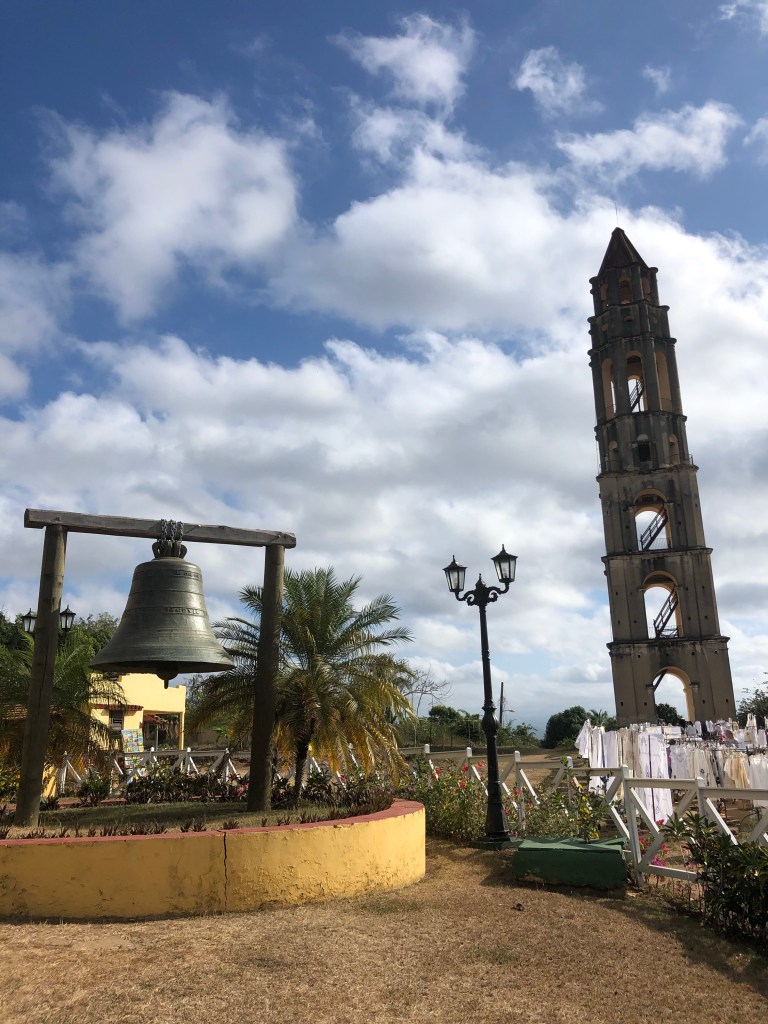
But I would have loved a proper guide or historian to describe how the slaves lived. (I had a pretty fair idea about the sugar daddies.) At least their culture lives on through music and dance every day on the street. Barbara took us out the back to show us the big cane crusher that would have been attached to an ox or a horse to extract juice.
Yvonne and dashed to climb yet another tower. This one was the steepest and most unsafe yet! No handrails and you could see straight through the steps, Mum! But the views over the building were awesome!!!!!
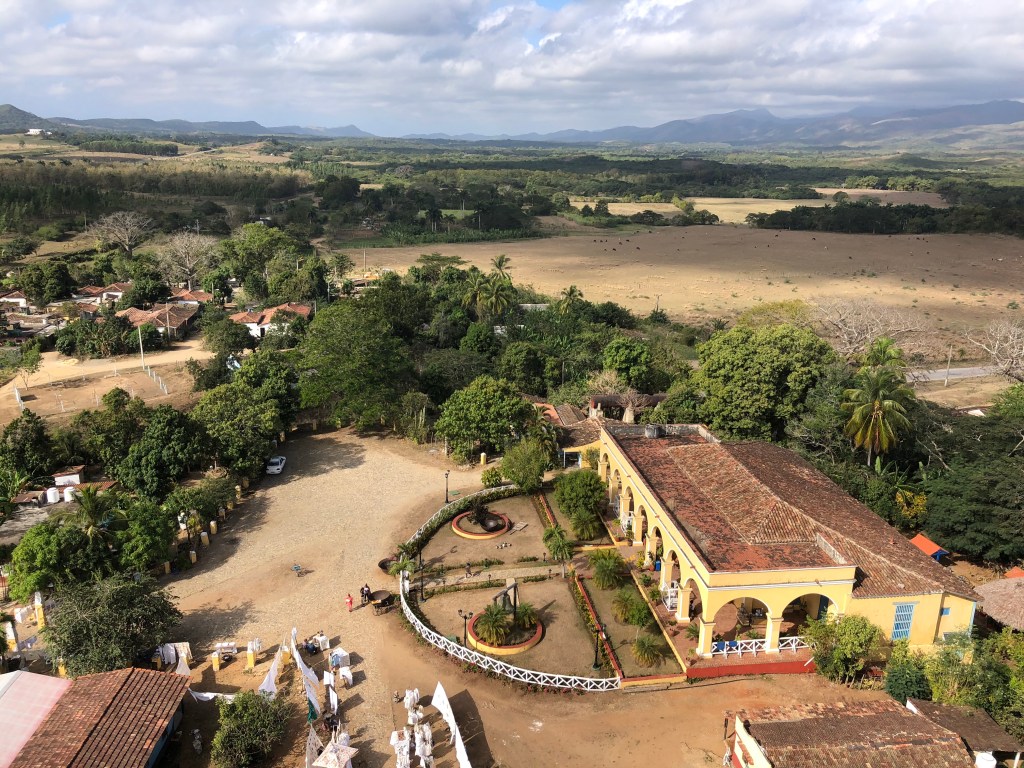
Just in time for a toilet stop and a quick cup of sugar cane juice before we hit the road!!!
It must have taken a good couple of hours to reach the Che Guevara mausoleum, just outside Santa Clara. Reminiscent of the Ho Chi Minh mausoleum in Hanoi, military police patrol the area and it’s a very reverential area with a no phone and photo policy. Unlike Uncle Ho, you don’t get an actual viewing of a body. Just a respectful place to honour and remember.
Che was born Ernesto Guevara in Argentina. Che was his nickname; it’s slang for ‘buddy’ because that’s what he was to so many. He met Fidel and Raul Castro in Mexico after the people in the July 26 movement (eg those who tried to storm a barracks that day) who survived Batista’s wrath were exiled there. Batista thought they would slink off for tequilas and tacos. Nope. They were planning their boots off for the granddaddy (or Granma) of revolutions to bring the Americano puppet down. They needed a doctor for the group: enter Mr Guevara who gained his medical degree in record time but really had an unofficial PhD in sticking it to governments repressing the people. He had zero affiliation with the Cuban people, but happily risked his life to liberate the Cuban people from the Batista regime.
The revolutionaries crossed from Veracruz to Cuba in a boat. 82 people in a boat for 23. Plus Fidel was big enough to be considered three and I do wonder if he was hitting the taco stands with a large serving of free soup. They couldn’t quite stick the landing. Batista’s soldiers killed many and Che was seriously wounded. The survivors laid low in the Sierra Madre mountains for a while, before recruiting the neighbouring people to their cause and then snowballing into a huge army that eventually overthrew the government. Che commanded the army in the mountains and much of the military strategy of the revolutionary battles with his mate, Camille Cienfuego ($20 note Camille). The final battle was at Santa Clara where the revolutionaries derailed a train. Che’s second wife – she was a soldier in his army – was also from Santa Clara. Hence, the location of the mausoleum.
Che became a minister, implementing the currency and designing the education program. Before the revolution, half the population was illiterate. After the revolution, the figure jumped to something like 90%. He also became a diplomat, flying around the world to other countries to negotiate deals for Cuba, particularly when it became evident that the Americans were trying to destabilise the government and assassinate Fidel with poisoned cigars. One of them was the missiles that got everybody in trouble a little later down the road.
But politics was not at the heart of the boy who rode the motorcycle through South America. The boy whose heart bled at poverty and injustice. The boy who stood up to help others no matter the personal cost to himself. Che penned a letter of resignation and went back to his roots as a freedom fighter. First to the Congo and then to Bolivia where it all went bad. He trained 30 or so fighters but they were all killed or captured. Che was captured and tortured. News of the great man’s capture reached many so it’s not entirely clear who have the final execution order. Fidel would have paid big bikkies to release him. A popular theory is that the Americans gave the Bolivians the order to shoot this commie blight on the world. Che Guevara, international freedom fighter, was dumped unceremoniously in an unmarked grave. He was 39.
Years later, the soldier who carried out the order identified remains in the Bolivian jungle. DNA confirmed they did belong to Che. Fidel shipped his mate home and built a huge mausoleum honouring him and the others who fight and died with him in Bolivia.
Inside the mausoleum, each soldier has a small Bolivian marble portrait of their face with a plaque listing their name and dates of birth underneath. Two female soldiers died in the fiasco. Native Bolivian plants grow in the far end of the room. It is very respectful.
Another room illustrates the life of Che Guevara through photographs and items donated by his family. One thing has become clear – Che Guevara was smoking hot. The Spanish word for hot guy is ‘mango’. (At least here it is.) I asked Barbara if any of his sons were mango. The reply was negative – apparently they are all a huge disappointment in that department. Maybe there are mango grandson throwbacks running around. How can a gene pool promise so much and then cruelly deliver nothing???
The photographs in Mexico and in the Sierra Madre mountains with Che, Fidel and the revolutionary army are fascinating. They are meant to be training and plotting to overthrow the government but it looks like a bunch of lads on a footy trip! They’re all smiling and posing. Nobody looks scAred, pensive or overly serious.
Dental equipment sits in a case. Imagine emergency dental in the mountains in the 50s. Oh god. Then I turn a corner and see a photo of some poor bastard on the receiving end of them from Che (apparently as doctor, he had to be dentist as well!) I also saw a photo of Che with a Mayan stelae at Guatemala according to the caption. Tikal maybe? Looked more like Copan but that was Honduras. God knows.
Barbara led us past cabinet after cabinet telling us about everything and everyone in the pictures. Just fascinating. Guns, uniforms, boots. When Che started going abroad for diplomatic missions, he disguised himself so he wouldn’t attract attention as the worldwide figure he now was. Not content with the Groucho Marx glasses and nose, he went for full prosthetics, threadbare wig and liver spots to become an old man. The transformation was weird and stunning. From memory, I think he added a beer gut too.
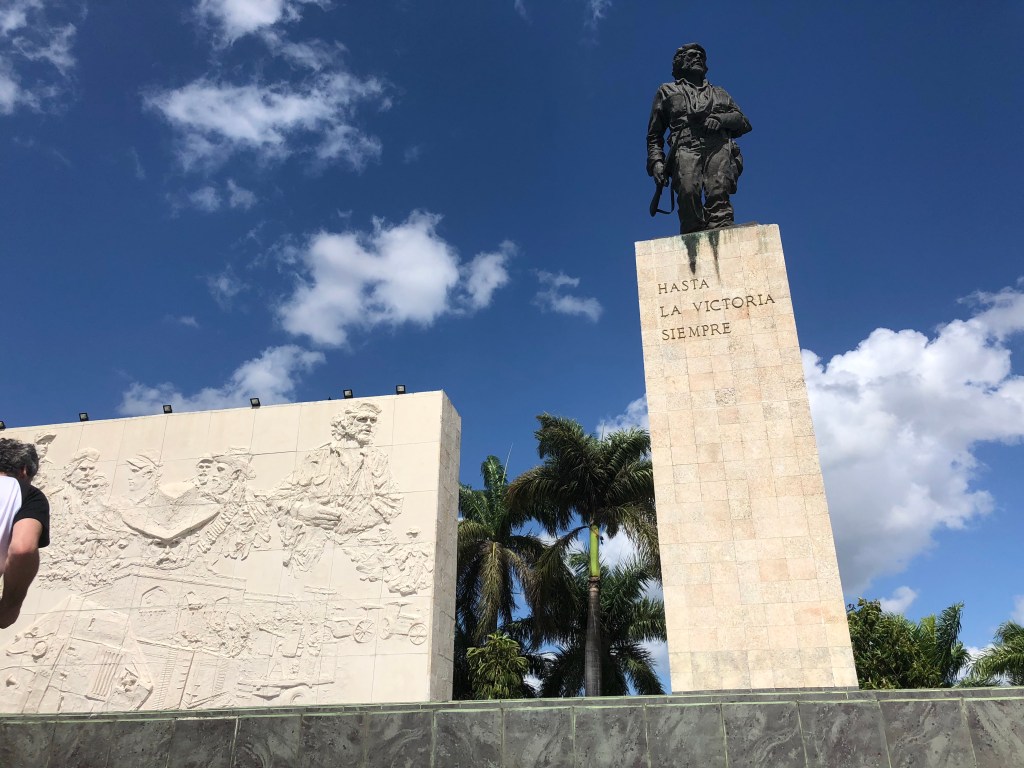
After a few photos outside of the big Che statue – and an exercise in enduring the French couple as they literally draped themselves all over as many steps as possible and photobombed as many shots as possible with their Che Guevara hat – bleccch- it was back in the bus. (Normally you want to spew on the bus, not before you get on.)
We drove to a restaurant with fairly retro décor. In this case, it probably was real retro – not try hard retro. We sat outside for a bit of breeze. It was a disappointing lunch. The waitress pointed to the menu – no tuna, no burgers, no tomatoes, Jesus lady what do you have? All the rich combinations of spam and cheese that could possibly be on offer. With stale crisps.
There was dissent in the ranks that there was too much revolution with their daily spam and guava juice. Seriously??? Cuba is the place it is because of the revolution. To understand Cuba, you need to understand the Cuban revolution. You eat spam because of the revolution. The people live the way they do because of their history – because 82 revolutionaries came across on a crap boat and fought for freedom – because the Spanish and the Americans exploited their resources and then ultimately made conditions so bad that communism looked good. The people I was with just wanted to dance or sit on a beach. They didn’t want to learn about history at all. Frankly, it made me really angry. Not because I am an historian but because I found it so disrespectful to the people who live there. It’s like saying you’re not interested in people’s lives or why they live like they do. It’s superficial. Unsurprisingly, the worst of them touched Che Guevara’s mask in the mausoleum. And remember, I was the youngest person in the group so it’s not a young person thing …
We then visited a little park where a monument to the Santa Clara battle had been erected. The revolutionaries used a bulldozer to derail the train. The little park contained the yellow bulldozer and two of the boxcars from the train. You could hop on the boxcars for a small fee. (Even I had to ask why for that one.) There were two small craft markets across the road with not much on them.
Then we headed for our casa particular (b n b ) to check in. This was a lovely little place with an indoor garden and tiny pool. Two dogs and a tiny puppy who couldn’t have been more than ten weeks old. The dining room contained old photos of the building and the neighbourhood, old deco china and glass cabinets (the kind Granny has).
Everybody else wanted to hang out in their rooms for four hours before dinner. I asked Barbara to take me to a coffee shop. We walked to the main square where Barbara left me for a few minutes to pop into a shop to do tour organising stuff. I checked out the square. It was beautiful. The colonial buildings around it were amazing.
Although my favourite was this more deco type one. Another one of their failed cinemas. Now a bar. But the Cinema Camille Cienfuegos! (I might also add that he was the hero of Havana when he marched in and took it.) Despite this being Che’s de facto home town, it wasn’t Cine Che. Camillo was his best mate though, according to Barbara, so maybe that was close enough. The fascinating thing about this building was the huge mortar holes from the final Santa Clara battle. I had heard they were bullet holes. These were not tiny little revolver holes. Somebody was shelling this building.
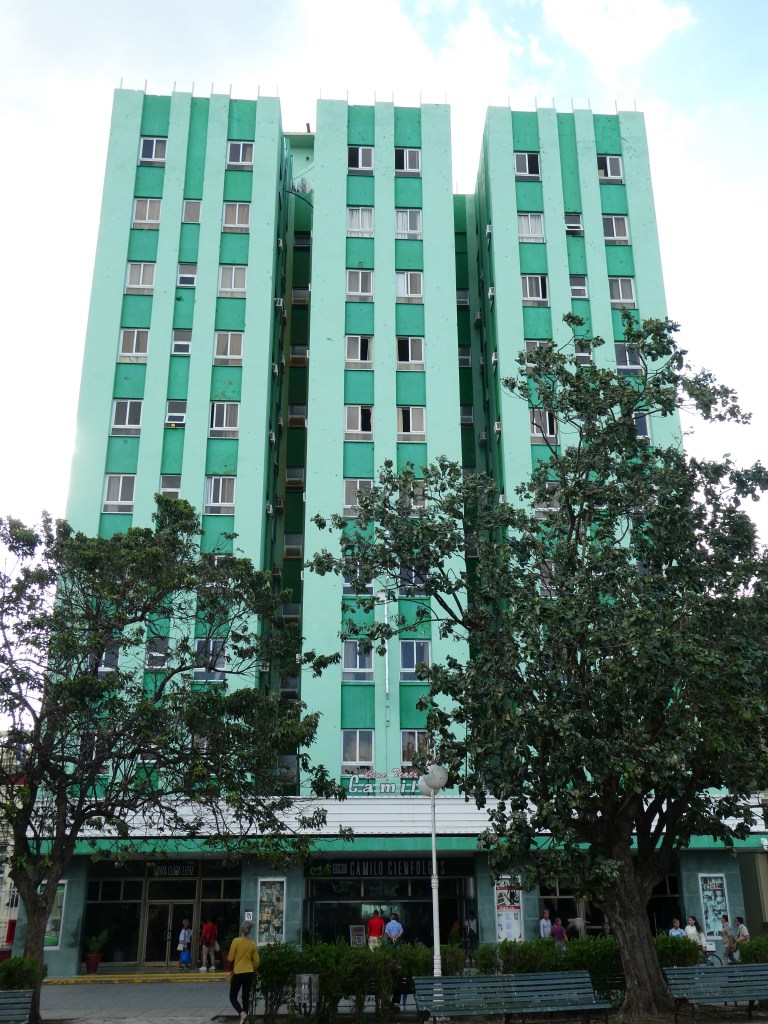
The square was opposite the theatre building which presumably held dance performances. These modern dance boards were all around the square – they looked amazing. One final thing of note was the fountain statue of the boy with a leaking boot. Apparently it’s a boy from the American Civil War who used to bring the soldiers water in a boot. It’s unlucky because the boot has holes in it. I didn’t quite get the reference – beware of Americans giving gifts???
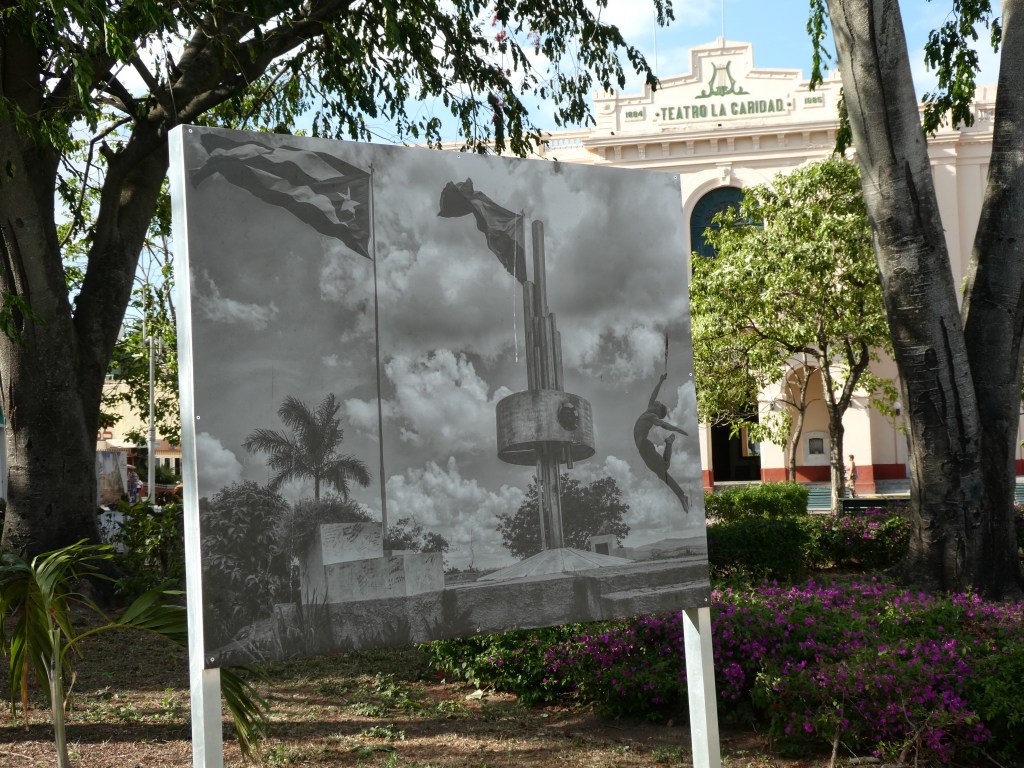
Barbara took me to a big hotel on the square where I sat on the front on a table with my coffee and people watched for a bit. I thought I would also have a beer but, naturally supplies had run out of cerveza National. But they had Dutch beer???? Windmill??? What random Flemish abomination had managed to get through the blockade hidden under the captain’s seat??? I had one and it was as average as it sounded. Not worthy of the Dan Murphy bargain bin.
Dinner was at our casa particular. The family cooked for us! Well, technically it’s a restaurant with a menu in the evenings so not exactly an intimate affair. I had grilled pork with guess what – rice, beans and I think vegetables this time. I also knocked off my rum.
Return to the world of HockTales for my triumphant return to Havana!
 HockTales: a Central American Adventure
This is the best one yet. Very informative.
LikeLike
Agreed!! Just loving doing this trip vicariously with you Jo!! Thank you!! Also making mental note not buy you crochet ☺️
LikeLike
Ps – ¿are the hot chicas called mangas?
LikeLike
That sounds more Japanese!!!
LikeLike