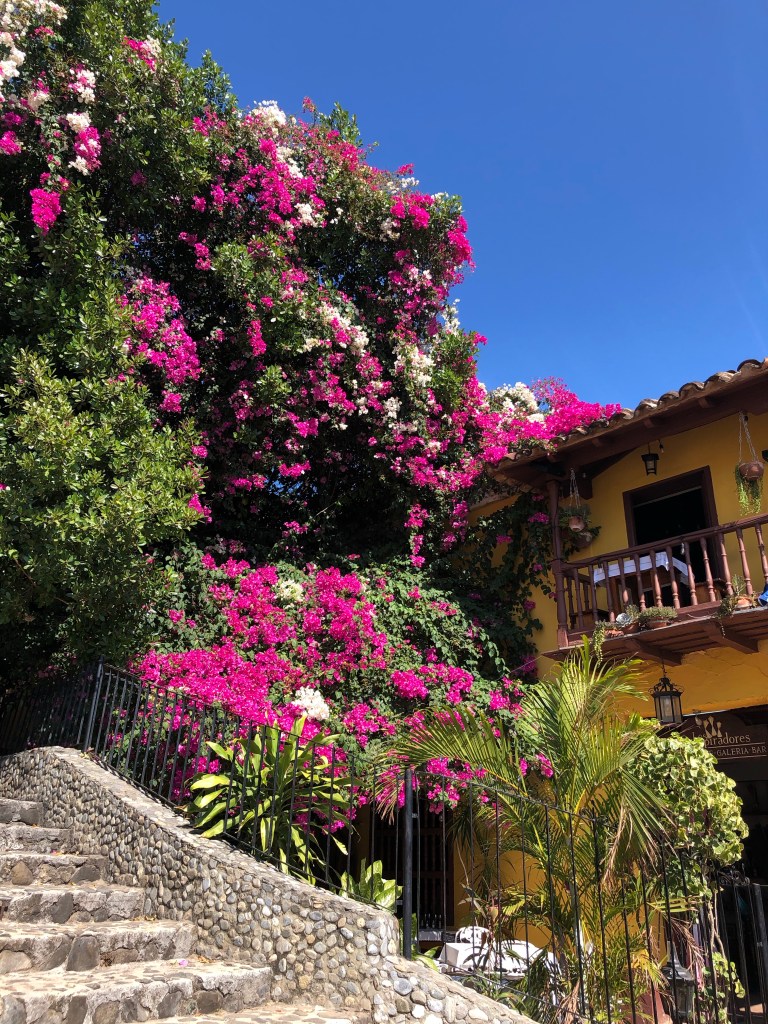
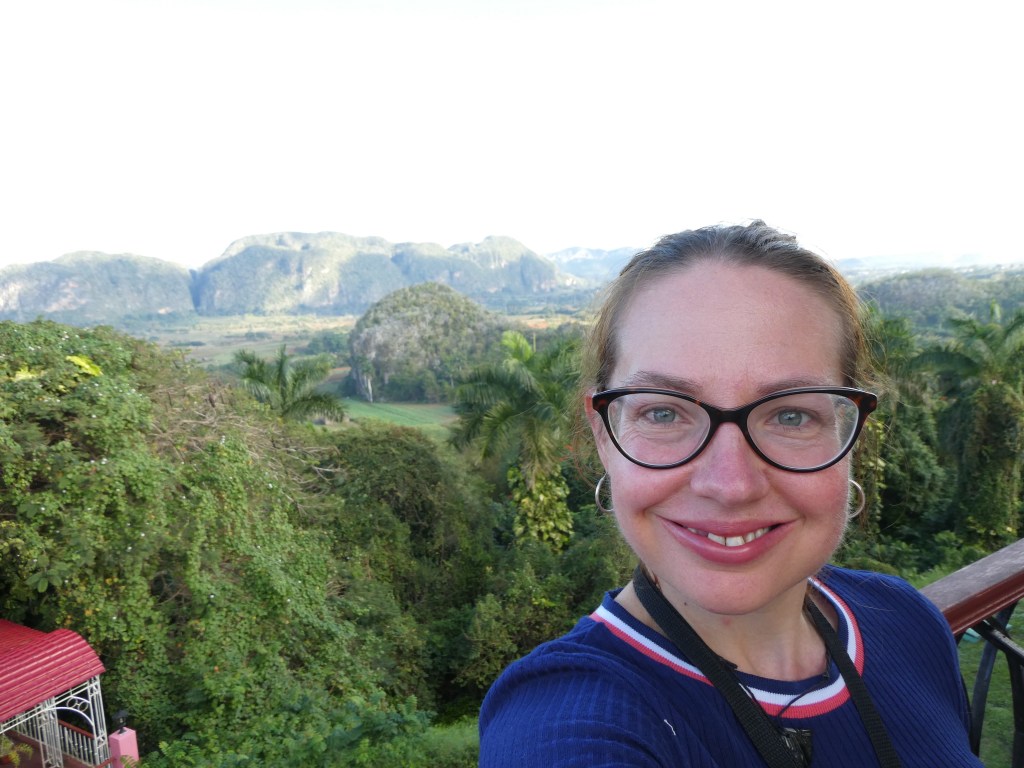
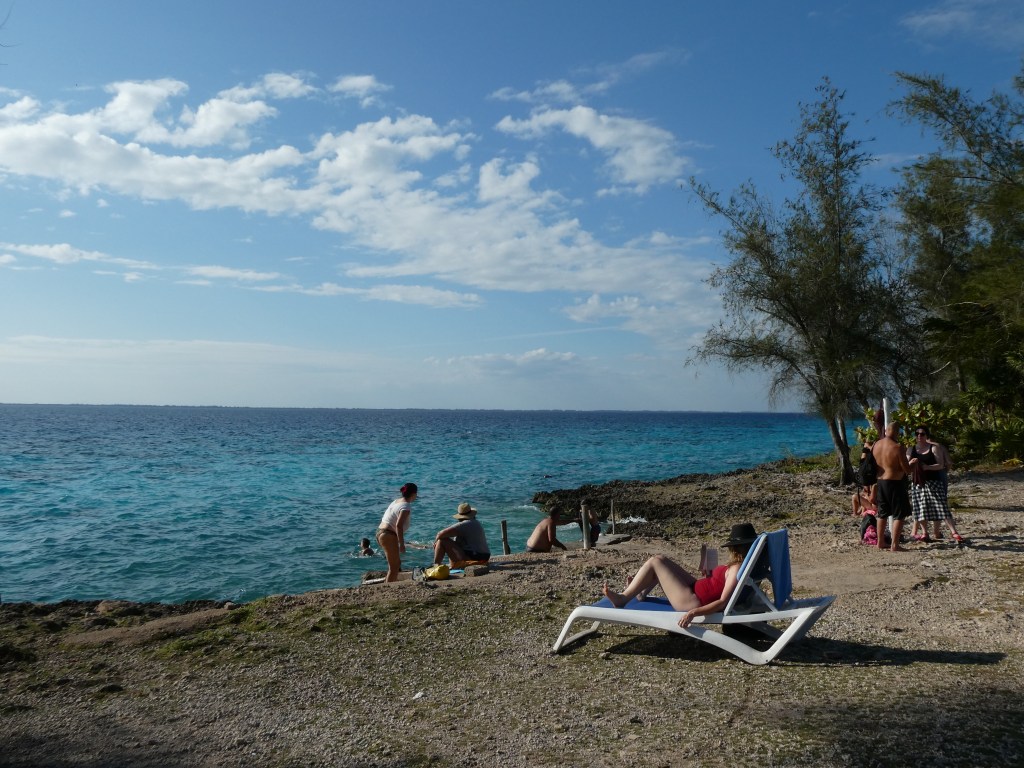
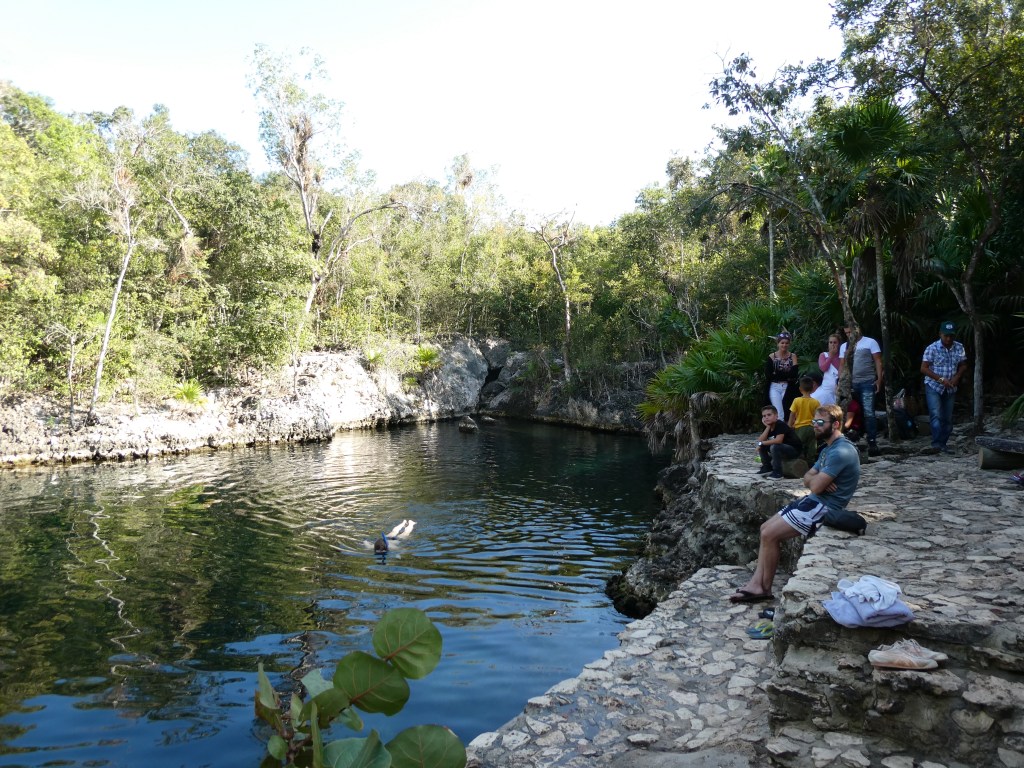
Day 22 – The Red Heart of Santa Clara

Sugar cane juice!!!!

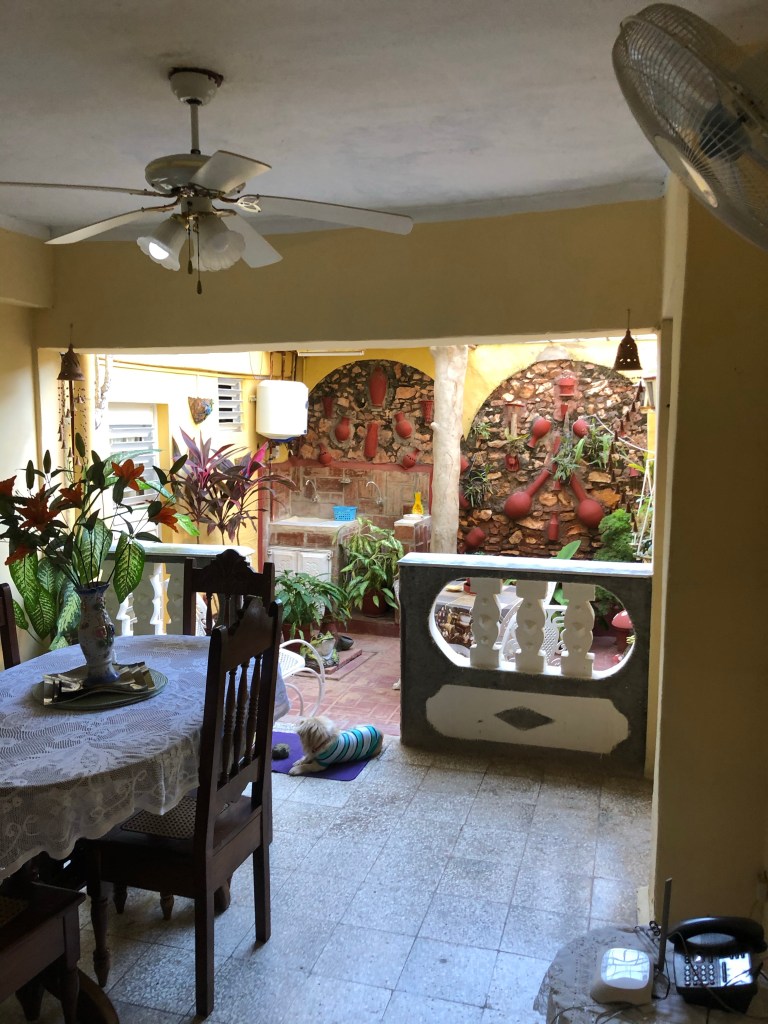
My fellow tour mates embarrassed themselves severely over the guava jam and hostess Spam, insisting that this morning’s breakfast was free on the itinerary. Barbara, organiser extraordinaire, had told us nothing of the sort. I knew who I trusted and which side of my squishy sandwich roll was margarined. (And to make a Meadow Lea reference – nobody ought to be congratulated for that incident.) Phone calls exchanged. God, it was shameful. She was only charging five cuc anyway. I preferred to pay the nice lady with the dog who fed us and gave us free internet for two days than rip her off. Five CUC meant more to her than me after all. Guess what – Barbara insisted we pay. Big surprise. Super embarrassing. The other two then went on to take it up with Barbara for the next half an hour. Let it go!!!!

The silent, stoic and yet seemingly all-knowing Hector (late 40s, glasses, in uniform with name tag all the time!!!) performed the daily ritual of removing the rucksack from my back and the bottle of Havana Especial from my hand for the cooler. (I swear one of these drivers is going to drag me into the boot with this bag one day.) Barbara also paid for two huge bottles of water for the cooler that we used to constantly refill our own bottles.

Today, we were travelling to Santa Clara via the Sugar Mill Valley where the owners of those airy homes made the sugar bucks in the 19th century. Or rather, where all the black slaves did all the work and the rich descendants of the Spanish migrants kept exploiting them to maintain their position.

The valley wasn’t far away -20 minutes? The bus pulled up and vendors were on us like seagulls on chips – crocheted goods, bananas, buy, buy, buy. Couldn’t blame them. I always remembered the bodegas. And Trump is trying to turn back all of Obama’s gains too. The blockade was not going to improve anytime soon. Frankly, I was surprised he hadn’t asked them to wall themselves in and pay for it. But none of this put me in the market for a crocheted tablecloth.

9am but it was baking hot. Imagine what it must have been like for slaves working all day in the cane fields. The place we arrived at used to be the administrative building for one of the sugar cane plantations but was now a restaurant. Barbara did the best she could.
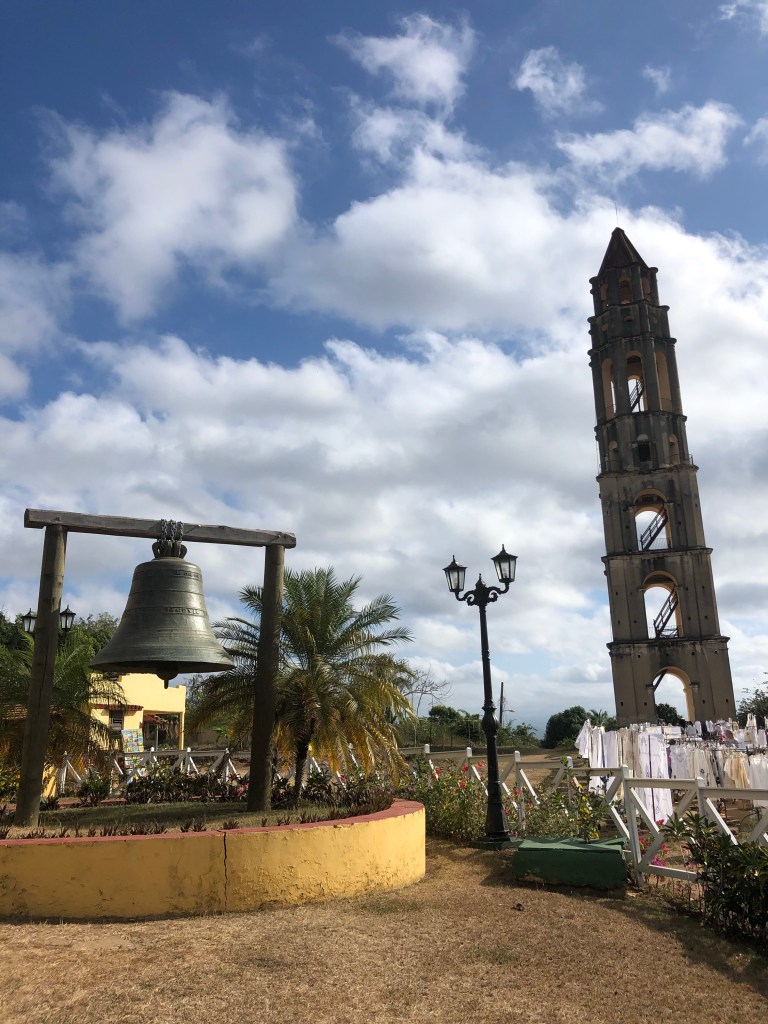
Tower and slave bell. Plus bonus crochet alley – a gauntlet of vendors.

 But I would have loved a proper guide or historian to describe how the slaves lived. (I had a pretty fair idea about the sugar daddies.) At least their culture lives on through music and dance every day on the street. Barbara took us out the back to show us the big cane crusher that would have been attached to an ox or a horse to extract juice.

Yvonne and dashed to climb yet another tower. This one was the steepest and most unsafe yet! No handrails and you could see straight through the steps, Mum! But the views over the building were awesome!!!!!
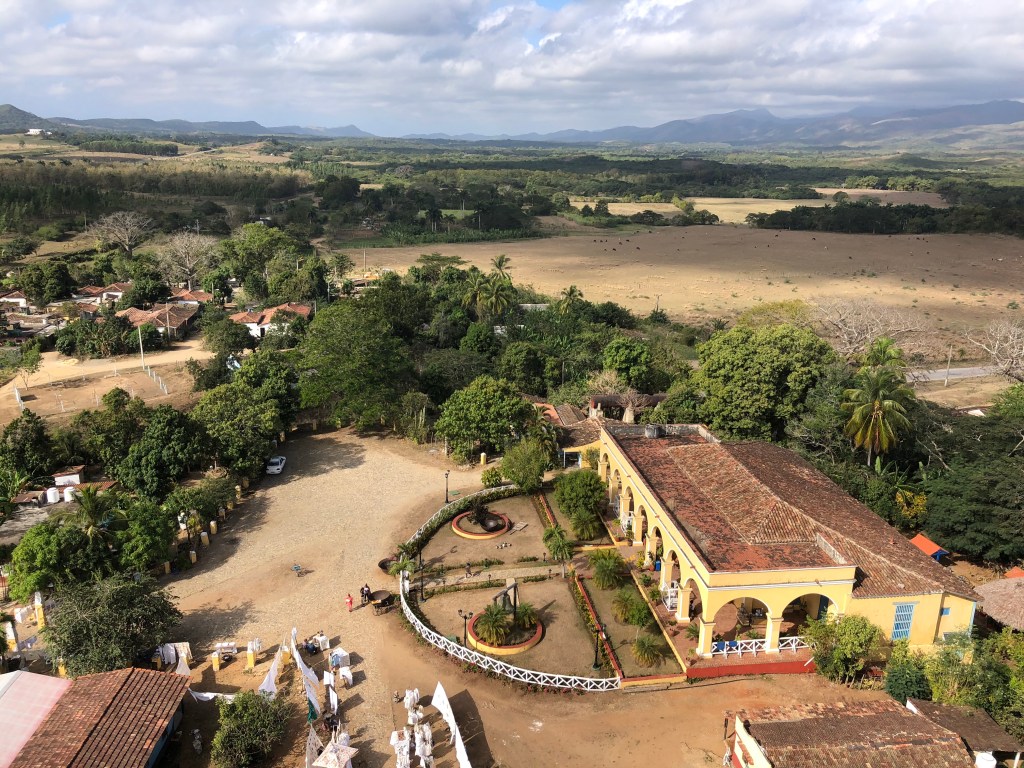
View of sugar refinery from the tower

Just in time for a toilet stop and a quick cup of sugar cane juice before we hit the road!!!

It must have taken a good couple of hours to reach the Che Guevara mausoleum, just outside Santa Clara. Reminiscent of the Ho Chi Minh mausoleum in Hanoi, military police patrol the area and it’s a very reverential area with a no phone and photo policy. Unlike Uncle Ho, you don’t get an actual viewing of a body. Just a respectful place to honour and remember.

Che was born Ernesto Guevara in Argentina. Che was his nickname; it’s slang for ‘buddy’ because that’s what he was to so many. He met Fidel and Raul Castro in Mexico  after the people in the July 26 movement (eg those who tried to storm a barracks that day) who survived Batista’s wrath were exiled there. Batista thought they would slink off for tequilas and tacos. Nope. They were planning their boots off for the granddaddy (or Granma) of revolutions to bring the Americano puppet down. They needed a doctor for the group: enter Mr Guevara who gained his medical degree in record time but really had an unofficial PhD in sticking it to governments repressing the people. He had zero affiliation with the Cuban people, but happily risked his life to liberate the Cuban people from the Batista regime.

The revolutionaries crossed from Veracruz to Cuba in a boat. 82 people in a boat for 23. Plus Fidel was big enough to be considered three and I do wonder if he was hitting the taco stands with a large serving of free soup. They couldn’t quite stick the landing. Batista’s soldiers killed many and Che was seriously wounded. The survivors laid low in the Sierra Madre mountains for a while, before recruiting the neighbouring people to their cause and then snowballing into a huge army that eventually overthrew the government. Che commanded the army in the mountains and much of the military strategy of the revolutionary battles with his mate, Camille Cienfuego ($20 note Camille). The final battle was at Santa Clara where the revolutionaries derailed a train. Che’s second wife – she was a soldier in his army – was also from Santa Clara. Hence, the location of the mausoleum.

Che became a minister, implementing the currency and designing the education program. Before the revolution, half the population was illiterate. After the revolution, the figure jumped to something like 90%. He also became a diplomat, flying around the world to other countries to negotiate deals for Cuba, particularly when it became evident that the Americans were trying to destabilise the government and assassinate Fidel with poisoned cigars. One of them was the missiles that got everybody in trouble a little later down the road.

But politics was not at the heart of the boy who rode the motorcycle through South America. The boy whose heart bled at poverty and injustice. The boy who stood up to help others no matter the personal cost to himself. Che penned a letter of resignation and went back to his roots as a freedom fighter. First to the Congo and then to Bolivia where it all went bad. He trained 30 or so fighters but they were all killed or captured. Che was captured and tortured. News of the great man’s capture reached many so it’s not entirely clear who have the final execution order. Fidel would have paid big bikkies to release him. A popular theory is that the Americans gave the Bolivians the order to shoot this commie blight on the world. Che Guevara, international freedom fighter, was dumped unceremoniously in an unmarked grave. He was 39.

Years later, the soldier who carried out the order identified remains in the Bolivian jungle. DNA confirmed they did belong to Che. Fidel shipped his mate home and built a huge mausoleum honouring him and the others who fight and died with him in Bolivia.

Inside the mausoleum, each soldier has a small Bolivian marble portrait of their face with a plaque listing their name and dates of birth underneath. Two female soldiers died in the fiasco. Native Bolivian plants grow in the far end of the room. It is very respectful.

Another room illustrates the life of Che Guevara through photographs and items donated by his family. One thing has become clear – Che Guevara was smoking hot. The Spanish word for hot guy is ‘mango’. (At least here it is.) I asked Barbara if any of his sons were mango. The reply was negative – apparently they are all a huge disappointment in that department. Maybe there are mango grandson throwbacks running around. How can a gene pool promise so much and then cruelly deliver nothing???

The photographs in Mexico and in the Sierra Madre mountains with Che, Fidel and the revolutionary army are fascinating. They are meant to be training and plotting to overthrow the government but it looks like a bunch of lads on a footy trip! They’re all smiling and posing. Nobody looks scAred, pensive or overly serious.

Dental equipment sits in a case. Imagine emergency dental in the mountains in the 50s. Oh god. Then I turn a corner and see a photo of some poor bastard on the receiving end of them from Che (apparently as doctor, he had to be dentist as well!) I also saw a photo of Che with a Mayan stelae at Guatemala according to the caption. Tikal maybe? Looked more like Copan but that was Honduras. God knows.

Barbara led us past cabinet after cabinet telling us about everything and everyone in the pictures. Just fascinating. Guns, uniforms, boots. When Che started going abroad for diplomatic missions, he disguised himself so he wouldn’t attract attention as the worldwide figure he now was. Not content with the Groucho Marx glasses and nose, he went for full prosthetics, threadbare wig and liver spots to become an old man. The transformation was weird and stunning. From memory, I think he added a beer gut too.

After a few photos outside of the big Che statue – and an exercise in enduring the French couple as they literally draped themselves all over as many steps as possible and photobombed as many shots as possible  with their Che Guevara hat – bleccch- it was back in the bus. (Normally you want to spew on the bus, not before you get on.)
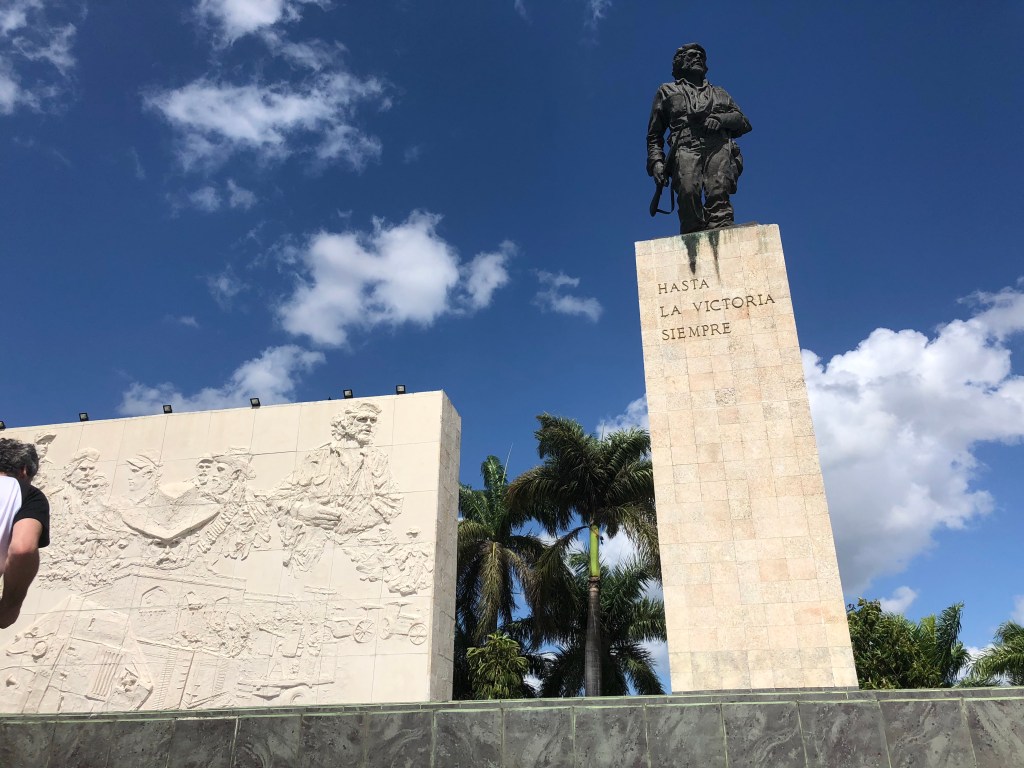
Commander Che Guevara

We drove to a restaurant with fairly retro décor. In this case, it probably was real retro – not try hard retro. We sat outside for a bit of breeze. It was a disappointing lunch. The waitress pointed to the menu – no tuna, no burgers, no tomatoes, Jesus lady what do you have? All the rich combinations of spam and cheese that could possibly be on offer. With stale crisps.

There was dissent in the ranks that there was too much revolution with their daily spam and guava juice. Seriously??? Cuba is the place it is because of the revolution. To understand Cuba, you need to understand the Cuban revolution. You eat spam because of the revolution. The people live the way they do because of their history –  because 82 revolutionaries came across on a crap boat and fought for freedom – because the Spanish and the Americans exploited their resources and then ultimately made conditions so bad that communism looked good. The people I was with just wanted to dance or sit on a beach. They didn’t want to learn about history at all. Frankly, it made me really angry. Not because I am an historian but because I found it so disrespectful to the people who live there. It’s like saying you’re not interested in people’s lives or why they live like they do. It’s superficial. Unsurprisingly, the worst of them touched Che Guevara’s mask in the mausoleum. And remember, I was the youngest person in the group so it’s not a young person thing  …

We then visited a little park where a monument to the Santa Clara battle had been erected. The revolutionaries used a bulldozer to derail the train. The little park contained the yellow bulldozer and two of the boxcars from the train. You could hop on the boxcars for a small fee. (Even I had to ask why for that one.) There were two small craft markets across the road with not much on them.

Then we headed for our casa particular (b n b ) to check in. This was a lovely little place with an indoor garden and tiny pool. Two dogs and a tiny puppy who couldn’t have been more than ten weeks old. The dining room contained old photos of the building and the neighbourhood, old deco china and glass cabinets (the kind Granny has).

Everybody else wanted to hang out in their rooms for four hours before dinner. I asked Barbara to take me to a coffee shop. We walked to the main square where Barbara left me for a few minutes to pop into a shop to do tour organising stuff. I checked out the square. It was beautiful. The colonial buildings around it were amazing.

Although my favourite was this more deco type one. Another one of their failed cinemas. Now a bar. But the Cinema Camille Cienfuegos! (I might also add that he was the hero of Havana when he marched in and took it.) Despite this being Che’s de facto home town, it wasn’t Cine Che. Camillo was his best mate though, according to Barbara, so maybe that was close enough. The fascinating thing about this building was the huge mortar holes from the final Santa Clara battle. I had heard they were bullet holes. These were not tiny little revolver holes. Somebody was shelling this building.
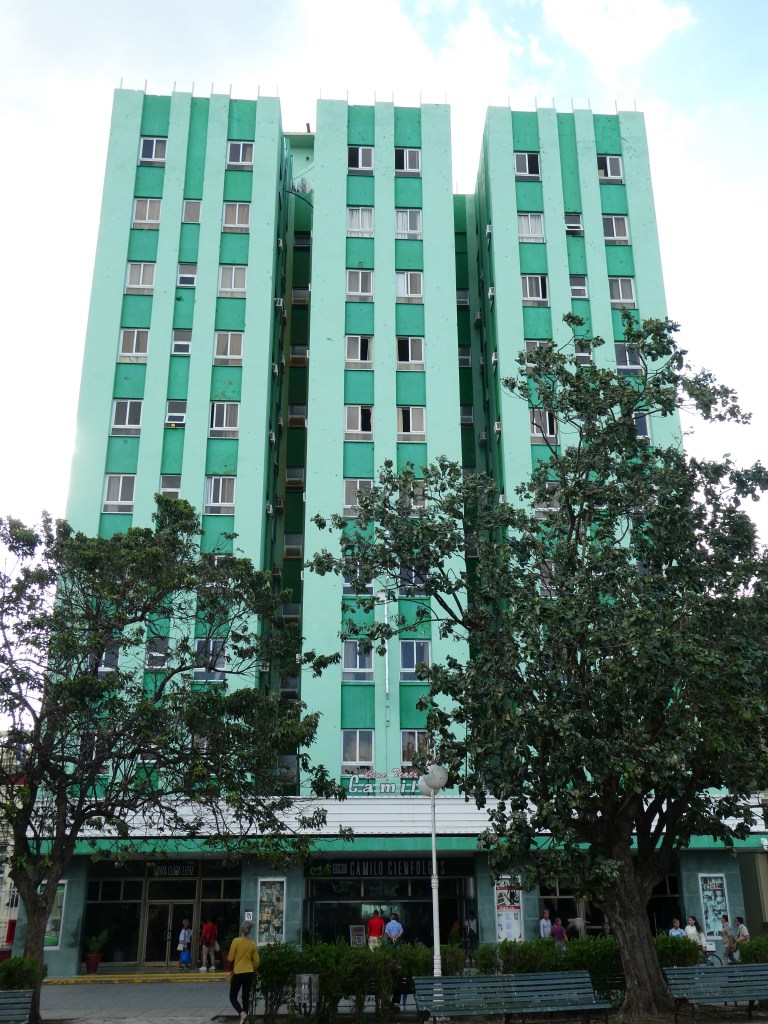
Cinema Camillo Cienfuegos

The square was opposite the theatre building which presumably held dance performances. These modern dance boards were all around the square – they looked amazing. One final thing of note was the fountain statue of the boy with a leaking boot. Apparently it’s a boy from the American Civil War who used to bring the soldiers water in a boot. It’s unlucky because the boot has holes in it. I didn’t quite get the reference – beware of Americans giving gifts???
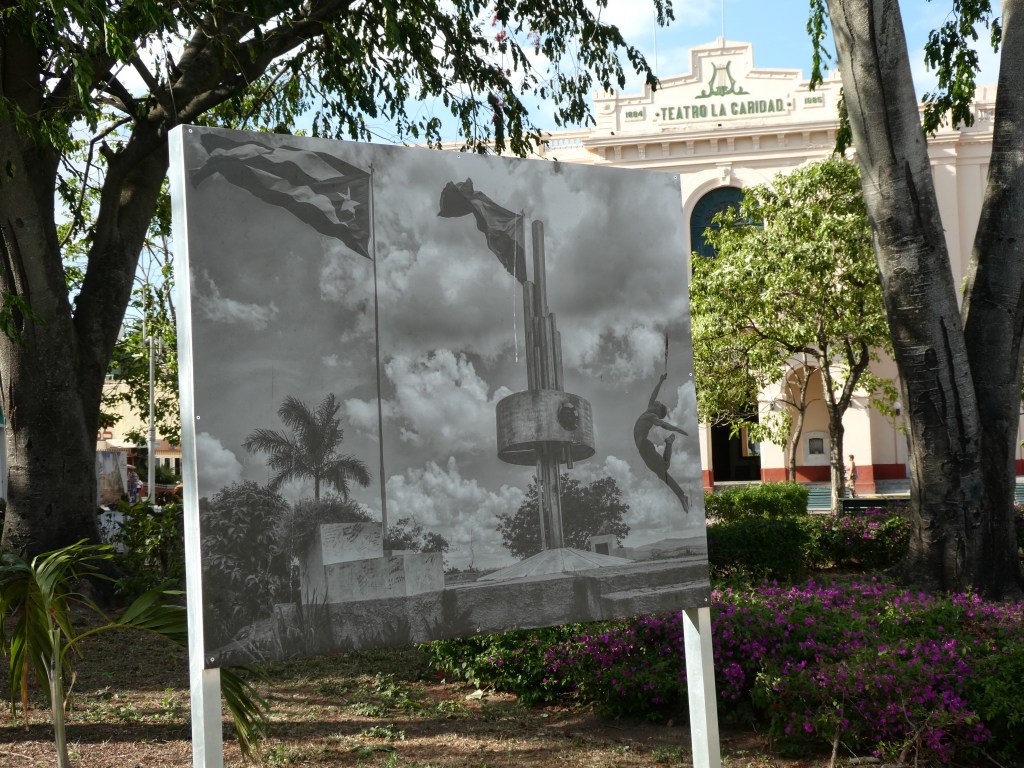
Dance, magic, dance!

Barbara took me to a big hotel on the square where I sat on the front on a table with my coffee and people watched for a bit. I thought I would also have a beer but, naturally supplies had run out of cerveza National. But they had Dutch beer???? Windmill??? What random Flemish abomination had managed to get through the blockade hidden under the captain’s seat??? I had one and it was as average as it sounded. Not worthy of the Dan Murphy bargain bin.

Dinner was at our casa particular. The family cooked for us! Well, technically it’s a restaurant with a menu in the evenings so not exactly an intimate affair. I had grilled pork with guess what – rice, beans and I think vegetables this time. I also knocked off my rum.

Return to the world of HockTales for my triumphant return to Havana!
Day 21 – Sugary Sweet Trinidad

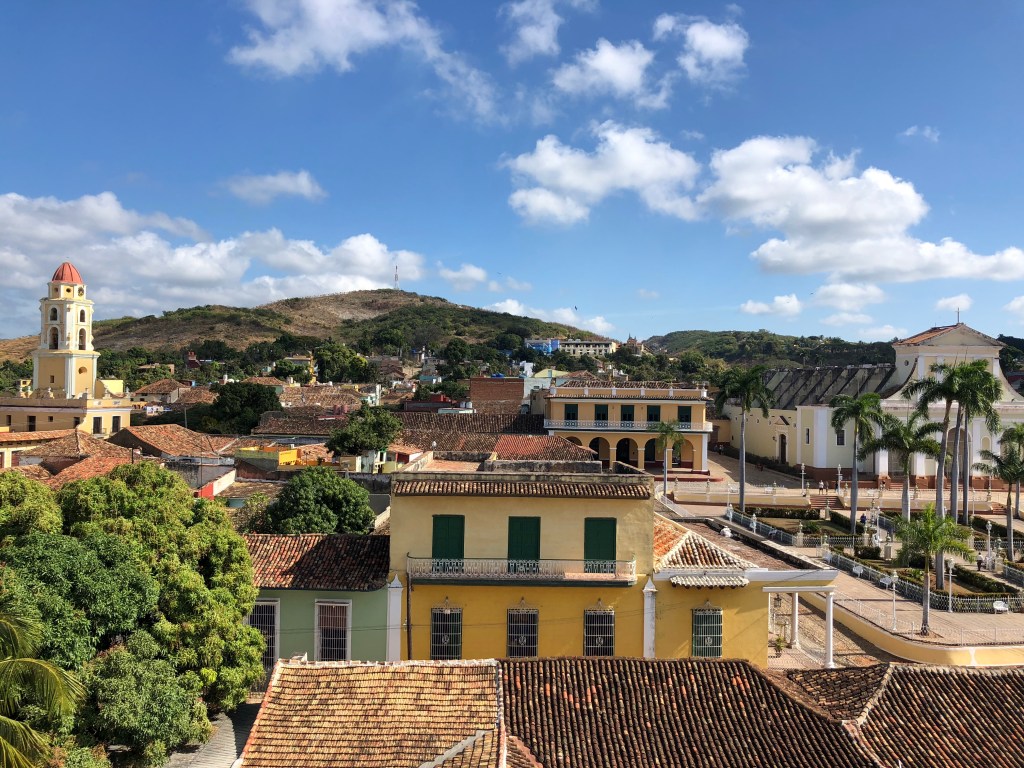
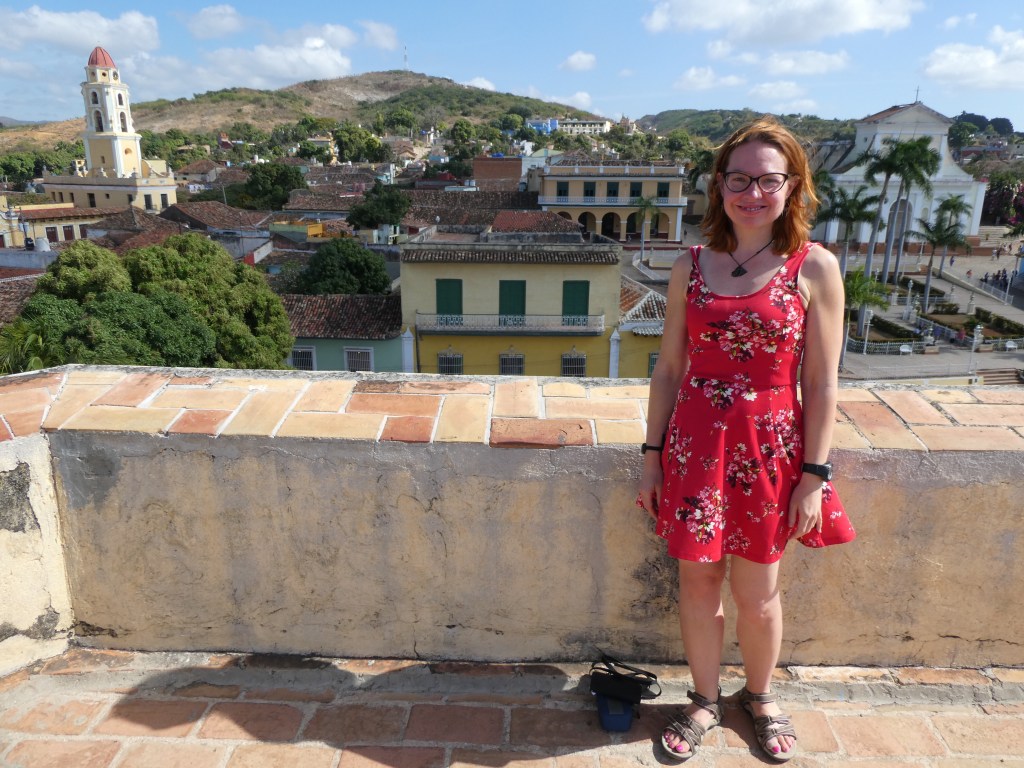
View over Trinidad from local history museum tower

Trinidad beckoned. Barbara led three of us around the small town’s centre. Highlights included a small square with a statue of Marti and a gaggle of wifi users (a regular sight -Marti might as well have had a wifi symbol emblazoned on his head), a huge queue of employers at the bank trying to pay their staff and the only department store receiving a load of boxes containing chicken breast. Apparently a small box was worth 12 CUC. A cleaning wage for the month was 40. Christ. Combine that with the egg rationing and I would shrivel like a protein deprived old lady here. Little wonder everybody kept their own urban avians!

I took in the huge wrought iron doors and bright colourful buildings. Historically, Trinidad was a wealthy city with cashola earned on the backs of the slaves who toiled in the sugar refineries in the 19th century. The doors protected the loaded descendants of the Spanish from ferals with bricks. Apparently. Or at least it made them feel better about the giant piles of loot they sat on by exploiting others. It was reminiscent of a well kept Havana.

One of the main drags – typical cobbled street with band, doors and colourful buildings. Very close to Salsa Corner. Seriously- that’s every corner

Barbara stopped at the main square which was unlike any other Caribbean zocalo I had ever encountered. It was basically an immaculate Italianate garden with a Greek goddess statue in the middle. All Mediterranean imports- signs of the extreme wealth 19th century sugar sweetened into the economy and civic heart of Trinidad under Spanish colonial rule.

It was a time of great prosperity for a few prestigious families with homes around the square. Now, these buildings with lofty doorways and airy ceilings are public museums for the many to enjoy – not just rich Spanish families who married each other. They owned huge sugar cane plantations in the nearby valley, riding a huge boom based on the product and also on the cheap costs associated with running slave labor. The reason the Spanish held onto Cuba as its last territory in the empire and fought tooth and nail for it – sugar and slaves. It was one of the last places in the world to decriminalise slavery. Cuba’s wealthy liked exploitation the way the drank their coffee – dark and sweet.

Revolutionary museum tower and the romantic museum. They love amarillo (yellow).

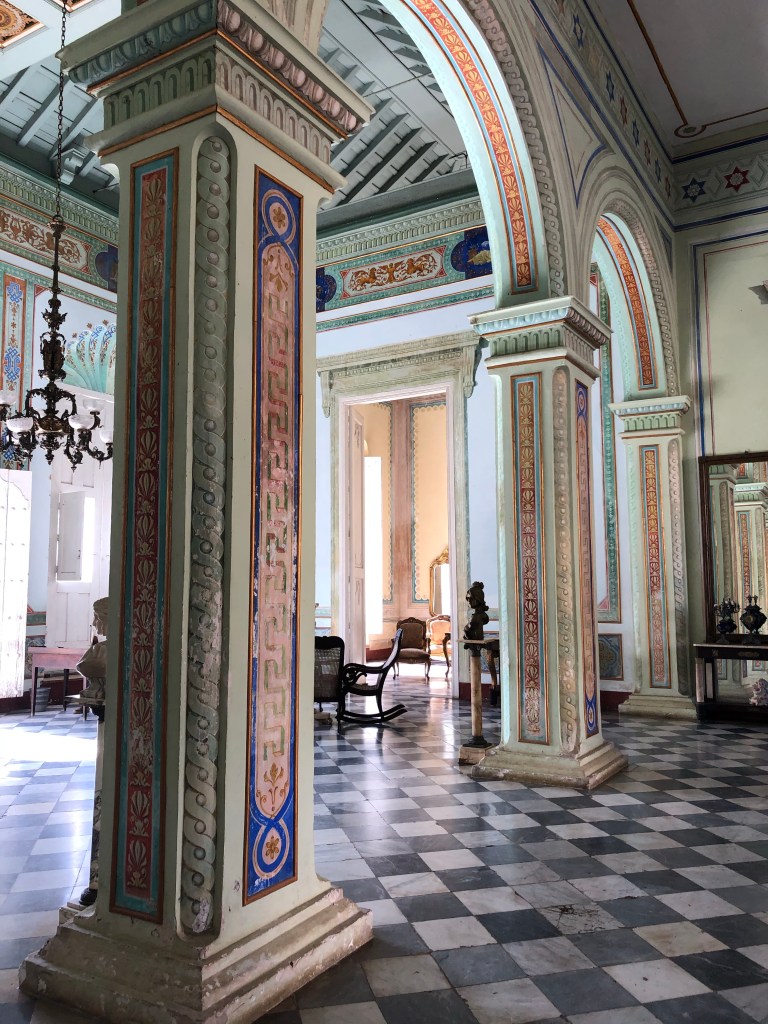
Shane, Yvonne and I visited the one billed as a local history museum but turned out to be more of a family history museum of one of the wealthy sugar families inside their house. (At least it’s more interesting than a day at the CSR factory!) Amazing high ceilings, vaulted columns, painted Italian frescoes, marble floor. My God, the place was stunning. I paid extra for a photographic pass but our guide let the others take photos for free. So much for being an international protector and respector of cultural heritage! The big scandal was that the Dona (the lady) was married to a doctor at the time she met Mr Sugar Daddy. Then he mysteriously died … Scandal!

The rooms were fully furnished. All those high ceilings really keep the rooms cool. Outside was hot as hell. Inside, noticeably cooler. We had an English speaking guide who showed us around the old bedrooms, kitchen, dining room, a room dedicated to generic black slavery, mementos of the family like old shoes, and the old coach. This was purely a ground floor operation. (Perhaps more money was spent on vases than a second floor???)

Local history museum. High ceilings to handle the tropical heat.
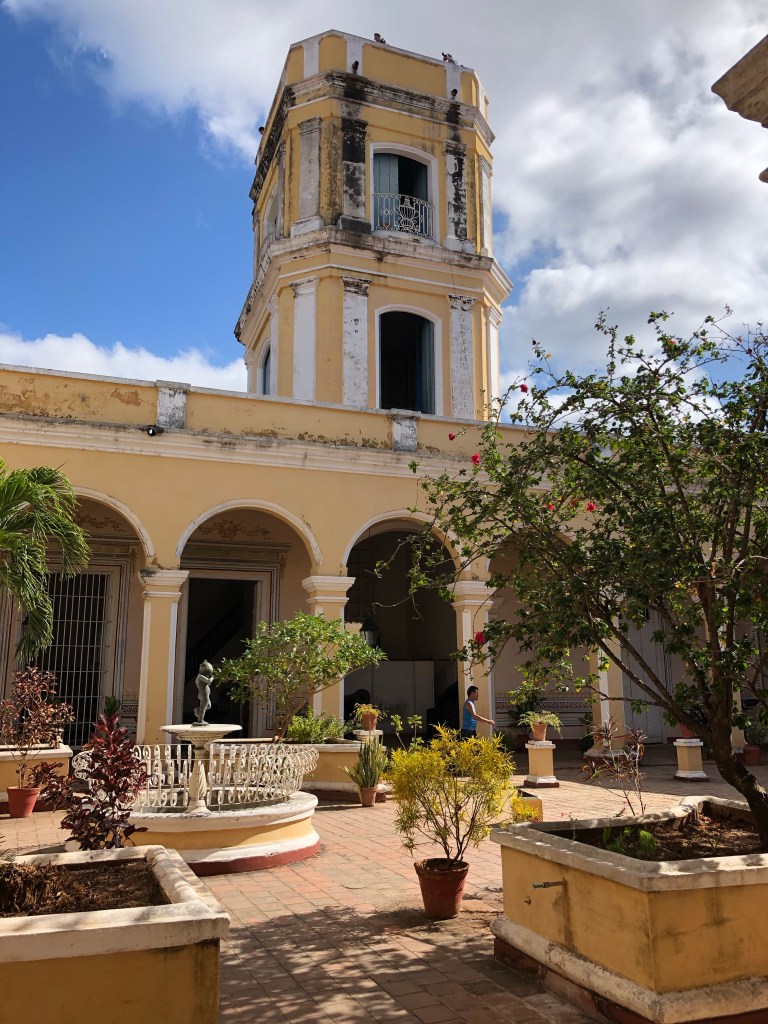
Interior of the local history museum with the tower

With the exception of the tower which attracts people from the square. Climb it for fun, stay for the baking heat and the excellent views.

View across Trinidad with Revolutionary museum on the left, square and cathedral on the right and romantic museum next to the cathedral.

From that point on, it was a HockTales adventure TM. The others all wanted to go to the beach for three hours. I understand the English doing it. The closest thing they get to a real beach is VR. But that’s basically consigning me to sitting on a towel for three hours – I don’t really swim, plus we have great beaches at home. I wanted to check out the rest of Trinidad!

So I started with the next big house in the square – the archaeology museum. Man, what a weird little place! No frescoes here but stuffed rodents that looked like they went through a washing machine in 1968, unknown skeletal remains and something about the Indian caves that I didn’t understand. No English captions. A woman tried to sell me doilies over a glass case of bones. Wrong audience there! (Crocheting is a big thing here.)  It was only 1 CUC but it was my last small note. I needed to break a Camillo.

I walked down a handicrafts market on the street behind the museum. I bought a pair of earrings – might have take forever to pick which one. Was about to try to knock two bucks off the price when the lady slapped a shell bracelet on my wrist with lightning quick speed, indicating I could have that too. I gave in. I am a soft touch and a betrayer of the McDuck name, I know.

Time to hunt for Don Pepe.this was not a man or pepper, but  Barbara’s favourite coffee shop. I had a map but must have turned in the wrong direction. Took me about 20 minutes to realise and then get back to where I was originally, then I found another market! After buying a super cute coco taxi – literally made out of a coconut to resemble the tiny taxis of Havana – the girl told me where Don Pepe’s was. Winning!

$1 for a nice espresso and a bathroom. Now I was getting hungry. Don Pepe’s was clearly a bit of an icon. Lots of people here. But no good other than the sandwich with a side of soul destruction I saw on somebody’s plate. This wouldn’t do. I would have to deviate further from the museums for food, do an ATM run and then head back up.

Prior to leaving Mexico, I downloaded the Maps.me app that is like Google maps but doesn’t need internet. You just need to download the country of choice when you do have internet. Stuff that old school map. It was always going to get me into trouble. I typed Café Adita into Maps.me and it gave me exact walking directions through the streets that look the same.

For the first time, I saw a Cubano sandwich on a menu. I now believe this to be a Miami Cubano thing invention since I ate an enormous one there once and didn’t see it on a menu anywhere in Cuba. Any traditional Cubano sandwich would be plain pork as the most available meat. The Cubano here was the same as the Miami one in content – pork, ham and cheese – but on a baguette. Not enormous – there’s not enough to go around! A good size with plantain chips. It was baking hot outside but I needed a caffeine hit. I couldn’t face a hot coffee so I ordered their cold coffee, the Frappuccino. Or the Fail-a-ccino. The blockade is no excuse for serving basically ice and whipped cream in a tea cup. I think there was maybe a shot of coffee in there? Barista courses needed urgently to Cuba. Please send charity money now. Situation critical in some corners of the country.

Despite this caff-tastrophe, I enjoyed sitting on the upper floor looking over the other patrons. Dona Rosa. I have decided that is my Spanish lady name. I think it sounds nice. Also because Don Rosa writes Scrooge McDuck comics!

Every a short sojourn to the ATM, I stumbled upon an ice cream shop. Seriously, it was really hot and I am from Adelaide where it can reach 48 degrees. I was thinking it must have been mid to late 30s? One of the hardest things to deal with was no weather apps. I was just guessing it was hot if it wasn’t Havana. Ice cream servings were mango and guava. Not generous and rather average – I wonder if the milk was powdered??

Time for Maps.me to roar to life. This time, I was on the hunt for the revolutionary museum. Barbara warned me this was not about Fidel and Che, but what happened after when counted rebellions tried to oust the rebellions. The museum is also known as the museum of the bandits because those insurrections were guerilla type encounters. I swear she told me there was a replica of the boat, the Granma, that Fidel Castro and the others officially started the revolution from.

No English captions. I hit upon the brilliant idea of waving Google translate over the captions. They made half garbled sense in parts????? I was through the museum itself quite quickly since comprendo poquito. I saw a boat and a tank. Faces and faces and names and names of people who were tortured and killed, I think fighting against those trying to destabilise the communist government. Another wing was more of a heroes of the revolution wing with photos, flags and memorabilia.

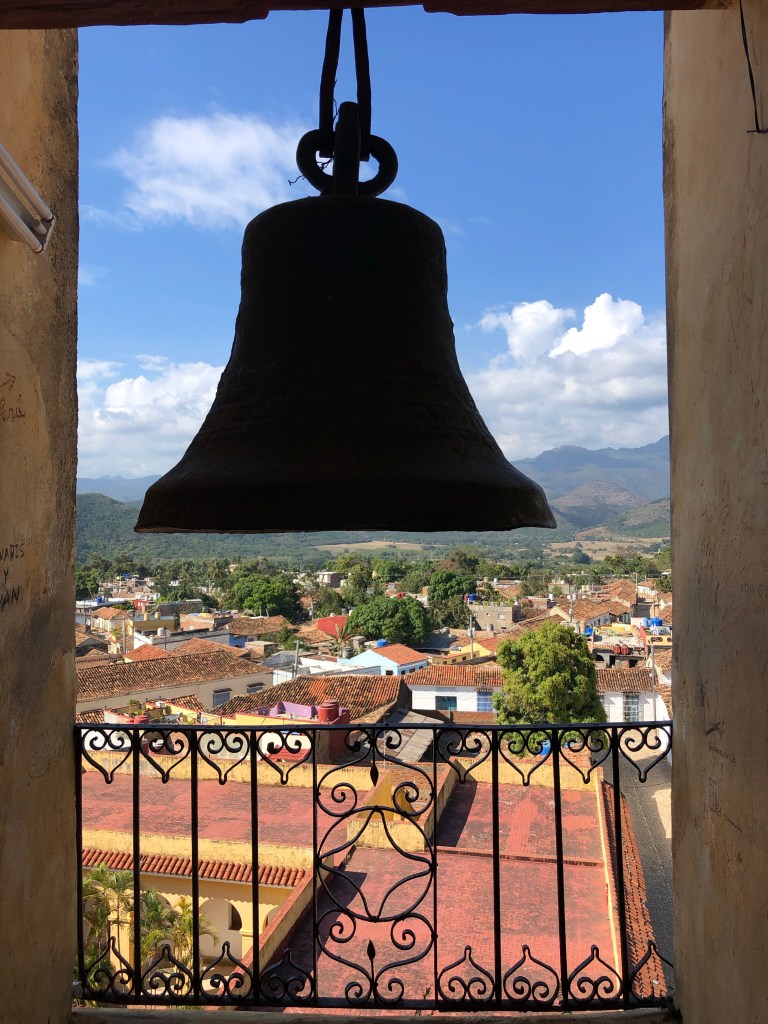
Then I climbed the museum’s tower for views. Wow! The big bells made the views look even cooler than the other tower!!

View from the bell tower of the revolutionary museum

Now it was time to visit Granma. I asked the tower attendant where Granma was and she pointed the courtyard. I descended, thinking she meant there was a further room I had missed. Nope. I asked another attendant. The reply, ‘Havana’. Oh well. I was coming back. I could pencil in a session with Granma who had proven herself an absent Boaty McBoatFace thus far.

Next was the Romance museum where Barbara’s husband worked as a security guard on a 24 hour roster. This sounds a bit like the Trinidad porn museum but this was not Amsterdam – although, trust me these Cubans are no prudes!!! I think it just meant Romantic like Italianate figures on vases – the shepherdesses and dashing men wearing breeches and wigs standing in front of ruins etc. What it really meant was another wealthy sugar family’s home reconstructed with china cabinets, portraits, dining rooms etc. It wasn’t too different from the previous one except that the rooms were smaller, the building covered a second storey and this family really liked their breakables!!! Without an English guide or information panels, I have no idea what was going on. It was a pleasant ten minutes with stunning views over the Trinidad rooftops.

View from window of the romantic museum

But it was time to head back to the hotel to meet the others for a scheduled rum tasting, which ended up being just across the street.  As I sat there eyeing off most of the bottles I had managed to sample myself, I thought that rum tasting was such a refined way of describing a taste of some of the dead cheapest booze I had ever bought in my life. There was old mate Havana Especial – 4 AUD. The gentleman also brought some from the top end – Ritual, Santiago, Havana 7 Anos – but mostly tried to pass around samples from the cheap end of the rum pool – especial, and blanco.(Quick lesson – dark rims are for drinking straight or on the rocks or with Coke. Blanco – white rum – is for mixing with cocktails – it is nasty on its own. All of these were dark except Blanco.) Granted, we got a crack at Santiago which is now owned by Bacardi and it was up to snuff. But there were four bottles from the top end just sitting there. No, no no, my friend. This was a tasting – not show and tell. Put your rummy where my mouth is!

Rum tasting. Why bring out the expensive stuff if you won’t let me sample it???

I asked outright about Havana Club Anos 7. Begrudgingly, he opened it and it was a salsa party in my mouth. Very smooth. I could see why it cost more. He very quickly shut up shop then, almost as if he was afraid I was going to force him to crack open every bottle for a free sample which I probably would have because it was a TASTING!!!! This man betrayed the spirit of spirits. What tasting lets you get away with only three sips??? And with one that they know you won’t like?

Barbara took us for dinner to a restaurant with an awesome sunset view over the city. I ate ropa vieja which translates directly as shredded clothes but is shredded beef – a Cuban specialty. I suspect there were rice and beans too. They love rice and beans!  I ordered water. It never came. That happened frequently.

Barbara told us about a nightclub in a cave. This sounded to me like the coolest thing on the planet. Unfortunately nobody wanted to go with me – did I mention I was the youngest at 41 ???- and Barbara didn’t want me to go alone so another disappointing night followed. Colm, Barbara, Yvonne and I drank the weakest mojitos in existence at the venue by the cathedral steps. We stopped in at salsa corner afterwards because Yvonne wanted to salsa. Colm and I had a better mojito before Yvonne decided she didn’t want to salsa after all and we went home. I later saw my friend Brin’s photos of the cave club and it looks awesome. It’s a cave!!!! Everything is more fun in a cave!! Particularly caving!

I am sure lots of people know what this flower is over the steps but I don’t. The area over the steps gets going after 9 with bands and weak drinks.

Tune in for the next post when the wheels of the revolution hit Santa Clara and everything is all about Che Guevara.

Day 20 – Hogwashed at the Bay of Pigs

View of the Vinales Valley. And my pinhead.

The morning was pretty rough. I lost my room keys and my phone about 20 times before breakfast in the last minute flurry of the final pack, dumping clothes over them and leaving them in the door. Classic move. Possibly (definitely) not helped by a few Havana Rituals (new discovery) the night before.

I threw down Isabelita’s international house of pancakes, fruit, omelette and palmed my ham and cheese sandwich for later. I say sandwich but it more closely resembled a squashed McMuffin. The coffee was a bit average but neither of the other two would take up the slack and god knew I needed it, so I downed basically the whole thermos like it was the vile pink medicine with aliens on it that mum and dad made me drink when I was a kid.  A sacrifice with honour like the Mayans or the Zapotecs. At least I was only losing my tastebuds and not my heart.

Eventually, I emerged last from the room with my stuff packed. Shorty, grab our stuff. I resembled that crazy bag lady puppet in Labyrinth doubled over with rucksacks and backpacks. I looked a sight with one hand clutching my daypack and the other my bottle of Havana Especial. Hector, the bus driver, spoke nada English but I could tell he was impressed with the importance I assigned to his national beverage. We frequently shared a knowing glance and a raised eyebrow about rum, or Ron as it is known in Cuba. The glass bottle went straight into the bus cooler. No way was I risking breakage through my stuff.

The bus trip to the Bay of Pigs was the longest travelling day on the Cuban leg. On the way out, we stopped for a scenic view of the Vinales Valley which was one of Spielberg’s original choices for Jurassic Park. It looks like Hawaii – so lush and green. Next door was an awesome looking hotel. Apparently constructed in the 1990s to look like the 1950s. Mucho dinero. It was amazing!

Barbara played a documentary on the TV about the Bay of Pigs invasion that I am ashamed to admit I mostly slept through. But for those who think it was a pork spit roast on the coast, it was not. It was the Americans’ attempt to invade Cuban with US soldiers and disgruntled Cuban exiles in 1962. JFK just got into office and had no idea about it but it was a done deal before he won the election and he was not happy. A planned air strike to bomb the crap out of Cuba was called off in favour of the boats and soldiers and big guns approach. Basically, the US didn’t want a communist country on their doorstep and a few attempts to know Castro off with poisoned cigars and lovers had failed. They figured if they could take out the Cuban government that the people would rise up and embrace their liberators, dancing the salsa in the Plaza de Vieja or something.

As if. The most disgruntled Cubans against Castro were the ones standing there with guns! The others had been through hell and back with the revolutionary wars, their families dying in the fight to topple the American puppet dictator, Fulgencia Batista who did a runner with something like 50 million worth of Cubano pesos. Castro brought them universal healthcare and education. American control had seen many die of malnutrition and live in abject poverty. Communism was new. There was still hope.

Plus the Americans planned their invasion poorly, picking mangrove swampland that would be difficult to take. JFK didn’t know all of this when he okayed the invasion. It was doomed from the start. The soldiers landed, the Cubans got wind of their location and it was a bloodbath on both sides. Castro wasn’t afraid to get his hands dirty, shooting at light aircraft from an army tank. (He was a big guy – I have an image of him stuck in the turret after a big lunch of rice and beans.) The Americans eventually paid reparations for this tragic fiasco – one of the very few times they have acknowledged themselves to be in the wrong in this way. The Vietnamese got zip.

Monuments where they found bodies dot the road to Playa Larga, one of the battle locations of the Bay of Pigs. I couldn’t take any shots as the bus whizzed past the monuments and I couldn’t find any when the bus eventually parked.

We enjoyed a delicious lunch in the farmers style along the way at a new restaurant. No individual meats this time. Everything came out and we shared the lot. Soup, lobster, fish fillet, pork, beef, rice and beans of course! Delicious! At this point, some people were complaining about the Cuban food – oh it’s just meat, rice and beans. Well, that’s the blockade for you. They were doing the best they had. I found the meat delicious, particularly the cuts of grilled pork which was their staple. Don’t eat the rice and beans if you don’t want it. I was trying to avoid the highly processed white rolls in the morning and the endless supplies of guava, but I didn’t complain about it. It was just a week!

So as we left for the Bay of Pigs, my elongated stomach made me feel like a fat pig, having gorged myself!

At Playa Larga, I was hoping for at least a memorial to the thousands who lost their lives in the conflict. Nope. Not even a plaque. It is essentially a monument to fleshy gringo capitalism – spend some cash to swim in the choppy beach or the sinkhole, sit in a chair, buy souvenirs, hold a crocodile with his mouth taped shut, or swig a drink before the kiosk shut at 4. The entire group went swimming but me. Seriously- it wasn’t that hot and it was only an hour and a half. I preferred to watch this spectacle of tourists snorkelling where literally thousands of men were shot to death defending their homeland and wonder how it had come to this. I felt very strongly that it would be disrespectful to swim (plus I generally just don’t like it). It was undoubtedly the most disappointing stop of the trip.

The Bay of Pigs. Now invaded by beached whales and white gringos
Or you can swim in this sinkhole

We piled back onto the bus to continue the long drive to Trinidad. It must have been another 2 hours or so, upon arrival, Barbara generally preferred for us to drop our bags with only a few minutes (maybe 10 minutes) before a brief fact-packed orientation walk of the main bits of the small town and then dinner. This meant we could start the next day knowing where we were going and I didn’t have to wait three hours for everyone else to get up. This was always fine by me because I found it efficient but others didn’t like this so much and didn’t like the rush. Also, I wanted to go immediately after the late night so I could get back earlier to the hotel to sleep, but no. Everybody else cracked it at the thought of a tour so Barbara arranged to take a couple of us in the morning.

She walked us to a tapas place where the waitresses were all dressed like slaves because Trinidad has a proud slave culture stemming from sugar refineries. (More next post.) The one thing I wanted was out of stock, my water never came, my alternative empanadas were average at best, service was a schmozzle. Trinidad itself looked lovely through my bleary eyes though. I really looked forward to exploring it the next day after some shut eye!

We retired to Casa Mimi with a huge attraction of free wifi when the neighbouring restaurant was open! We took breakfast here the following day and my room was right next to it. You can just see the door on the left.

Trinidad breakfast room with Toby!

Stay tuned for an Adelaide girl hitting the baking hot cobblestones for cultural adventures and a Frappuccino that disgraced all things caffeinated.

Day 19 – Getting Tabac to Nature at Vinales

The day I joined the Havana Club for $4 AUD

Casa Isabelita. Now known to me as the House of Pancakes. After an incident with the shower curtain (that rod was attached with a wing and a prayer truly- so not my fault), I met Yvonne and Kim in the dining room of the main house. Yvonne, from Switzerland, and Kim from the UK were rooming together while I bunked alone. The three of us as the solo femmes were always placed together in guesthouses. Isabelita’s underlings excelled themselves with the usual fare plus a toasted ham and cheese sandwich and a pancake!

Vinales is a small country town. No giant doors here. The houses are all single storey with fences and beautiful front gardens. Only a few main streets, including a cinema but the experiment was less cine-phile than cine-fail. Cubans don’t go to the cinema. (Maybe they can’t sit still long enough. Maybe it’s too expensive. God knows they aren’t downloading movies without home internet connections. There must be some serious booty in pirated DVDs here???) Despite the signs, cinemas in Cuba are officially bars now. Big surprise.

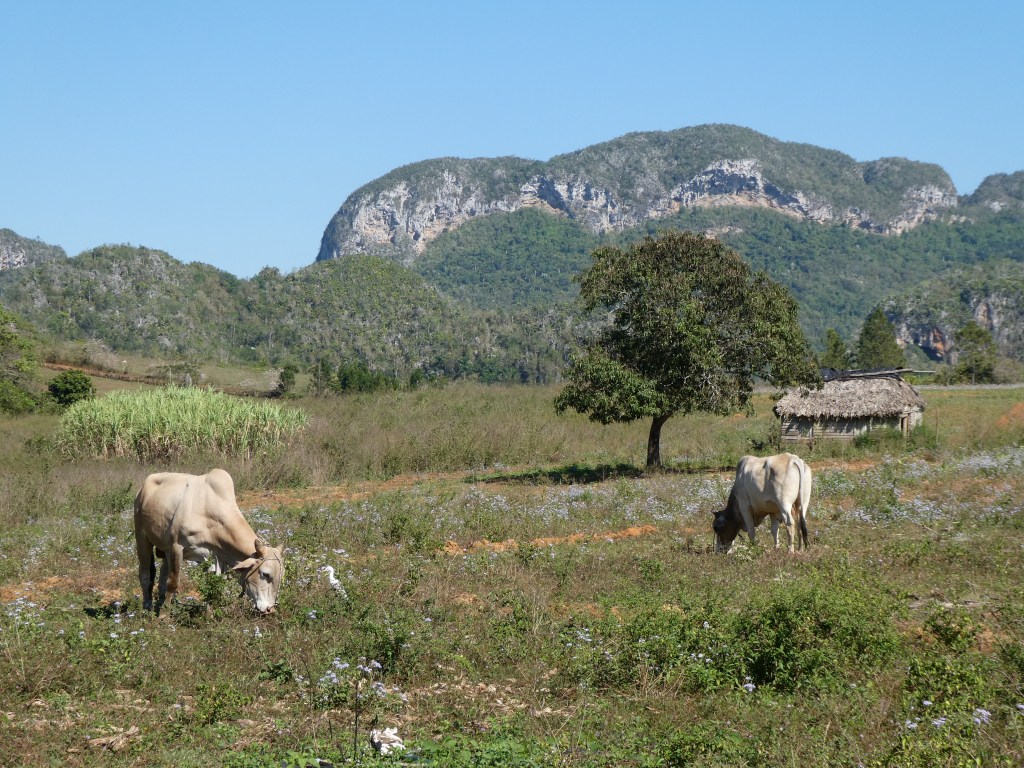
The attractions are mostly associated with the area’s natural beauty. The popular highlight of Vinales is the tobacco farm. Don’t get me wrong – I don’t smoke and didn’t touch a cigar the whole time I was there – but this was one of the best things I did in Cuba. It sounds boring but was so much better than going to see a bunch of tobacco plants or a soulless factory. Vinales has a unique microclimate in Cuba –  cooler than any of the other places we visited – that promotes a thriving horticulture industry of tobacco and coffee. Probably doesn’t hurt the gardens. I also saw a papier-mâché t-Rex peering out from the undergrowth in some garden.

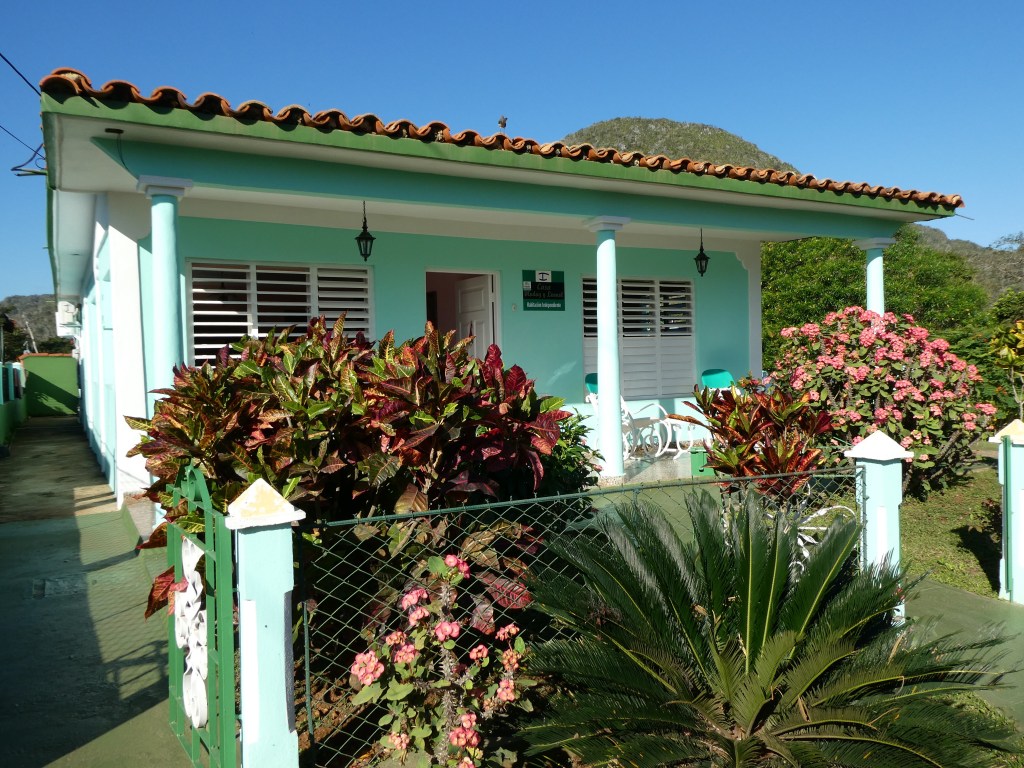
The local guide, Abel, was not afraid to rock a massive touristy sombrero to stand out (the first time I actually saw somebody wear one). He led a relatively large group of mixed tourists from everywhere, but only Yvonne accompanied me from the tour group. We walked the streets towards the fields, stopping at quaint houses with green and red plants, bright flowers and fruit trees. The houses are iridescent; you can probably see them from space. The contrast with Havana is marked. People clearly love these homes and/or rely on them as the guesthouse dinero for a crust (not that they have those without sliced bread) and they are meticulously maintained. Nobody will be crushed under a balcony here. Still a few 50s cars out here too but that’s more a Havana phenomenon. The taxis are just yellow.

Typical Vinales house on the walk

If Havana is like a 1940s urban timewarp with ration books, Vinales is a rural 1910s flashback without the big pre-war collars. A dirt road marks the end of suburbia. A man ploughs a giant field of dirt by hand with two bulls. Not a piece of John Deere equipment in sight. Going to be a while before the Internet of Things gets agricultural sensors and geospatial data out here. Abel tells us pesticides are banned. The farm is also a bit of a cowboy and horse riding hangout and some beautiful horses trot by.

The scenery is breathtaking. So green and lush. Abel takes us to the tobacco field with green plants that come from the same family as the potato. He turns to the right and tells us to look at something special. Suddenly, a shot of ice water stronger than mezcal flushes my veins. A turkey! I scream and bolt behind a brick structure. They terrify me! I have a pretty solid phobia of the winged demons with the horrible wattle. Even pictures in books scare the crap out of me. They are my nemesis.

With a vigilant eye on my ancient enemy, we move on …

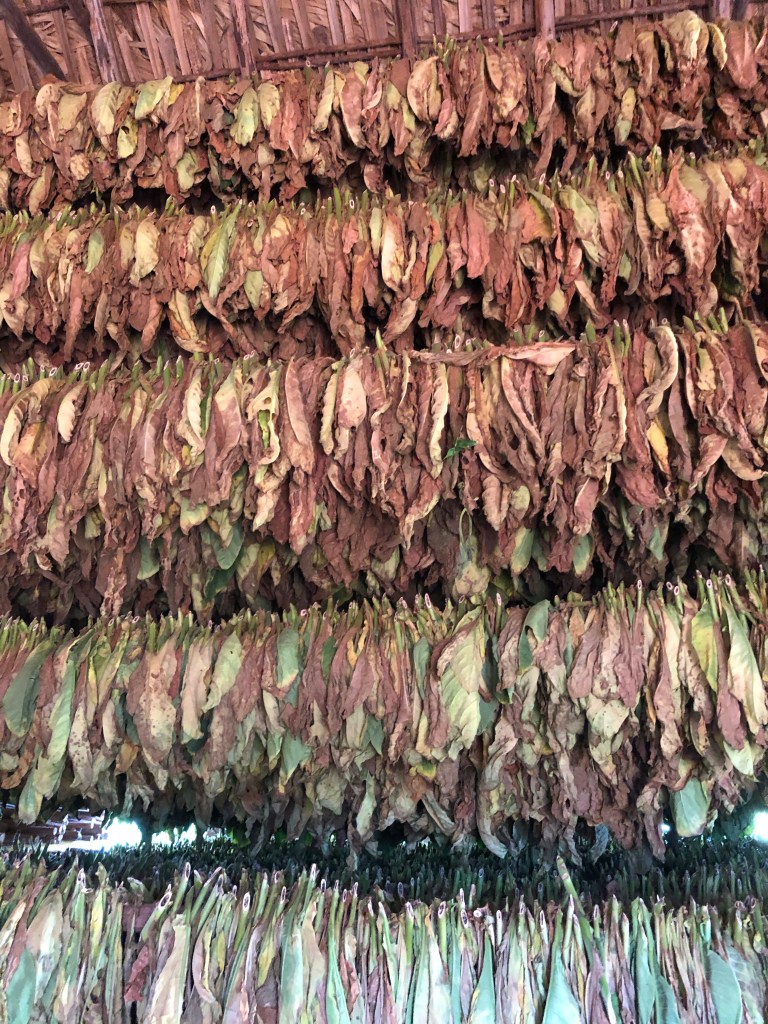
We enter a huge wooden shed filled with dry tobacco leaves. The huge racks and walls of leaves look amazing in the shed. Rustic,  powerful image. Abel tells us Vinales supplies all the major cigar companies. Chickens lurk. I keep a wary eye. Not keen on those either.

The tobacco leaves

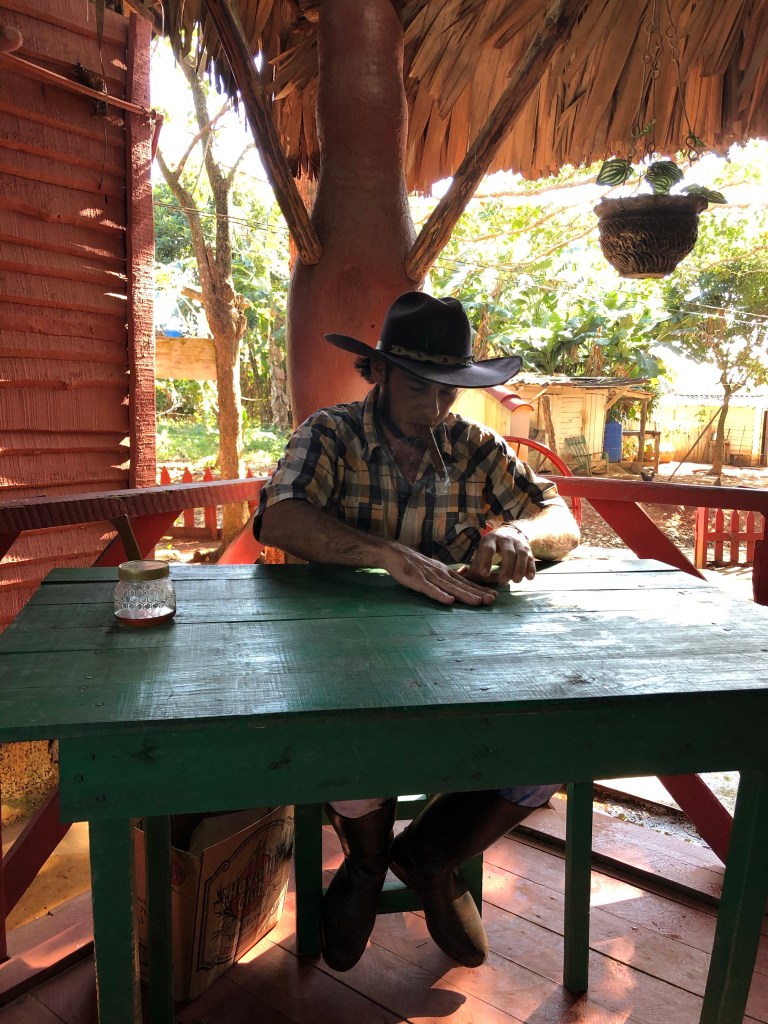
Next, we take a seat and watch this surly cowboy roll cigars. Charles Bronson eat your heart out. He even stuck a knife in the table. I got the feeling he did this for the tourists under great sufferance. Watch me take my time, capitalist pigs.

You will watch me, gringos

Our stroll through the farm took us past the houses of workers living on the property. Do bright and colourful with immaculate gardens and plants. Abel stopped to point out little plants and fruits along the way. We stopped at Antonio’s, an 83 year coffee grower and roaster whose 5 children helped  him run the business from the back of his house. A short black was in order. Strong, hot and delicious. Antonio sold beans to go but with five countries to go and a Nespresso machine at home, there was little point.

Typical worker house on the farm

Vamos! (That means move on).

The walk was quite relaxing as we strolled through fields and gazed over scenic vistas. More bright horses, horses, fields. After the concrete jungle of Havana, it was tranquil and chill. Instead of being killed by a falling balcony, the worst that could happen was stepping in horse poo.

The cows had little mates! A heron accompanied each one looking for stick insects. Maybe attracted to the cow dung??? A woman in our group thought it was a seagull. Jesus.

Cows with mates

Abel then led us for some alcoholic refreshments. It was about 11am. Surely it was time to put rum in something. This time, it was a coconut. Same deal. Drink it down but the staff filled it up for you. No self-serve, less bueno. By the way, white rum goes in cocktails. Dark rum is always straight. Just sayin’.

On the walk back to town, the cigar rolling cowboy told my friend she was beautiful in Spanish and they chatted the rest of the way back to town. Turns out the cowboy rides a push bike instead of a horse. Frankly, that was disappointing.

After Yvonne and I threw down a quick lunch, we grabbed a can to the Indian caves. Nada context here. I think Indian remains were found somewhere. That’s about all I can say. No guide here. Nothing show where or what or anything about said remains. I have been in many caves in my life – this was pretty average. Limestone I think? Caves are pretty cool on the whole – very Geiger-esque. This one was a 5 minute walk to a dock where it suddenly took a Disneyland Pirates of the Caribbean twist with a queue for a boat ride. Boat guy used a laser pointer to highlight a skull, face profile, an eagle and a few others. We emerged outside from a very lush jungle opening and into a bunch of tourist stalls. Ah, Cuba. Always trying to make a quick CUC.

Indian caves

We eventually located our cab and headed back to town. 10 minutes. Nothing is far from Vinales. Yvonne and I split up. I think she just wanted to rest. I checked out the handicrafts market, grabbed a coffee and then looked in the closest thing Vinales has to a convenience store. First thing you notice is that all bags must be deposited in lockers and there’s a guard standing there monitoring everything. Ok. I dumped my bag to check out the shelves. Pringles, washing liquid, water, some tourist tat, I think some toothpaste and sun cream, and two whole rows of rum. But the price!!! A bottle of Havana Especial cost the same as a litre of water. 2.95 CUC or 4.38 AUD. Ridiculously cheap. I couldn’t resist. Truly, if I was after the authentic Cubano experience, I couldn’t leave that mercado without a bottle. So I queued up, desperately hoping I could bust a Camillo here. (Explanation- Camillo Cienfuego, the revolutionary, is on their 20 CUC note. That’s a big bill. Nobody wants to take it. The mercado checkout chick didn’t bat an eyelid -suspect there was a lot of rum bought there.) On the way out, all shoppers must present their receipt and items to the security guard for inspection! It’s going to be a while before Cubans hear the phrase ‘unexpected item in baggage area’.

I headed home to quickly get changed into the red number in the photo I’ll the top. Yvonne, Kim and I were going for a salsa lesson. Cubans have been salsa-ing since birth. They literally just grab each other off the street and start doing it. We all just mosh, jump up and down or sway to music in clubs – not here. These people move their feet and hips forward, backwards and sideways and partner each other. There’s so much music on the street or coming out of clubs or bars or coffee shops. If you’re not in the band, you’re dancing to it.

Well, I tried. I guess it’s just not my thing. I am a bit of a perfectionist. The instructor kept telling me to relax but how could I when I couldn’t remember the steps and kept getting one in particular wrong? The most important thing is to keep moving. I decided I just preferred to stand in a corner with rum and nod my head a lot, hoping for the Macarena or the Madison.

Once the sun went down, a chill permeated the air. I performed another dash for a costume change before meeting the others for tapas. The national beer – Bucanero – came out with a free snack. Salud to that! I went for grilled pork. Then I had another beer michelada style which means with Worcestershire sauce, lime and salt. I added tobasco for an extra kick. Afterwards, Kim, Yvonne and I went to a nearby bar for the lamest daiquiri in history – so weak that I abandoned it – was a slushie for grown-ups. The nice bar staff gave us access to their wifi which was incredibly nice – never happened anywhere else throughout the trip.

Cuban Internet is terrible. You can either rely on the generosity of others like the nice bar staff giving you their password, or you can buy a wifi access card from a telecom outlet. The card gives you a password valid for one hour but you have to find a hotspot where it will work. Big hotels or some public squares mostly. That’s the hard part. Even if you find it, the signal might be very poor. I didn’t bother, devising that digital detox for a week was a good thing.

The three of us met Barbara and went to a local club which was a pretty casual affair. Not like there was music pumping for people to dance to. More like a band with a singer and some dancers performing the salsa I sucked at. But people did get up and have a go when the floor was clear. Not me though.

Stay tuned for the HockTales Bay of Pigs invasion!

Day 18 – The Havanas and the Havana Nots

Not salsa dancing with the Gentleman of Paris – note glazed over look indicating impending disaster

Urban roosters rudely awoke me from my slumber at about 4am, a trend that continued every day for the entire trip through Cuba. I am not an avian admirer. I love to eat them but suffer a terrible phobia of those knobbly clawed feathered beasts of death. To mangle the words of the Soup Nazi, no sleep for you. I had slept badly all night actually. Woke up every couple of hours. This was a harbinger of doom.

The guesthouse terrace was (and presumably is) still super cute.  An oasis of plants, animal statues and a red retro breakfast bar. The view is amazing!

View from guesthouse terrace towards waterfront
View from our terrace in other direction

The Cuban experience of guesthouse breakfast is remarkably consistent, as I would shortly discover. Let’s play Cuban breakfast bingo. Thermos of dubious coffee, bread rolls, guava jam, guava juice, small fruit plate of guava, papaya and pineapple with rotating bonus of watermelon or star fruit, choice of scrambled eggs or omelette. Check, check, check. Winner! Sometimes more but never less and never different. Vista del Mar also served ham but my Spam filter was going off. Thus began a daily pattern more reliable than the weather – drink as much dubious coffee from the thermos to power up for the day and avoid the sugary jam. FYI – I never saw a piece of sliced bread all week. It doesn’t exist. Sandwiches are all rolls,  baguettes or even burgers. It just means meat and cheese shoved inside a bread product. Breakfast was always 5 CUC plus 1 for a tip. (The CUC is roughly on par with the US dollar)

Today we were blessed with no rain. The weather was lovely! A bit fresh in the morning but I trusted nobody and nothing after that sheet of sleet so the raincoat cane with me.

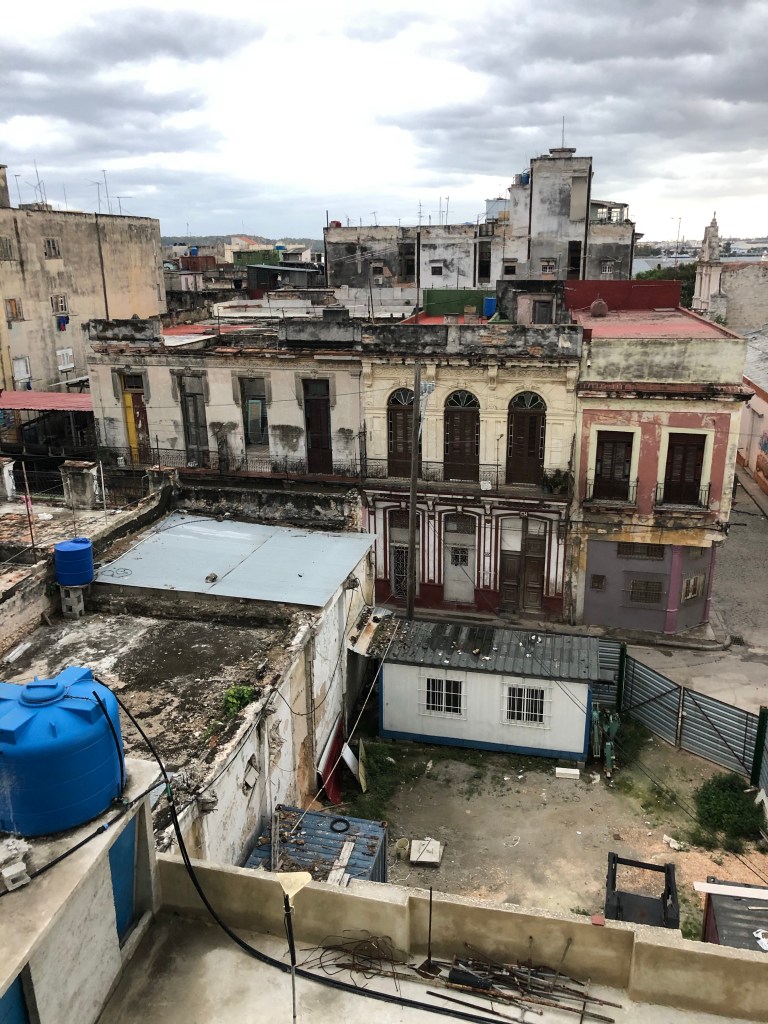
Barbara – who preferred the name Adita as a nickname but my group seemed to lack the linguistic ability to call her this so opted for the easier Anglo name – led us through the streets of Havana. My mental picture of Havana was a streetscape of bright, patchy colours and dilapidated buildings. This was true for a big chunk of it. Our hotel was smack in the middle of that. Immediately opposite the hotel was a derelict looking building. Barbara advised that at least 5 families lived there and in places like this all around the city. Terrible conditions but they were off the street.

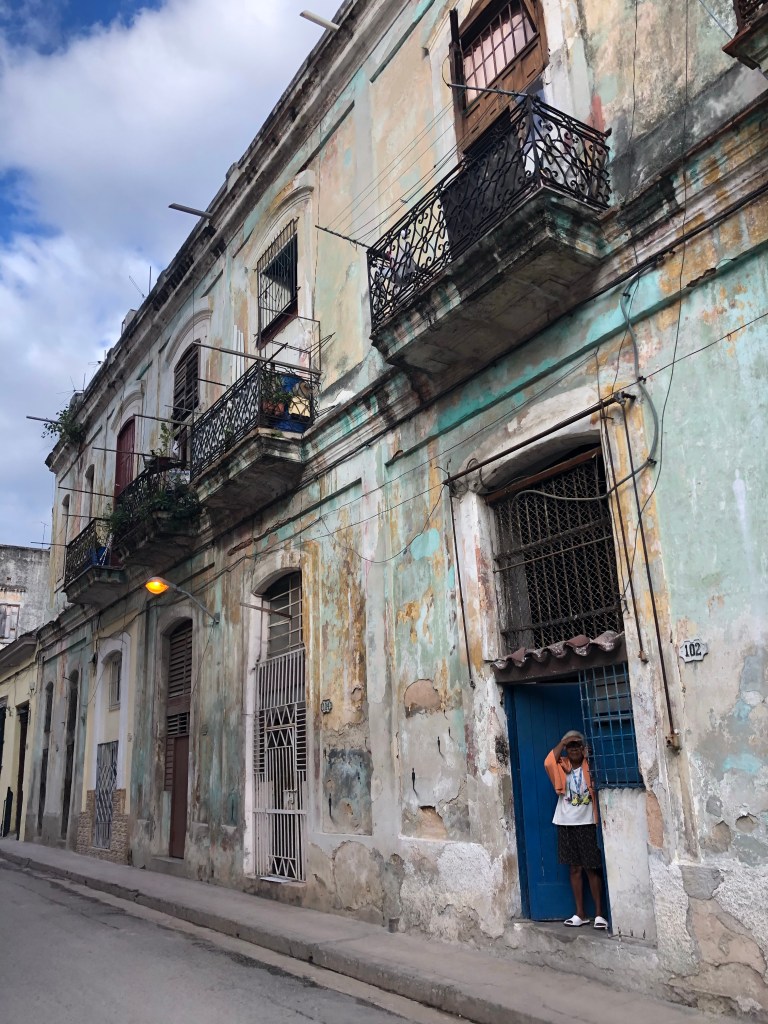
Segue into terrible conditions. Despite the cars, locals walked in the middle of the road to avoid the crumbling balconies. Three little girls were killed the previous week by a balcony collapsing on them. There is no city maintenance on most of these 19th century domestic dwellings and many would be condemned with a date for a bulldozing. With proper restoration, these once-beautiful homes would scrub up like a new penny. At least from the outside – I suspect plumbing is non existent in many. Walking around, you get a sense of derelict grandeur. A bit like an abandoned theme park falling to pieces. My enduring memory will be the huge doors. At least 20 feet high. Every building has them – it seems such a juxtaposition that people live in squalor in the shadow of opulence.

Traditional Havana street
Another one

Every picture book of Havana shows the gorgeous Instagram colour pops of these historic streets. But I didn’t know that Havana was such a rich source of contemporary street art. Amongst the tourist tat is a subculture of record stores and hipster cafes breaking free of the stereotypical Havana timewarp experience. This is a taste of modern Havana trying to move forward despite the blockade and its communist heritage. I even found a vegan café selling wheatgrass shots and organic beetroot cake. See – around every corner a contrast.

Just around the corner. When I saw this record shop, I knew I was nearly home.
This one stuck out a mile

We strolled the Plaza Vieja, a square established for merchants when the priests from the nearby cathedral couldn’t handle the noise! Batista, America’s puppet dictator from the early 50s (well the second time around), built a car park underneath it at one point that destabilised it. Barbara started pointing out cafes and restaurants. This one’s state-owned, this one’s private. You’d never know. Supporting local is big here. People prefer to give their dinero to people who have managed to set up their own businesses now that it is permitted to do so, as it was banned for many years. But yes – many guest houses, restaurants, bars, shops etc are owned by the government.

Barbara took us to St Francis’ church which was beautiful on the outside and unknown on the inside since it was always roped off. The statue I am posed with in this post stands out the front. He is called the Gentleman from Paris. Apparently, he was a migrant from (Italy maybe – it wasn’t France) with a family. But he had an affair with a married woman whose husband reported him on a trumped up robbery charge. He went completely mad in the slammer. When he got out, he lived on the streets but generously donated whatever he found to other people. Upon his death, the city honoured this local hero with a statue. Touching him on the hand, beard and foot brings good luck. Popular theory about his name is that his high level of education was associated with France. No, he didn’t have a baguette in his pocket and he wasn’t happy to see me.

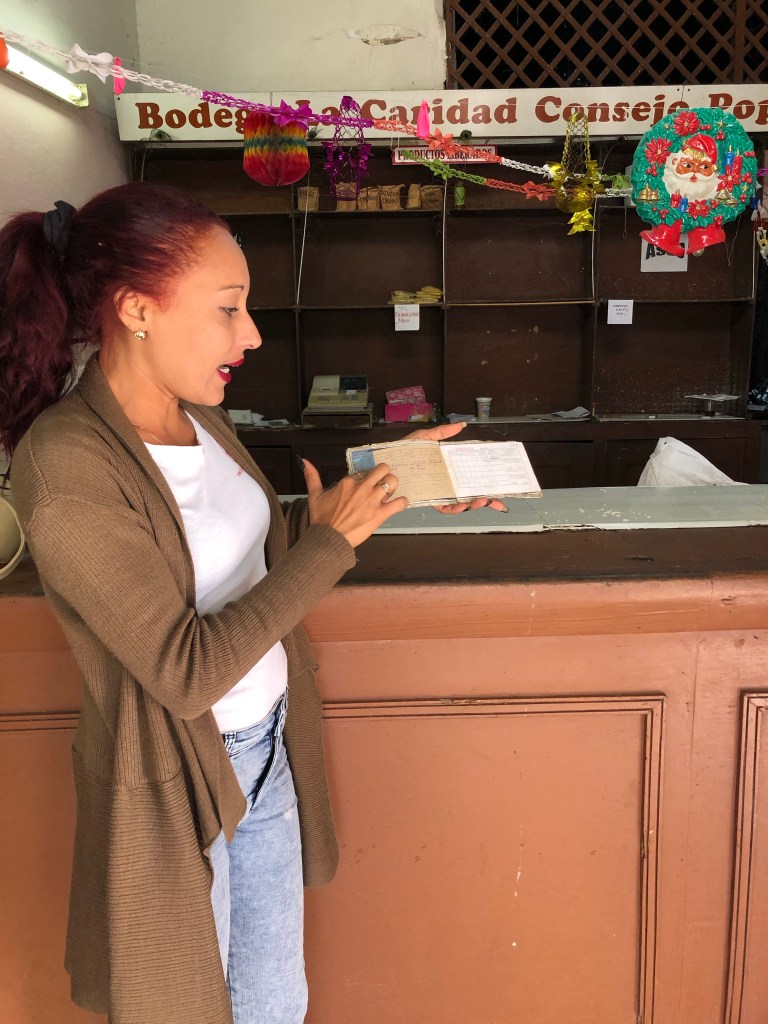
The bodega was a real opener. To me, a bodega is the convenience store that gets robbed in a Law and Order episode. Throughout Cuba, bodegas are small stores where families can collect essential groceries at state-controlled, low-cost prices by using a ration book that looks straight out of the 1940s. Goods include rice, eggs, coffee, sugar and cigars etc. (Meat is available from a butcher in the same way.) It differs per month based on availability. 10 eggs per month per family. Huev-nos! A few three egg omelettes and I’d be gone. I felt my biceps withering away in sympathetic protein withdrawal. One month, there might be a shortage of something. Of course, you are free to make your own arrangements with swaps and deals and to source your food elsewhere. I suspect it leads to all the urban chickens.

Barbara shows the ration book at the bodega

This wouldn’t be so bad if you could just pop into an On the Run for a snack. No bueno. No convenience stores or supermarkets in Havana. No supermarkets anywhere actually. You might find a guy with a cart selling chips and packets of biscuits. That’s it.

Next stop, Plaza de Armas with the oldest military fort in Central America. The Spanish built it in a crap spot – copped too much fire from ship cannonballs – so they abandoned it to built another one further down the mouth of the bay. Interesting point later picked up by me as I walked past another tour later – the statue on the Havana Club logo is copied from the statue of Love on the top of the fort.

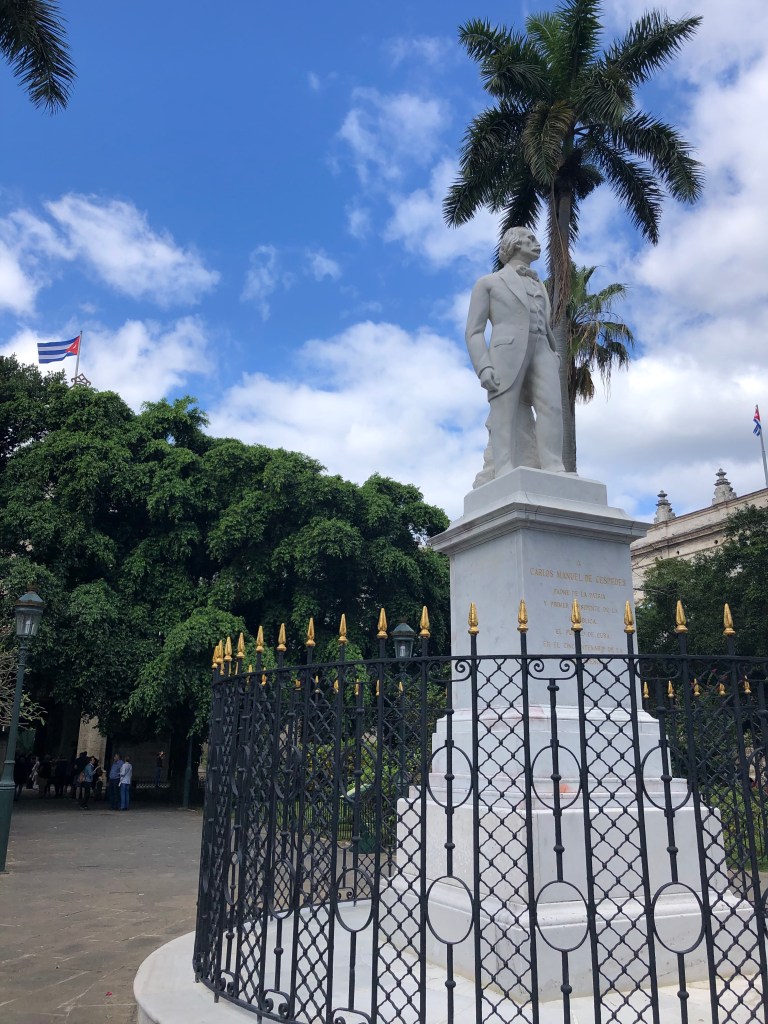
A large white statue poses in the Plaza. This is Cespedes, designer of the original Cuban flag in the 19th century. Cuban history is full of stories of bookish guys who should have stuck to fighting for freedom via politicking but bravely picked up a weapon and died in battle. Jose Marti, who fought for independence against Spain in the late 19th century, is their true national hero. I was expecting to see big Castro monuments or statues demonstrating evidence of an enduring cult of personality. Didn’t see one. Marti was Castro’s hero. He’s everybody’s hero because he’s their original liberator from colonial oppression. Every town has a Marti Street, a statue or a bust of Marti, a Marti Square etc.

Plaza de Armas with Cespedes

I could have kept going but the group demanded coffee and a sit down. This was good coffee. As opposed to dubious ‘functional’ thermos coffee, all the purchased coffee from cafes was great! Others complained about the intensity but I like it strong and black.

Next stop, Cathedral Square. No prizes for guessing what that’s named after. 2 minutes inside was the command.

It was a whistle stop tour of Havana because we had to leave the guesthouse by 12.15 to make a 2pm bus to Vinales, our next destination. I was not feeling great. The telltale signs of impending migraine were there . My eyelids flickered, I felt a weight behind them, my mouth tasted funny.  We returned back to the hotel to grab our gear and head to the bus station where we waited an hour after checking in. It was an interminably long wait for me. My migraines don’t hurt like headaches but they make me dizzy, vague and weird. I can’t talk to much and I basically want shut my eyes in silence.

The three hour bus trip was perfect for that. I slipped in and out of consciousness with my noise cancelling headphones on. I had no clue of where I was. I felt like complete trash. When we stopped to refuel, everybody got off the bus and I had no idea which way was up. It was like floating in a half-asleep zombie state of no awareness.

The dozing did help. By the time I reached Vinales, I was feeling a bit better. We checked into our guesthouse – Casa Isabelita – where my room was more basic but fine. Barbara was not one for letting the group check in and chill. She was more of a girl after my own heart – dump the bags and let’s hit the town. There wasn’t much to see -a square, a main drag with some restaurants and a mercado store. What? I hear you say. Read the next post when I tell you what was inside.

Time for dinner. Barbara took us to a charcoal meat specialist with another specialty – the best pina colada in the world. I don’t really like them myself. But when in Vinales … For god’s sake, it’s served in the pineapple. The staff deliver it virgin (eg no alcohol), let you drink it down a bit and then GIVE THE TABLE A BOTTLE OF WHITE RUM TO POUR YOUR OWN. Rum really was cheap if they could afford to pass it around like that. After you drained the drink, you could hack into the pineapple with a knife and spoon. Dessert and drink in one!!

For dinner, I ordered grilled tuna which arrived with an expectedly limp salad. But the meal was served farmers style which means each person picks their individual meat and share large plates of rice, rice and beans, soup and vegetables. Mine was delicious. The others ordered more pina coladas but frankly, it was a little sweet for my liking. I needed to continue my education in rum. (Jo ho ho and a bottle of rum?)  I ordered a shot of Havana Club Especial based on Barbara’s recommendation. Delicious!

Serious pina colada

There was talk of night club attendance but I needed to sleep off the remaining migraine effects of weirdness. So straight home to Casa Isabelita.

In the next exciting instalment of HockTales, I watch a cowboy roll cigars at a scenic  tobacco farm full of animals and cute houses, take a boat through a cave, try my hand (feet at a salsa lesson) and hit the Vinales night life.

Day 17 – The Revolutionary Road to Havana

View from outside the guesthouse

Have you ever heard of Interjet? No? Aussies – this is our Jetstar. Instructions state to be there three hours before an international flight, presumably so you can enjoy the pre-flight entertainment of sitting on your rucksack for an hour in the queue with no sign of Interjet staff or even logos on screens. The only indication I was in the right place was the $25 US fee I had paid for a tourist card as an Australian citizen. It was pretty much my visa.

With an entire plane not yet checked in and now an hour and a half before scheduled departure time, there wasn’t a snowballs chance in hell it would leave on time. But nobody was going to admit that. A sentence on the boarding pass even stated that Interjet did not make announcements about departure times over the speakers- it was your responsibility to get there on time. Helpful when you don’t know the gate or the revised time. The gate had in fact changed too. Luckily I just happened to see it on a screen walking past the specific gate – not the departures board which took half an hour to update. Had no idea when the plane was going to actually leave – spent some of my last pesos on a Starchucks espresso shot because I had no idea whether I had to swig or sip!

When on board, a delightful snack of cheese Ruffles awaits you about halfway. If you request a Pepsi, you get a 600ml bottle. If you request juice, you get a 600ml bottle. If you request water, you get a tiny cup with as much liquid that you spit out at the dentist. WTF?!?! Dehydrate and die, passengers!!!

From the start, Havana airport was a scrum. No clear signage and only two x ray machines going for an entire plane. I got told I didn’t need a customs form because I was a tourist and then of course I did after I queued 20 minutes, then they sent me right to the back again.

With the delayed flight and all this stuffing around, I was not surprised there was no sign of my prepaid guesthouse transfer. Three laps of the arrivals lounge and no name. Crap. Cuba is a no phone, no internet black hole. I had no idea of the name or location of the guesthouse. There was literally nothing I could do. Then I heard a mighty sleet of rain pelting the pavement. I turned to look outside. The palm trees tilted like botanical leaning towers of Pisa. It was pouring down in almost horizontal sheets. Ma, the rains are in!!! And this was dry season!!!

Eventually I recognised another lady from the plane waiting for transport and went over to her. Turned out my name was on a list according to a driver who wasn’t mine but he was now mine. Along with a random Indian couple, we hopped in his cab. The young dude who resembled Pitbull identified himself as Junior and proceeded to deliver a brief lesson in money, telling me that the nearby artisan market and weather. He explained that this rain was part of the cold front that happened occasionally in dry season. This was my first brief taste of what a pain in the arse it would be to not have instant access to weather forecasts. Junior drove past Revolutionary Plaza where a big famous artwork of Che Guevara decorates the outside of a building. Wow! I was sure I would be back!

Junior drove along the waterfront. An enormous cruise liner dwarfed the terminal. I later learnt that it was European because Trump has barred all American liners from docking in Cuba. Apparently Obama was very popular for trying to mend relations. Cheetolino is less so.

Havana is famous for its 50s cars and they are everywhere. Tomato red, hot pink, Ribena purple and orange orange Chevrolets, Dodges and Buicks all cruise the street like predatory autos in search of their latest pickup. I didn’t know about the horse and carts, tuk tuks or coco taxis though. The coco taxis look like bubbles, kinda yellow and round like they are cut out of a coconut. Sit three people in the back. All these are taxis for hire which I found surprising. Not private hot rods like I thought. But I guess that’s why they are all immaculate. Get closer and you see they are all stickered with taxi logos. The engines are not original in many cases but they do have to run 70 years later so who can blame the cabbies or the owners for keeping them roadworthy??? The horse and carts are not as pretty as the Merida carts – more like rattle traps. But they would have been fun.

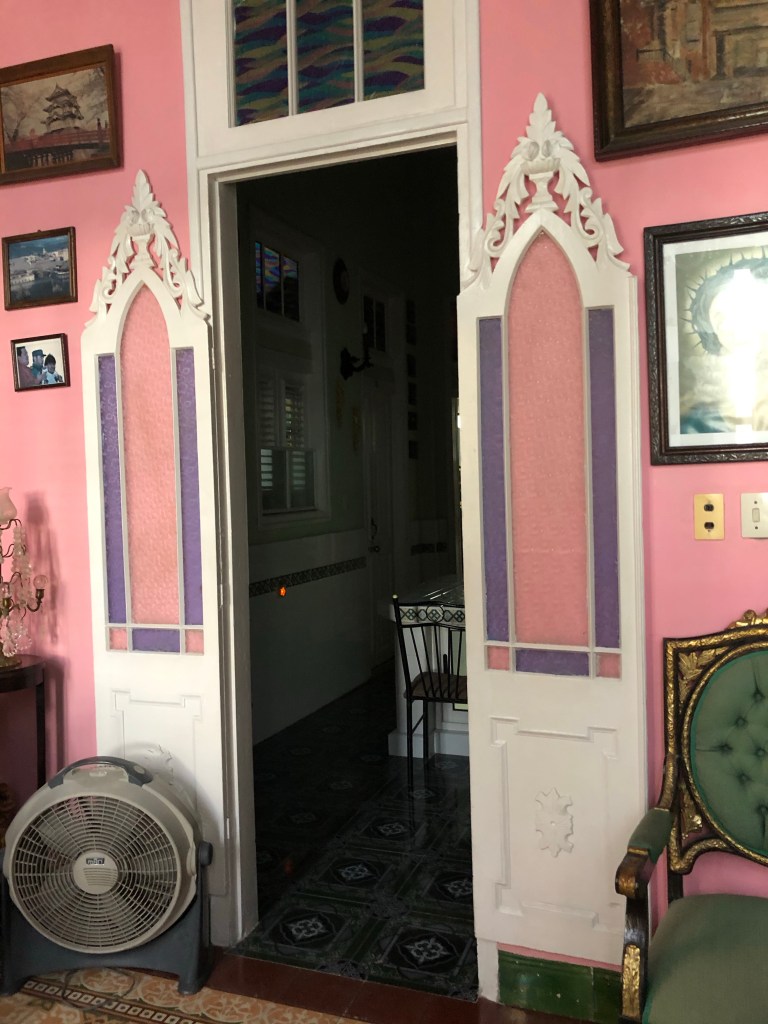
Junior dropped me off at La Vista Mar on Paula Street, around the corner from the very boringly named Cuba Street. The heavy rain had stopped but it was bleak and drizzling. A Cuban guesthouse is a bit like a bed and breakfast where the owner lives and/or staff make you breakfast. This one was a three storey townhouse with a rooftop terrace for breakfast. The living room was a merging of Jesus pictures with Victorian style furniture, pink walls, glassware, and a small framed photo of Fidel Castro.

Living room of guest house
Living room also with photo of Fidel on left. He’s everywhere. I was excited.

The young chap who clearly worked there showed me to my room. It was palatial!!! Nobody was sharing the wealth here in room 7. I was a fat capitalist pig hogging it all for myself. And a minibar!! I hadn’t seen a fridge since I left Australia. Loaded with water, beer and soft drink. This was my first observation of the national beverages. In Cuba, there is only the Ciego Montero brand of water. No Evian, no Mount Franklin, no black and gold. This is what you are getting if you order an agua. Ciego Montego. Your only choice is what size – big or small – and whether it’s sparkling or still. That con or sin gas to you. (Remember con, sin and tan angles from school – not sure about tan – but con and sin are useful here – maybe Trump took all the tan.) Soft drinks are Ciego Montero lemonade, cola and orange. Only once did I see Coke or Fanta in a week. Same with the national beer – Cristal is the lager and Bucanero the slightly darker version.

So the nice young chap took my passport details and informed me that if I wanted to exchange money, I had about five minutes to haul butt down to the artisan market before the exchange shut. Raincoat on, lock room and go!

Extensive research and interviews with subjects yielded a clear result – US dollars were not accepted. In fact, they only exchange pounds, Canadian and Euros. I had carried 300 euros on me from Australia for exactly this moment and it was their time to shine (aka get the hell out of my wallet). I hotfooted it over to a bright yellow building in the drizzling rain past the Cubans who like to hang out on the street. The market was full of routers. “Bag, lady? You like T-shirt?” No, gracias. Found the exchange and a nice lady exchanged my cash into big inconvenient notes – mostly 50s and 20s that I would find a pain in the arse to break. At that point in time I had no way of knowing how much stuff cost or whether a 20 was a lot.

I quickly collected myself at this moment of vulnerability. Foreign country, passport in one hand (needed for currency exchange) , wallet in the other, keys to the room in pocket, in the middle of a market of touts. I was a tasty severed arm dropped into a shark tank!

I briefly checked out the market. I had a group meeting at 6 in that pink dining room and didn’t want to be late. My enduring memory of that market that I will carry to heaven in my head handbag (see previous post) is a sea of cream coloured canvas bags with Havana club rum logos on them. Stall after stall after stall. It was my very first experience of how deeply rum was soaked into the very fabric of the culture. Markets reflect popular culture to make mucho dineros. So it was the highly distilled upchuck of the very essence of Cuba if you will. I wish I had a photo to show but too vulnerable with all my stuff!!! I have other market photos to show in later posts. I did buy a bag to bust my first note though. Figured it would roll up. Couldn’t go eying with a canvas bag with a cool car and palm trees on it! Weirdly, in all my travels, I never saw another bag exactly the same. Same design, but mine also had some tassels on the top that I never saw in the hundreds of other tourist tat shops. I wasn’t too keen on them at first but now that I have circumnavigated the island (well half of it) I think they represent more of Cuba than just the cars and Havana rum – the tassels remind me of the twirling of salsa dancing and the Caribbean-ness of a culture created on the backs of slaves from the sugar refineries. A good buy for 8 CUC (pronounced Cook by the way).

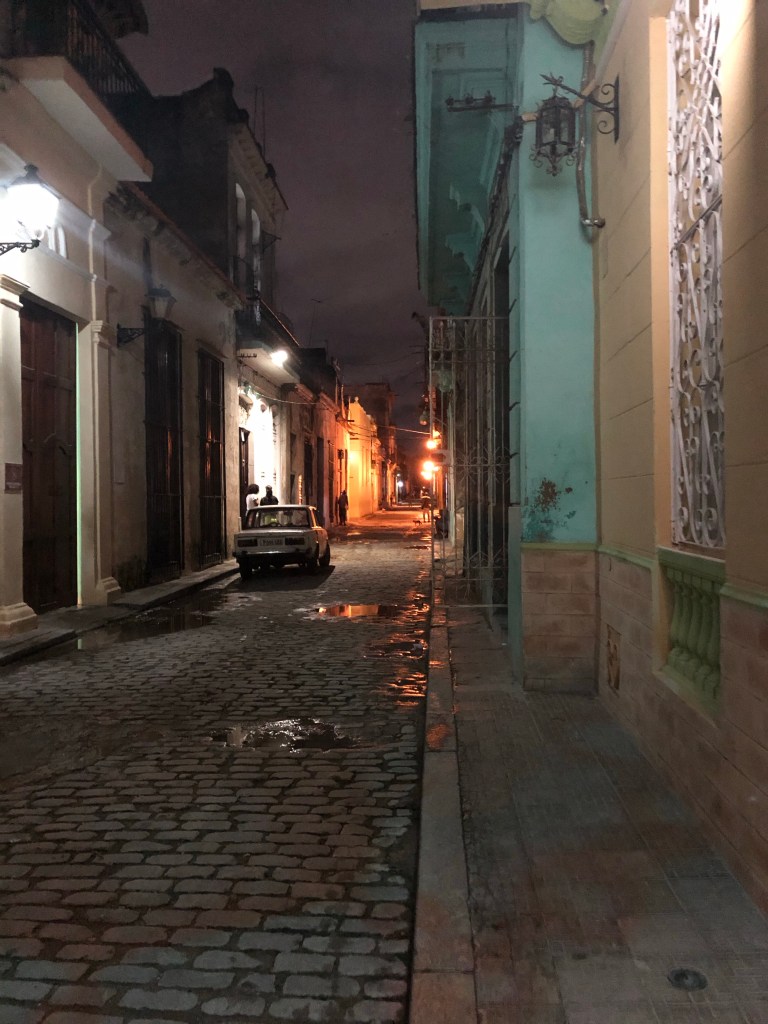
Back to the hotel to meet the group. Tour leader, Barbara, was from Trinidad, where we would later visit. Supremely organised, informative and a walking encyclopaedia. I loved her. Long nails, glittery shoes. I was the baby of the group. The others were from Ireland, UK, Switzerland and one Aussie. Barbara took us for the welcome dinner to a restaurant around the corner, although three had other plans. The streets of Havana look very similar at night and are not well lit. I was pretty glad she was taking us!

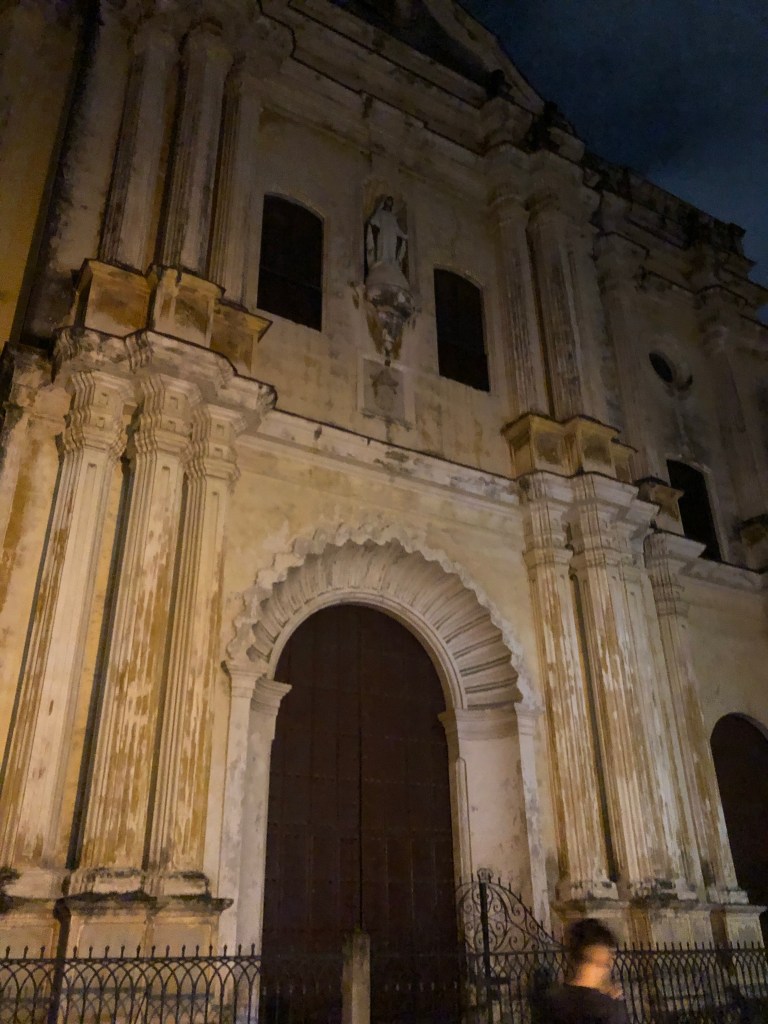
Nearby church on the way to dinner

I ate this!

Fish wrapped alfoil was soooo good. Plaintain fritters on left. I also had a tuna salad entree.

I also had a mojito. Then I began to realise something as the Boomers around me dipped on their mojitos that tasted a bit weak to me. I take my coffee strong and black, and my mezcal straight and hard. I couldn’t drink this lolly water. It was Bickfords cordial for grown ups that went straight to the thighs with no buzz.

I had seen the canvas bags. I knew what I had to do. The young waiter was particularly obliging that night, paying me a little bit of extra attention over the other ageing Boomer half of the table perhaps. I shot him the HockTales eye, which sparkles like an elusive gem in Uncle Scrooge’s treasure quests if I want something, and he gave me his off-the-menu personal rum recommendation for the same price as Havana Club. I sipped it slowly like a refined old billionaire McDuck. It was smooth and delicious. Ron de Santiago which I later learned is owned by Bacardi.

And thus began my education in rum or ron as it is known in Cuba. I now have the first prerequisite skill to become a pirate.

Vigilant friends, return for the next post as I hit the mean streets of Havana during the day and it doesn’t rain! (I promise better pictures too – sorry – travel day pictures are a bit el crappo.)

Day 16 – Playing Chichen Itza and Playa del Carmen

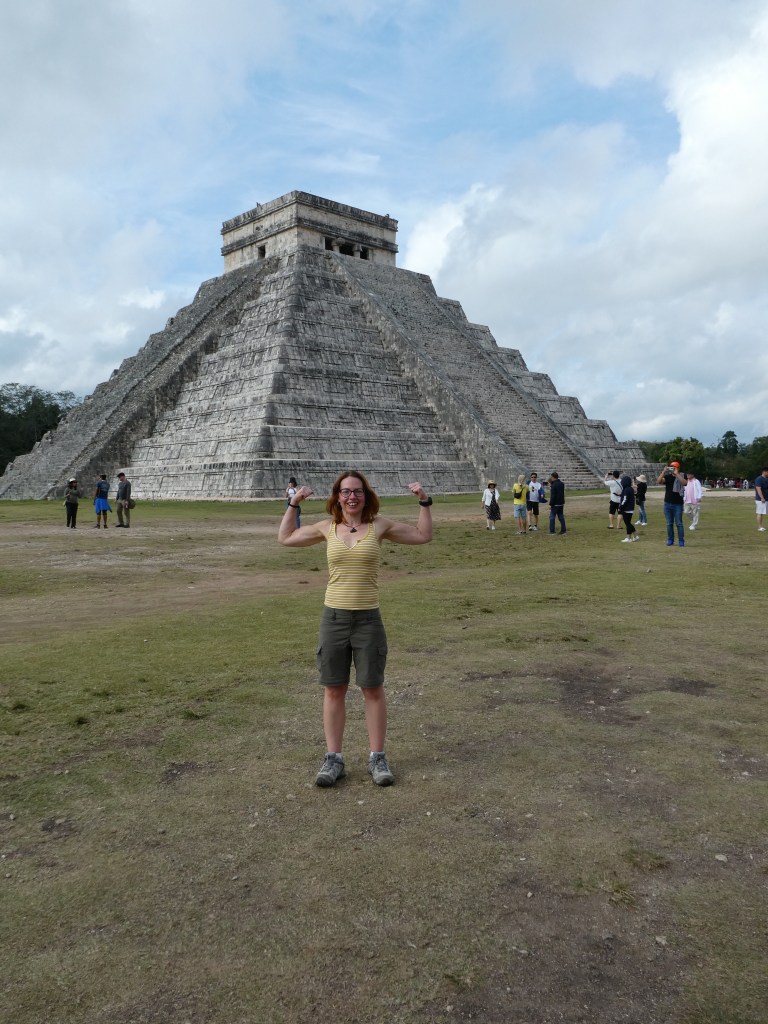
I could do Chichen for breakfast, lunch and dinner

It was an early departure of 6am to beat the crowds at Chichen Itza. No breakfast. Unacceptable. Random HockTales readers may think I am obsessed with eating or should just harden up, but I just can’t. Not eating or eating junk first thing will only result in headaches, nausea, dizziness and generally feeling like dumpster juice for the rest of the day.

So a briny breakfast with plastic forks before hitting the backseat of the minivan with Dave and the two girls from the Gold Coast, Tiani and Raeanne. A classy hand pump coffee from the Oxxo was the first stop. Times stuck on the urns informed when the brew was last made. 9.30pm??? Fresh. I went for Intenso over Mexicans, figuring truck stop coffee wasn’t going to set the taste buds on fire but could maybe fire me up. Tried to write blog posts in the van but stopped when my attempt to balance coffee between my legs failed in a potential Kramer burns incident. Lucky.

Chichen Itza is the big Mayan site that gets all the credit, all the crowds and probably all the funding. It’s the one people think about when they picture Mayan pyramids. Two snake heads at the bottom of a big pyramid, right? The shadows of two serpents snake down the steps at the equinox one day a year. That’s the big Pyramid of Kukulkan. (Aka Quetzalcoatl in other places – the feathered serpent). The site geographically is reasonably large with huge structures but it’s looky looky, no touchie or climbie here. No toucar. Admire from afar. UNESCO says hands off. Or maybe UNES-NO. At least it keeps them preserved.

My companions elected to forego the guided tour, possibly to save cash. Me – I wanted to absorb the information of the guide. When I was a little kid, my favourite book was something called Puddle Duck. Mum said I would beg her to read it again and again. I am like that with history and archaeology. More, more, always more. Again, again. I never get sick of it. I had been to Chichen Itza before and had the tour but to me it’s so important to know what I am seeing, to have context, to understand. I am not an expert. I forget stuff. I need a refresher. I can’t remember every little carving. The guides know it all and I want to know it all in that moment too. Plus new theories and discoveries happen.

Turned out my guide was Guillermo, the same guide I had previously. He was chuffed when I dug out an old picture of the two of us by the Pyramid of Kukulkan. (Incidentally, that picture graces my office cubicle wall. I look at it every day.) Guillermo has been a guide at Chichen Itza for over 30 years. He knows everything. He’s also very lovely. He carries around an umbrella like a quaint Mexican Doctor Who. Within about 10 minutes, we were WhatsApp mates. By the end of the tour, my WhatsApp account was clogged with 82 pictures he had taken of the site, or found online, and selfies of us! I didn’t mind paying the entire fee that the whole group would have paid. Guillermo is service with a smile and information on a platter.

First, he took me through a very small museum of artistic depictions of engravings on the site. Immediately, he pointed out small details I would never have noticed. I matched the engravings to the replicas I saw in the Merida Mayan museum. He was impressed. I knew we would get along! They were beautiful artworks. I must see if I can find a book of them when I get back. Theodora or Anastasia somebody? It will surely be in the 82 WhatsApp pictures.

As we went through the entry gates, I noticed a place where you could get your birthday printed out in the Mayan calendar glyphs. Just like the Merida museum that failed to do exactly that!!! I left my details with them to pick it up later as Guillermo and I headed off. I plodded along with a distinct limp from blisters on my big and little toes and a shin splint from overuse – all on my left leg. Basically felt like the victim of a street beating in a Double Dragon Sega game circa 1987. I wouldn’t have made it past the age of 25 in the Mayan world with these debilitating injuries.

Side note for tourism entrepreneurs- set up a restaurant called the Chicken Schnitza and a bar called the Cinnebar next to the site. Cash in on novelty value eats. Crumbed feathered serpent schnitzels would be delicious. If made without hair. Every Aussie would eat there. Cinnabar would have a signature red drink with spices of some sort in it.

I digress … This is why I am over a week behind in this blog …

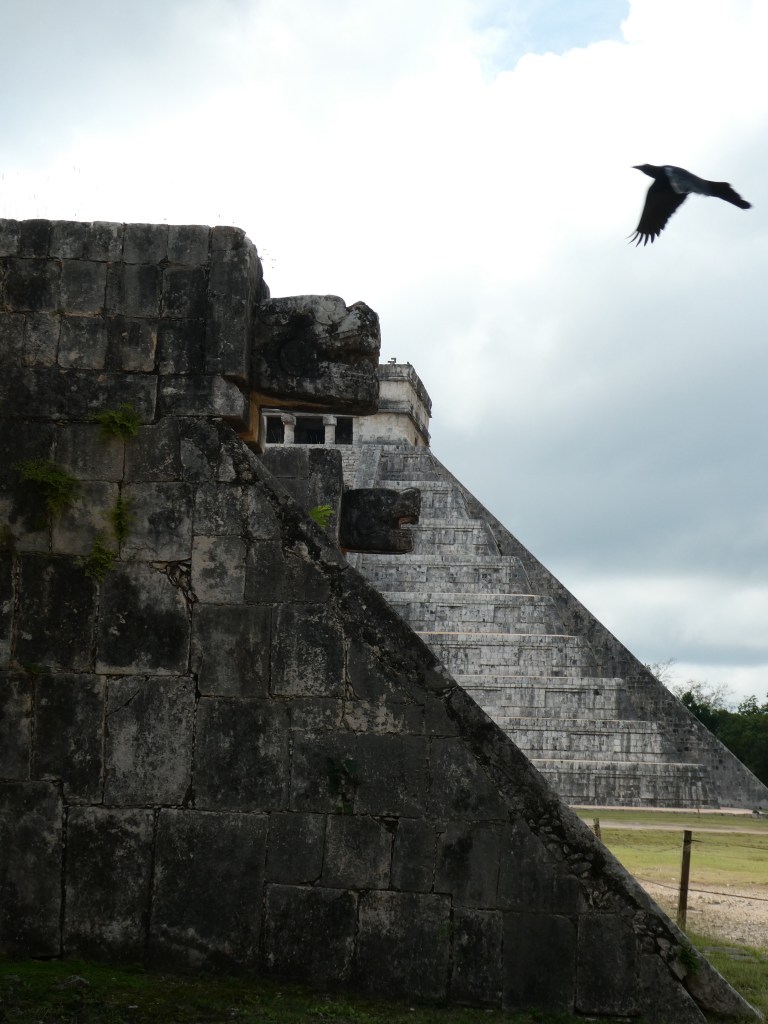
Guillermo took me to the Temple of Kukulkan which is massive and the most famous landmark of Chichen Itza. But there are bigger. Stephens and Catherwood could climb back in the day. This part of the site belongs to the Toltec influenced part of the site. The Toltec were more from Puebla way but further up – remember that giant statue from the anthropology museum. The Toltec came down here and merged with the Itza (that means people). They were a bit more intense – that’s why the ballcourt and this part of the site is a bit more violent and warlike. The pyramid of Kukulkan is beautiful though. Three sides nice – one side dilapidated. One side more awesome and famous with the feathered serpents on the bottom and a Chac face up the top. The temple is also called El Castillo (the castle) in Spanish. Kukulkan is heaps cooler. It means feathered serpent.

365 steps for the year. The serpent shadow snakes down them in March and September for the equinox, when the Maya would take this as a signal to plant or harvest their crops. People these days take it as a signal to form an enormous mosh pit around the pyramid.

Chichen Itza is pretty late in the Maya world, going up to 1200 AD in some bits. It would have been painted a brilliant white and red stucco like Palenque. White sacbes too. The sun would have bounced off it all with a brilliant glare. The past would have been so bright and nobody wore shades.

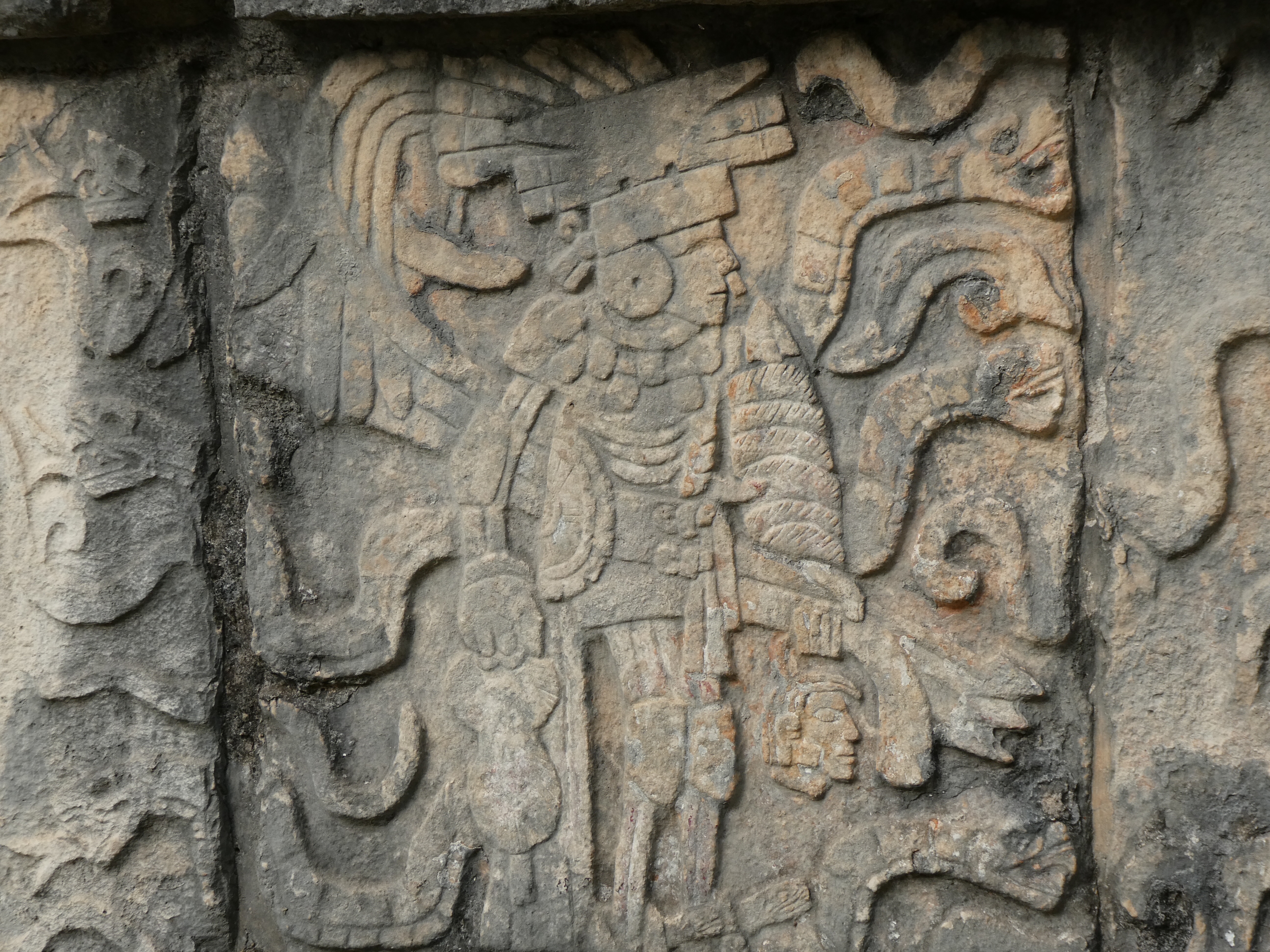
Guillermo led me to the enormous ball court – the biggest surviving one in MesoAmerica. The carvings here are extremely elaborate. Players spraying blood from their decapitated corpses and others engaged in the warlike ritual of the ballgame. I love it. Brutal beauty. I am fascinated as usual.

Say it, don’t spray it – decapitated warrior with blood spray

The acoustics are amazing. There’s more clapping going on than a Pentecostal church as the sound carries from one end to the other. Guillermo loved your pull out old photos of the site. On the left, you can see how the ballcourt used to look (e.g complete trash) while standing in the ballcourt. So cool!

As we head around the corner, Guillermo shows me the long row of skulls. Depictions of sacrifices or honouring the dead? Jury is out but he likes to think the latter. Skulls are cool.

And I was very partial to this panel depicting the ascent to heaven for this guy. He’s lost his body but he’s carrying his memories in his head like a Gucci handbag.

This bird flew right into my shot as Guillermo was telling me about the alignments of the Kulkulcan pyramid with this smaller structure depicting marine life including fish with feet.

Not a chicken but a bird at Chichen Itza. Magical!

The Toltec influence is strongest in the Temple of a Thousand Columns. It consists of a series of pillars with engravings of men and women. Back in the day, the pillars would have held up a roof to become a terrace. It was a public building for administration and hanging out. At least no Coke bottles and Bluetooth speakers.

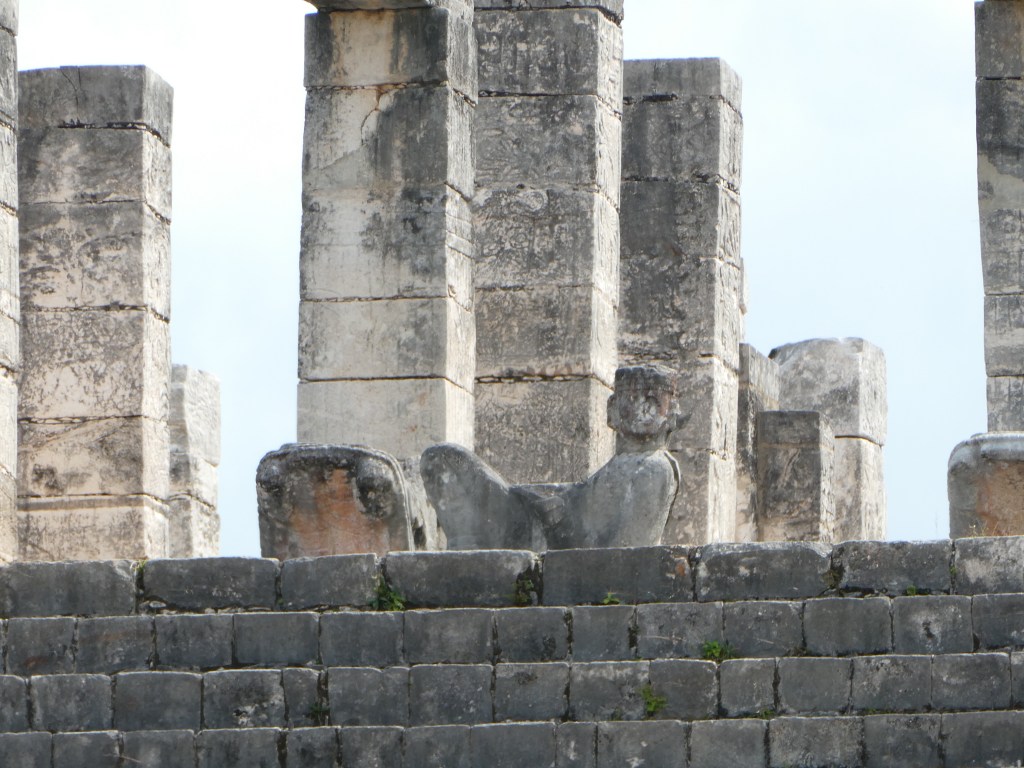
Right up the top of the stairs is a famous chacmool. This is a reclining statue of a guy on his back with a hole in his belly. Guillermo told me it caught the rays of the sun. I have also heard that it held human hearts. Chacmools are all over the place in Aztec culture too. I told him they should be sold as rain catchers domestically to make mucho dinero.

Baby got Chac(mool)

This area is also a primo photography angle for Kulkulkan.

Mexico is full of guns

We sauntered – Guillermo – and limped – me to the back half of the site. First, we sat and took in the replica Kukulkan that housed dead priests who worked in the big pyramid. Then the slow pace continued to the observatory, a building I never really dug. Looks a bit like something out of Cambridge or Oxford. We discussed the importance of never forgetting that sense of wonder, adventure, excitement and learning that you have when you discover things as a kid. I told him I would promise to try to get a Mayan Lego set made. Not sure how that will go down with the human sacrifice element but how awesome would it look?!?!

We hobbled over to the furthest part of the site – a part that was contemporary with Uxmal. Here, the distinct Puuc architectural style is clearly visible. Big nosed stacked chacs everywhere.

Uxmal esque school and nunnery area

Latticework too. Guillermo told me that the latticework was associated with snakeskin so was a very powerful symbol but also the basis of geometry and angles. Stephens and Catherwood wuz here too.

This one is called the nunnery. It’s another famous one because of the ornate carving over the door. Guillermo enjoyed taking photos of his only student. Teacher’s pet.

The nunnery – closest I got to Catholic school

As we hobbled back to the centre, I felt a looming sense of sadness at saying goodbye. He told me about his life in Merida, his wife and grandchildren. I promised to send him videos of the Bonampak murals before he snapped a selfie of us. What a lovely man!

Me and Guillermo!

I honestly couldn’t walk too far on my bad leg. I chose to spend my free time communing with the big three – Kukulkan, Thousand Columns and tried to head for the ball court but ran out of time. (Ok – I bought earrings. Guilty.) hobbled back to bass camp to pick up my glyphs which look awesome! (Naturally, I have since dinged them. Not too bad. Just not perfect anymore.) A printout explains what every symbol means. I can frame it when I get home.

Naturally, I was the last one back. So then back on the bus for a traditional lunch with a Yucateco family. What a feast!!! Cochinita pibil, pollo, other pork, tortillas!!! After the two tunas and a bag of nuts, I was starving.

Yucatec home ec

The drive to Playa del Carmen was as of little note as the actual city. Playa is like the Hold Coast of the Riviera Maya. It’s mini Cancun. I spent the free time hitting the main drag of high end shops looking for shampoo, memory cards for my camera (guess what – lost it already) and being disappointed by singlets that were too big for me. Was there time for a sneaky mezcal before dinner? Of course!

Before dinner, we watched a cultural performance by the fliers. Four guys climb up a giant WHS unsafe maypole in the middle of town, tie ropes to their ankles and descend headfirst by spinning around in a choreographed circle. No harnesses. I have a 12 minute video, most of which consists of them waiting up the top until the guy at the bottom had drained the crowd of sufficient tips!!! Editing required!!!

Dinner was at an Intrepid favourite restaurant – the Tropicana – which is famous for serving some meals in huge volcanic rock dishes shaped like pigs. I went for shrimp fajitas. Well, seafood it is when at the beach after all! Tonight was our last supper together. I was off to Cuba the next day to join a new group and leader, while a few others were off in other directions. I had already said goodbye to my mate Brin earlier that day. He had his own adventures planned.

After dinner, a few of the younger crew headed off for sheeshah. I knock Playa because it is so touristy with Starbucks and malls etc, but it is a huge centre of tourism and employment that keeps people off the breadline. It’s like Vegas. Bars, clubs, drinking and dancing on the street. Just not my scene. Sheeshah was new to me too. I am not entirely used to shoving a hose down my throat to suck on apple vapour but when in Playa …

Los siete amigos – I miss them

I enjoyed watching the large mamma types who I thought only existed in old Ricky Lake episodes busting a move or 20. They lost it when Missy Elliot came on. The sheeshah made me a bit headachey and soon I was painfully tired. Dave insisted on us seeing the beach in the dark. We trudged down there and promptly turned around when we saw two cops with semi-automatics there.

Time for bed!

Stand by for la Cubanita Hock in the next exciting instalment.

Day 15 – Magic Carpets and Magic Roundabouts in Merida

Dona Hock rides again

It was time to say hasta luego to my sidekick, my constant companion, my travel amigo, the precious – the Zapateco rug. Intrepid was responsible for organising my upcoming flight to Havana. Details from Tanya, my guide, were sketchy but I was fairly sure it didn’t include a business class seat for a 3kg woven rug. Perhaps I could go in the overhead compartment and the rug could have my seat? No – it was time for the rug to go.

The other members of the group mostly headed to a cenote tour which I was sad to miss, but my schnozz can sniff out a schmozzle a mile away and mailing a rug to Australia from Mexico had the strong, unmistakable scent of pending shitstorm. No way was I going to get this done quickly. I needed a free day, figuring mailing this beast was Priority Goal Achievement Numero Uno. I would hit the town for the rest of the day after this was done.

I enlisted Tanya’s services as translator in chief. Thank god, or I would have been stuffed. We had a lovely chat on the way to the main post office in Merida which is located in a pokey little building. After a lengthy conversation, it transpired that the main post office doesn’t send packages over 2kg in weight! WTF?!?! Not a lot of eBay selling going on in Merida then. New directions to a new postal outlet and we were off again.

After a bit of stuffing around to find the new outlet, the following happened – I paid $140 equivalent AUD to ship about 3.4kg home (I chucked a couple of other small things in the box), this maxed out my peso stash as they wanted it all in cash (that’s a shit ton of pesos – about half a week’s worth of living there – it was lucky I had just been to the ATM), I was given a receipt that I lost (and now found again!), a tracking number on the receipt (I photographed that) so I can track it once I am out of the black morass of no orweak Internet in Cuba, and told it would be 3 weeks to reach Australia. If it bounces back, the lovely staff at the María Jose hotel will have a new rug for the hallway because that was my return address on the box … And they don’t do insurance … Will it leave Mexico? Will it leave the post office??? A future HockTale will hopefully reveal good news from my Dad who I sent it to.

Fare thee well old mate

It seemed like we walked for ages. Turned out, the whole process took two hours! My schnozz for a schmozz had been right as usual. It was 11.30. As always, a conflict between hunger and a desire for adventures warred inside me. Adventures won. Merida has a world-class Maya museum and I do love a dead guy so I Ubered. FYI – Uber is the bomb overseas – at least in Mexico. No haggling over the price, comes out of the credit card, GPS means no language barrier trying to explain where you want to go. Just sit in the back and secretly eat your snacks. The drive took ages. The museum is about half an hour away from the historical centre of the city.

The driver dropped me opposite, conveniently next to La Economica Comida. No shit. Cheap eats. Two ladies with a fridge, a sandwich press, a stove and some buckets. I got the craves up for somebody else’s egg and bacon toastie and waited an interminably long time for mine. I was seriously on the verge of whacking the lot on the sandwich press myself at one point. Feed me, woman! Finally, sustenance … Rage subsiding …

Maya Museum

The Museo de Maya is pretty on the outside and entirely achievable on the inside. Only one floor – in and out in an hour and a half – not like the National Anthropology Museum. But it’s not just antiquities. It starts with the current culture of the Maya today. They didn’t disappear out of the jungle or get sucked up by aliens – the people left the cities circa 900AD for reasons people can’t agree on (lack of access to water or political unrest mostly) but the people and the cultures survive. The museum demonstrates the cultural traditions of the Maya in the Yucatan Peninsula – the states of Yucatan, Chiapas, Campeche, Quintana Roo and I think there’s another one – sorry. The traditional costumes (eg Yucateco = bright plant embroidery), the morphing of traditional beliefs with Catholicism, and other customs. It then goes through into the colonial period when the Spanish subjugated the Maya by force and disease, and had some cool dioramas of traditional life in towns in the 19th century after Mexican independence. I was delighted to discover the dioramas were based on Stephens’ accounts of village life and the people he met travelling. No dioramas of local Maya going at both ends from the salmonella which the Spanish also brought – fun fact!

Lots of cool artifacts, well lit, English captions. Excellent.

Then it was ancient Maya time. Engage Jo mode. The collection was strong on goodies from Chichen Itza and Ek Balam, the latter being a site I will be headed to after Cuba. It looks seriously awesome. This is a replica of the top of one of the pyramids. It’s a bloody great monster with teeth. How is this not the best thing in the world? This is what makes me feel like I am five years old. Wow! And it’s just a replica!!! I am likely to lose it when I see the real thing if it’s still this ornate and in good nick.

Replica of Ek Balam acropolis pyramid. I am totally going to lose it when I see it for real.

Other highlights included a full panel of the ball court carvings from Chichen Itza, a reconstruction of the tomb of the king of Ek Balam and the bano (toilet) at the end. The lowlight was a touchscreen to enter your birth date and email address to receive a free copy of your birthday in Mayan glyphs. The glyphs flashed up and they looked cool! A message said an email would be forthcoming with further instructions. Lies make baby Jesus cry, Mayan museum!!!! A week later, no email and I check my junk every day. I eagerly await the arrival of whatever newsletter or Mayan glyph porn ring I just unwittingly subscribed to.

Museum mode disengage. Time to head back to the city. Coffee needed first though. I prostituted my soul at a Starbucks 10 minutes away while following the WhatsApp exploits of Dave who had accidentally wandered into a brothel and was providing live updates. I called my Uber and chatted with the guy this time – he was from Chiapas so I apologised for drinking Starbucks. We had a long discussion about eating national animals – he couldn’t believe we ate kangaroo.

It doesn’t really fit in here but I will write this now while I think of it. In every place I have stayed in Mexico and maybe half in Cuba – even with their crap internet – somebody always asks me about the bushfires and how sad they are for Australia. Mostly it’s the guide for the day or it could be the desk clerk in the hotel etc.

After dropping me at the hotel, the driver recommended I visit the local markets while I still had time. Tanya had mentioned that too. Figured – why not? Google maps said 10 minutes away. Now, it was hot as hell on the street. Being from Adelaide, I adapt to hot weather like a Mc Duck to water. Our climate in summer is hot and dry. I am useless in the cold but, in the heat, just watch me go while others wither by a pool somewhere.

Merida has the colourful buildings and the old doorways of a colonial Spanish town. I charged past them confidently, headed in the right direction thanks to Google Maps and 3G Vodafone. (Five bucks extra a day on my plan in Mexico only which is why the blogging was prolific there.) Now I have the Maps.me App for offline maps which has been great for Cuba. Just need to download it for the other countries.

The market was a total fail. Closed. Nice old church next door. That was it. Nothing in the area even vaguely worth looking at. I backtracked, headed for the main square to check out some shops. Merida goes straight from tourist tat to high end jade in the space of about a metre. A shop guy went the hard sell on some exquisite Maya pieces but man, they were expensive. I resisted, walking out with my dignity and my wallet intact. Went for a cheapo magnet and a cap elsewhere.

The Merida zocalo is also a parking lot for the gee-gees. Well, it’s not like they race. I couldn’t resist taking a horse and cart ride around the cobbles of Merida. Perversely, it did make me feel as if I were a 19th century Spanish wealthy woman headed home to my house of mestizo domestic help. Dona Hock. I loved it! I am really bad at relaxing – this was probably as relaxed as I would ever get – and it still had the element of exploration as the horse clip-clopped past the big 19th century mansions along the Paseo Montejo. The driver tried to describe statues and houses but I could hardly hear him. Didn’t matter. I was just happy to see it all. The sun had set by now but the temperature was still quite warm.

The absolute highlight occurred when he dropped me off at the coolest, most elaborate traffic roundabout in the world. It’s a monument to the people and history of the Yucatan. I had seen it but didn’t realise you could explore it. The traffic is a bitch though. So, in order to get to the roundabout, the driver enlisted the services of a handy policeman. (I still can’t believe one was right there when needed!) With a whistle and the international symbol of ‘talk to the hand’, he stopped three lanes of traffic so the Aussie girl could appreciate the monument to his homeland. Moses had parted the Red Sea in the name of cultural heritage. I strutted across that road like Hollywood hot property.

The monument was fantastic. It was a circular monument depicting key events and people, with a massive Mayan figure on the front and plates commemorating every state of the Yucatan on the back.

Front of the magic roundabout. Epic!!!

I think it might also have been a fountain but that part wasn’t working. Plus it was all brilliantly illuminated! It was indeed a magic roundabout! I did spend ages on the roundabout – the driver looked pretty bored when I got back. I had been on the horse and cart ride before three years ago and we had gone around the monument, but the fact that this guy stopped to let me explore, made my day. He got a generous tip from me when he dropped me back at the square.

Back end of the magic roundabout

The rest of the evening consisted of a brief look in the Saint Alfonso Cathedral, the oldest cathedral in Latin America apparently. I think the driver told me it was built in stages over the 16th century. Old stone, a huuuuge Jesus on a cross, lots of other Jesuses. Then I bought the same pair of earrings I had originally bought in Merida three years ago and subsequently lost – winning! Then I found a relatively pricey but small and pretty pair of replica Maya plates of my old mate Pakal and the Red Queen! Well, that’s what they tell me. Sometimes you go on faith. They are aesthetically pleasing anyway. Straight into the Hock treasure trove depleting my McDuck money bin.

By this time, it was 9pm and I was starving. The most famous restaurant in Merida, Chaya Maya, was right there and no queue!!! Amazing!!! Don’t let anybody tell you that eating alone in a restaurant is sad. It’s the opposite. It’s awesome. You people with families are secretly jealous that I can order what I want, not have to make inane conversation, not have to wait for somebody’s missing meal before I have to eat, not divide the bill, not share any food and do it all on my own timeline. I ate a delicious meal of pipien – a pumpkin based sauce with a meat. So like a stew. I went for my ancient enemy, the turkey (more on that later). Women in the restaurant make tortillas right by your table. More chaya juice consumed. Complimentary chips and salsa consumed (RIP my abs). In and out in under half an hour and home to bed.

Turkey pipien with handmade tortilla, chaya and huevos! No sharing! All mine!!!

A magical day in Merida!

Tune in for next next exciting instalment of HockTales featuring dodgy service station coffee, the UNESCO listed Chichen Itza ruins and the final night with the group in Playa del Carmen.

Day 14 – The Quest for the Lost Temples at Uxmal

Does this photo look familiar? Yes – it’s the 2020 version of the main blog photo that WordPress won’t let me change on the app!
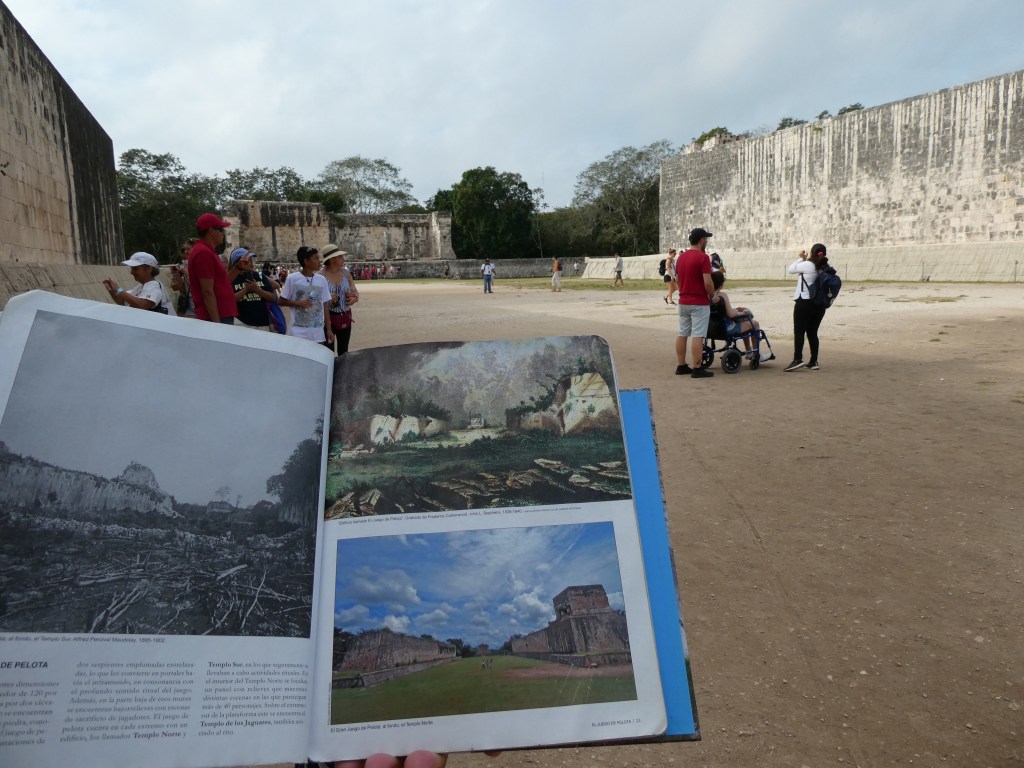
The hotel at Mérida – the María Jose – was great except for my swipe card that refused to work every single time. Naturally, I was located at the very back of the rabbit’s warren of the hotel, necessitating a labyrinthine walk back to the front desk a couple of times a day until I got sick of it and demanded they reactivate my card just automatically. Room card 47 was clearly stuffed, and no I was not putting it anywhere near credit cards.

But nothing could dampen my mood. I was off to Uxmal (pronounced Oosh-mahl) with the gang of Boomers in my group. Uxmal is a special place. Another one on the Stephens and Catherwood trail of ruins surfing, the ruins are very ornately carved in the Puuc (pronounced Pook) style. They are Mayan – everything in the Yucatan is Mayan – but it’s a different style of Mayan. No carvings of people like Palenque – more of animals, birds and the rain god, Chac. Soooo many Chacs.

Why go back to back Chacs? Why go back to see it again? I could be with the other members of the group on some muddy swimming thing or hanging around town. A few reasons – I had learnt that I missed out on seeing a few buildings last time, a possible different perspective with a different guide, and really I just love the feeling of being there. The thrill of history, exploration, culture and beauty when you are standing in the middle of an ancient Mayan plaza just can’t be beat. This is an Uncle Scrooge adventure – not a sitting on my arse Juicy Couture mall excursion. I am here to climb temples, marvel at ancient construction, explore temples and take lots of pictures of iguanas.  Swimming! Pah! I have a bath at home.

I also consider myself so privileged to see some of these places twice in my life when so many people in Mexico won’t even get to see them once. It is truly a great honour to experience them. And they are all unique. It’s not a case of seen one ruin, seen them all. The people who built them were all diverse. All Maya but different Maya. Different times, different people, different architecture.

But first, laundry! It was a crisis of no sock proportions. Could my friends tell I was wearing the same singlet I was sleeping in? The previous laundry refused to do my socks and undies!!! (As I write this in Santa Clara, Cuba, I just learnt that Che Guevara boasted of wearing the same rugby jersey 25 days in a row when he was at uni. #laundrygoals) Laundry in Merida is pretty cheap – couple of bucks – same day service next to the hotel – perfecto.

Then breakfast! I headed for the zocalo. Jo time does not always coincide with Mexican time. I tend to get up earlier and he hungry before shops open. I realised that the only place open was a restaurant I had been in before but mucho decoration had occurred. I showed the waiter an old photo I took three years ago, as I knocked off my last huevos motulenos (cry). He loved it! He poured mas café for me before I dashed back to the hotel.

Our guide for the day, Jose-sway, not Jose, Jose-sway, was earnest and meant well but I don’t think ruins were his passion in life. He knew what he was talking about for sure but crucial details were left out. For example, the first pyramid is known as the Temple or Pyramid of the Magician or Sorcerer.

The steps and door are smaller than usual. Jose-sway neglected to mention that the king was a dwarf – the little people were considered to possess magic powers. I passed on this knowledge nugget to the tour crew.

Sorcerer’s Pyramid at Uxmal, it’s the first thing you see

The pyramid is also unusual because it’s round. Check it out.

Was it hand sanded by the ancients?

But this is the arse end of the pyramid. The main facade is my favourite. Up top, it’s a giant monster head with a face and the steps are like a huge rolling tongue. Chac rain gods adorn the side like tongue piercings. No, they are not elephants. No elephants in the Americas. That’s Chac’s nose. It takes my breath away. Just magnificent. I could stand there forever gawping at it.

Primary facade – e.g. other end of Sorcerers’ Pyramid. Terrifying and yet beautiful.

This beautiful monstrosity is in a courtyard. New discovery – bats in a doorway! Cool! Naturally a group of school kids shot blocked me, spoiling the vista and the silence. Stone macaws, quetzals and hummingbirds adorn the roof of a building in a shady corner. Like at Palenque, it was a hot, clear day.

Next was the Quadrangle of the Nuns. Not named for Nuns on the Run or any other Robbie Coltrane movies, but the Spanish thought it reminded them of a convent when they found it. Four buildings – I happen to know one was for nobles, one for workers, one for religious types and I think one for royals – but don’t recall hearing that pointed out. One side is truly breathtaking. Right up there in terms of intricate carvings.

The awesome side of the Quadrangle of the Nuns

Two serpents slide their way down the entire panel on the top of the building which features carvings of faces and more snakes – one with a man’s face protruding from the mouth.

Man’s head in snake
Fond of this too

The site is also home to a roving pack of iguanas. Jose-sway is on a first name basis with them. One was called Panchita. Another was so fat that I was startled to see his stubby little legs moving him along with such speed. The iguanas poke out of rocks, lie about on steps, laze on the grass, dash into holes. Cute!

Gordo! That’s fat in Spanish!

Then it was off to the Governor’s Palace via the ball court. The ballcourt is quite small at Uxmal – the Chichen Itza one is epic. But it does have a nice ring to it! Boom! Dad joke for Mayan enthusiasts. Let’s go on …

The Governor’s Palace was the administration centre. It’s very ornate. Stephens and Catherwood holed up at the GP for a bit during their travels across Mexico. Some of Catherwood’s most famous drawings are of the GP including a magnificent headdress and a Mayan arch, highly romanticised with locals lolling about out the front like there’s nothing better to do. I think there’s a snake too.

Famous arch and carvings on the palace

Really, poor old Stephens and Catherwood were probably shivering and sweating at death’s door the whole time, but Stephens’ account still retains this sense of wonder despite his delirium. They also found a cool double headed stone jaguar on display.

Jose-sway left us here to our own devices for half an hour but I needed some special assistance. Like a half-murmured legend lost to the ages, I had heard rumours of an Uxmal temple of .. well .. er … the male appendage. Yes – it was now Indiana Jo and the Quest for the Lost Temple of the Penis. (This is now the bit where my Mum will have to do some creative reading aloud to my grandparents.) I only had a few minutes. I couldn’t beat around the bush. I shamelessly asked Jose-sway if it existed and where it was. He laughed and seemed only too eager to show me! I suspected white chicks from Australia didn’t often ask for the penis temple which was not on the standard Uxmal tourist route of buildings. In fact, it’s not on the map at all. I only knew about it through my personal readings.

Jose-sway – estimated age in his mid 30s – and I broke away from the rest of the group who had no idea what was afoot. I giggled like a schoolgirl.

First though, I did want to see two other buildings I missed last time so I commandeered Jose-sway as my personal guide. (He knew a chunky tip was coming his way by indulging me, I am sure.) First, the House of the Pigeons, named for the building’s resemblance to a pigeon run. Or whatever you call them on top of a roof. No intricate carvings here but the square design of the top of the building was pretty. Jose-sway was like Princess Margaret’s husband, snapping photos of cute birds in trees for me. I also got wonky shots of me out the front too.

Pigeon toed out at the House of the Pigeon

Next was Casa de Tortuga – the House of the Turtles. Somehow in my mind this was bigger. It was really the size of a bike shed with some cool turtle decorations on the top. I had probably walked right past it last time. But thanks for another nice photo, Jose-sway.

View of Uxmal site from the Governor’s Palace

Ok. After dragging Jose-sway around (I don’t think he minded too much), it was finally time to discover the Lost Temple of the Penis. He warned me that it was set a bit away and we would have to walk fast to get back to meet the others. Well, of course, any self-respecting penis temple would have a modicum of modesty. Couldn’t set it up in the Quadrangle of the Nuns for example. De nada (no worries).

Devastation! The path was roped off! Jose-sway was sad in his heart that I had come so far to fall at this final hempen hurdle. He apologised as if he had underperformed somehow. He showed me pictures in a folder as a conciliatory gesture. Four foot phalluses coming out of the ground!

He asked if I had seen the boneyard. (No pun intended.) What boneyard??? Turns out there’s something like an ossuary at Uxmal too. It’s truly the gift that keeps giving. Next time …

Now it was a supermarket sweep of the five or so shops. I hastily bought skinny guidebooks of Uxmal and Palenque, a necklace with a Mayan glyph on it and a fridge magnet. We wolfed a delicious lunch. Nobody had told my crew that Yucateco pork was the schizzle so nobody had ordered it but me when I came screaming into the restaurant late for lunch after all that conspicuous consumption.

While the others hung around the small museum – I had already breezed in and out – I picked up a cup of chaya. This is a green juice made from a leaf a bit like spinach but it is more refreshing and sweet. It’s a very Yucateco thing to drink. FYI – we crossed from Chiapas to Yucatan state on the bus the previous day. Chiapas is all about the coffee. Yucatan is all about the cochinita pibil or orange flavoured shredded pork. And the chaya.

Uxmal was the main event but we headed to the small after party, Kabah, 20 minutes up the road. This is a much smaller site. On my previous trip, I was told it was a wealthy guy’s place. Jose-sway told me it was an actual city, but a bit smaller. I like that better. It’s so ornate – far too much detail has gone into it. Seems more likely to have been public buildings. The main building is called the Codz Poop. It has the most Chacs on it of any Mayan ruin. Fully packed Chacs. Side by side. Stacked Chacs.

Me at the Codz Poop at Kabah. Chac attack!!!

Stones with glyphs are littered around. Some bastard took them from the top of the building at some point. There is an altar out the front that was trashed before Stephens and Catherwood got there in the 1840s. Some of the glyphs are amazingly well preserved. Others are harder to read.

Out the back, is another terrace where two statues of warriors are clearly visible. One has undergone ye old fashioned iconoclasm with his hands and head chopped off. Only pedestals remain where at least five or six others should have stood. A lintel in a doorway depicts a warrior about the decapitate an opponent. An unexpected iguana ran a mile when I nearly stepped on it.

Bits radiating off him are not rainbows of love, but his headdress.

Nobody clearly gives a stuff about the back of Kabah. No cool carvings or Chacs means it’s less sexy to maintain. It’s looking a bit run down with weeds and undergrowth poking through. Not in a cool jungle way either. More in a Jim’s mowing needed way. A bitter orange tree adds a pleasant contrast.

Everybody seemed to have enjoyed themselves, although general consensus was that Jose-sway was no Francisco. The transport took us back to town.

It was time to hit Mérida. First, I hit the bookstore where I found a small photographic book on Yucateco ruins. No Espanol needed for photos of old guys in pith helmets! Then a cheap dinner of conchita pibil and conchita pollo gorditas – tacos but more floury like hot pockets – seriously, that was like three bucks AUD.

I may also have popped in for a quick mezcal on the way home …

Mezcal can go down the hatch straight or with lime like tequila. Note the presence of bikini top knot because of laundry day smalls washing emergency crisis point

Dear friends, return for the next HockTale where I bid adios to my amigo . ..

Day 13 – Indiana Jo and the Tomb of King Pakal

Temple of the Cross at Palenque

The Intrepid hotel was unexpectedly swish. Toiletries worth stealing and a coffee maker! Whoa! I cranked that baby to full black as I performed my usual prepack and repack to check out of the hotel and head down for the in house breakfast. (Turned out I left my shampoo behind. Crap.) I know I could have eaten another cheap tuna can but if there are huevos, I am generally in. I suspect my high energy levels are brought to you by the letters E and C – eggs and coffee. If I don’t set myself up with those things at the start of the day, I will pay for it later with headaches and feeling terrible. Sadly, I just can’t get away with living on cheap snacks.

Speed was the order of the day – as was my omelette and coffee – as we needed to depart for the Palenque ruins at 7.30. I met Laurie, Sylvia and Sara – three others from the tour group to regale them with stories and movies of my jungle exploits. I also ate Sara’s plantains. (God, they are like crack to me. I forgot to mention the massive bag of plantain chips I scoffed like a dog on the 13 hour Oaxaca bus trip. Woke up feeling like I had licked the Sahara desert and I had no water.) All aboard our personal mini bus and we were on our way. Palenque ruins are not far from town. 20 mins max.

Francisco was waiting for us with his trusty Honda hat, iPad and folder. I met Francisco last time I was on the Palenque tour in 2017. I stuck out like a sore thumb. Not a lot of Australian girls can talk about Mayan ruins and fangirl over the 19th century explorers Stephens and Catherwood who slept at Palenque, basically high on a cocktail of malaria, crazed itching from insect bites and recurring fevers. (I am seriously thinking of writing a kids book based on their adventures. Stephens’ accounts are gripping reading but also really funny!!)

I digress …

Palenque is one of the classics for Mayan ruins on all the top ten lists for people in the know, but I don’t think most people know about it.  Everybody goes to Chichen Itza and they should because it’s awesome, but Palenque has a special Chiapateco vibe. I put it down to a combination of the jungle setting, the huge temples, and the intricate carvings of people – not all sites have all three – but these things are more the unique filling of the cake. The icing is King Pakal. Palenque is all about Pakal. This is very much still his place.

Pakal was the king of Palenque for a whopping 68 years. He lived to a ripe old age of 80 during a time when 45 was considered to be knocking on death’s door. Granted, he was the king – he could eat the best of everything and was not lugging huge stones up hills – but by the end of it, he would have been a bit Weekend at Bernies at appearances surely? Pakal was crowned by his mother at the age of 12. Note  how precise these numbers are. It’s not me mucking around in the iPhone calculator. That’s because it’s all inscribed in glyphs, the Mayan writing system carved in stone.

Pakal was a very powerful, successful king. He was basically a god during his lifetime, probably due to his longevity. Perhaps he popped to the Chedraui for some probiotics and some Metamucil? After his death, he continued to be deified by his descendants and the people of Palenque. His son took over and very cleverly kept power by continuing to honour the cult of his father, rather than stamping his own authority. This kept the loyalty of the people. Unfortunately nobody knows where he’s buried – he’s still out there waiting to be found. I guess he must have felt a bit like Prince Charles, wondering if his parent will ever die so he can take up the role he was meant to play.

Palenque was a massive Mayan city so spanning maybe 200-800AD. Archaeologists have excavated only about 10% of it, which happens to coincide with the most important buildings in the ceremonial centre. Lidar technology has shown there’s HEAPS MORE! In the jungle, there are a lot of mounds. Except they are not mounds. They are pyramids hijacked by the undergrowth. We are talking maybe another 20 square kilometres of potentially valuable archaeological discovery stopped in its tracks by money and politics. Heritage is not always a priority for governments …

Francisco delivered the briefing on the site in a small shed outside the gate. (I think I remember a tent from last time, so an upgrade.) Not everybody in the group wanted a guided tour – some chose to save money and walk around on their own. Despite my thrilling off-road exploration of Yaxchilan, I always choose the guided tour option (when it’s in English!)  because the guides know what they are talking about and I want to learn. I am such a nerd!!!! Plus Francisco has such a passion for the topic  that shines through. The others in my group could see it and later told me they gave him a really good tip because of how good he was.

As we entered the turnstile, the ground shaking Jurassic Park roar reverberated across the site. Howler monkeys! Everybody was captivated, thrusting their iPhones aloft. As if their paltry zoom would catch anything! Let me tell you – I have wasted so much time trying to take pictures of howler monkeys. All I have ever got is blurry backs fit only for deletion. This time, one of them gripped a branch with its prehensile tale and I snapped this corker.

Howler monkeys also love to poo on tourists

Then the Temple of the Skull loomed into view. Everybody gets excited about it because it’s the first one you see and it looks cool because all Mayan ruins look cool, and for gods sake it’s called the TEMPLE of the SKULL! Truth is – it’s the least interesting building there. Francisco skipped over it and went straight to the next two – the Temple of the Inscriptions and the Temple of the Red Queen.

The Temple of the Inscriptions is like the Mayan equivalent of the tomb of Tutankhamen. It’s right up there, maybe  with the Bonampak murals, as one of (and perhaps even the most important) discoveries in the Mayan world. The temple contains the tomb of King Pakal and it’s still there in its original condition. Pakal rests in a giant sarcophagus which is a massive stone box – not like an Egyptian sarcophagus that looks like a person with a creepy face. I can’t remember exactly how much it weighs but it’s tonnes. The lid is carved with an image of Pakal in the tree of life, but if you look at it horizontally, he looks like he’s flying a spaceship. The sarcophagus is still there because it’s at the bottom of the pyramid down a twisty turny dark Indiana Jones pathway and not even Allied Pickford Movers can get it out. (That’s a joke.) It’s too big and heavy to ever take out. It was only found by accident. I can’t remember when but quite literally somebody found a step, then dig, then found another and kept going until they hit paydirt.

As for Pakal himself, he was sprinkled with cinnabar. That is not a delightful sweet scroll from the bakery; it’s mercury. The Mayans routinely did that with their dead. (Perhaps cinnamon might have been a nicer smell. Again, Chedraui?) So Pakal dissolved but his jade adornments remained including the famous mask of Pakal. These goodies were taken from the temple and kept on site in the little Palenque museum until recently when they were transferred to my beloved National Anthropology Museum. Remember that spaceman photo of Pakal? That was from Palenque and sent up to Mexico City. Palenque also had a fantastic reconstruction of the tomb in the museum – gone. The anthropology museum had a smaller one that I kind of breezed past because I had seen a better one. It made me sad to learn of the transfer. I think Pakal should be with his people who think he is a god king – in Mexico City, he’s one of many competing for attention.

The Temple of the Inscriptions has been closed to the public for nearly 20 years. So no poking around Pakal. You can’t even go near the building. It’s roped off. This is the closest photo you can get with the king.

I pose with Pakal and the Temple of the Inscriptions

Did I mention I bought a necklace with the image of Pakal on it? It was at Yaxchilan so not Pakal’s crib but they would have heard of him out there back in the day. It’s a cheap river stone but I wear it all the time.

The Temple of the Red Queen is right next door. Another sarcophagus containing the red cinnabar ashes of a woman was found inside. Archaeologists believe she was either Pakal’s wife or mother. You can go inside to the room where she was found through a fence. There are no cool glyphs or engravings but you get to go inside the cramped little passageways so there’s a bit of a sense of what Pakal’s pyramid might be like on the way to his tomb.

The next building is the palace where Pakal hung out. Remember the temple is just where he was buried. The palace was a place with rooms for the nobles, tiny toilet holes, saunas, and a massive quadrangle for councils on important matters.

Inside the palace

Huge slabs of engravings depict images of conquered warriors killed by Palenque’s finest. You can tell they’re dead because dead Mayans all have this huge fat lip. These slabs would have intimidated visitors.

Scary dead guys

Pakal would have sat on a huge throne, surveying it all. And it would have all been painted a bright white and red stucco, not the lifeless stone it is today. It would have been magnificent.

Pakal’s hot seat in the middle

Last time I was here, it rained. Sure, the pictures are all moody and kinda cool. But it sucked having to constantly shove my camera under my jacket like a shoplifter. I was so glad my Palenque day this time was sunny and perfect. Such a contrast.

I could tell that my tour mates were enthralled too which was great. The only downer was not enough time as always. I always lag behind taking so many pictures, then just soaking in the atmosphere that I miss the information and the group was far ahead. Then I stopped to sneak in a couple of leather carvings. I already have two at home that are my prize possessions. I bought two more – one was of Pakal’s mother crowning him which was depicted on a carving I had seen just minutes ago.

I bolted to catch up with the group, my backpack jingling with its full contents of snacks, water, chargers and hats I never got around to wearing. Francisco had led them around to the final group of buildings from the time of Pakal’s son, whose name I can’t quite remember. Something Balam? He launched into one of his pet topics – Mayan numbers. It’s maths. I am a writer. It’s basically lost on me. It works on a times by 20 system with bars. Generally, I find bars don’t tend to help my maths skills in any way, shape or form. So I just quietly admired the three buildings.

The cluster of three temples constructed on top on top of three hills were built in the time of Pakal junior – the Temple of the Cross, the Temple of the Foliated Cross and the Temple of the Sun. They are named for the engravings inside – not for any Jesus activities. The cross was an ancient Maya symbol long before Columbus, Cortez or any of those conquistadors got their grubby gauntlets on the land. You can climb up the steps to gawp in at the engravings that consist of two panels on either side of a central panel. A bit like a fireplace. A couple are a bit hard to see. A particularly famous one is an old crone who is a healer. I bought a dodgy magnet of her.

Old crone in Temple of the Cross

The view from the Temple of the Cross is spectacular, extending over all Pakal’s buildings and the lush jungle. There are some winning photographic spots.

It’s hard to take a crap picture here

I insisted on a few photos with Francisco before I ran around the three temples like a loon shooting my usual mix of iPhone movies and Panasonic camera shots. As usual, I was last. I was determined to soak in every last morsel of history and drag the chain. There was nothing to rush back to anyway – an hour for lunch in Palenque town and then a long 9 hour bus ride to Mérida.

Francisco and I by the Temple of the Foliated Cross

Francisco and I bid farewell. Next time, I will be confident enough to come without a tour group. It’s pretty easy with the buses. Francisco will take me around for a few days with no rush.  So back to town it was for now.

Let me explain a bit about Palenque town. Unlike the colonial cobbles of San Cristobal or the cool street art of Oaxaca, Palenque is more what I like to call a modern frontier town. Nothing is on point here as the hipsters would say. Palenque has a leafy side of town called the Canada area where I overnighted in the Hotel Chablis. It also has a couple of bars, restaurants and cafes. Not exactly much browsing fodder though. Although it was early for lunch at 11am, I thought I would head to Café Jade, a really nice café that cooks the best eggs in town. I was hoping the breakfast menu was still going and it was. Huevos motulenos. Two fried eggs on tortillas, peas, ham, tomato sauce, plantains – I know it sounds disgusting and it doesn’t look much better but my god, it’s delicious. I have been dreaming about it for three years and it didn’t let me down.

Huevos motulenos!!!!

So I crossed the bridge to the mean streets of downtown Palenque where toilet based desperation forced me into a Burger King. I bought a water – the check out chick knew it was all a front – it was all a shameless façade. If it were a Maccas, using the facilities in such a way would be called a McShit with Lies.

Palenque town is big on shoe shops for some reason. My rucksack is already at a chiropractic crisis – shoes would be a no no. With a quick stop for an icy cold beer for the trip to Mérida, I just made it back in time.

The 9 hour bus trip was memorable because of the onset of food poisoning for one of the girls who chucked three times. Poor thing. Chunks all over the seat in front of her. Thankfully, nobody in the splash zone. Bus karaoke also fun. 90’s classics before the onset of Queen and Beatles. Dave in his element. At a truck stop, I think we were meant to stop ten minutes but Btin and I crossed the road for a restaurant and had the best truck stop meal ever!!!! We made the bus wait a bonus fifteen minutes. I think they thought we were getting smashed at the bar. No. I squeezed in a whole fried seafood ball called a marisco with salad and free entrees of some sort of mystery roll up and bonus Jatz with a tuna dip. My god, it was delicious.

Amaze-balls!!!!

Pina colada average but experience of watching sunset with classy meal knowing the rest of the group was in the bus snacking on junk food from the service station while we ate like kings = priceless. Definite highlight! Good thing too because we didn’t pull into Merida until about 9 and eating that late would have killed me.

The next post sees Indiana Jo return to her all time favourite ruins at Uxmal, hunting for previously unseen temples (unseen by me that is) and run amok in Merida, the Yucatan’s cultural capital.